
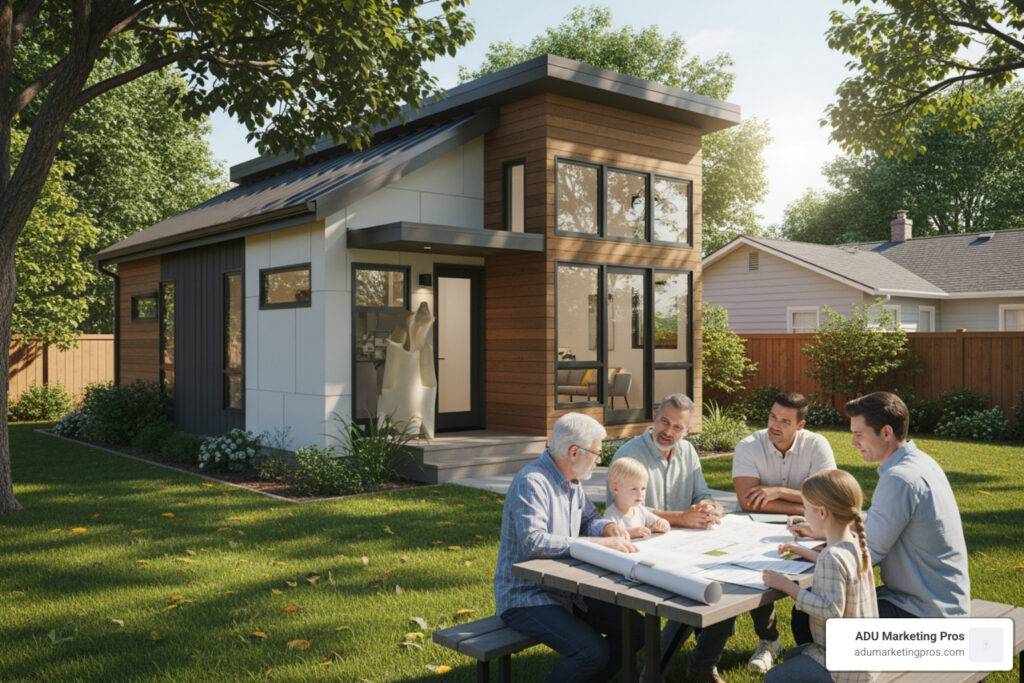
Why Granny Flat Financing Is the Key to Unlocking Your ADU Project
Granny flat financing is the process of securing funding to build a secondary dwelling unit — also called an ADU (Accessory Dwelling Unit) — on your existing property. In the current economic climate, where housing inventory is at historic lows and interest rates remain a primary concern for homeowners, understanding the nuances of these financial products is the difference between a successful build and a project that never leaves the drawing board.
Your main financing options at a glance:
| Financing Option | Best For | Key Feature |
|---|---|---|
| HELOC | Homeowners with equity | Revolving credit, low fees |
| Home Equity Loan | Lump-sum needs | Fixed rate, predictable payments |
| Cash-Out Refinance | Low current mortgage balance | Replace existing mortgage |
| Construction Loan | New builds, limited equity | Based on post-build value |
| Fannie Mae HomeStyle / Freddie Mac ChoiceRenovation | Purchase + renovation | As-completed appraisal |
| Government Programs (CalHome, CalHFA) | Lower-income households | Low interest, deferred payments |
The Shift in the Housing Landscape
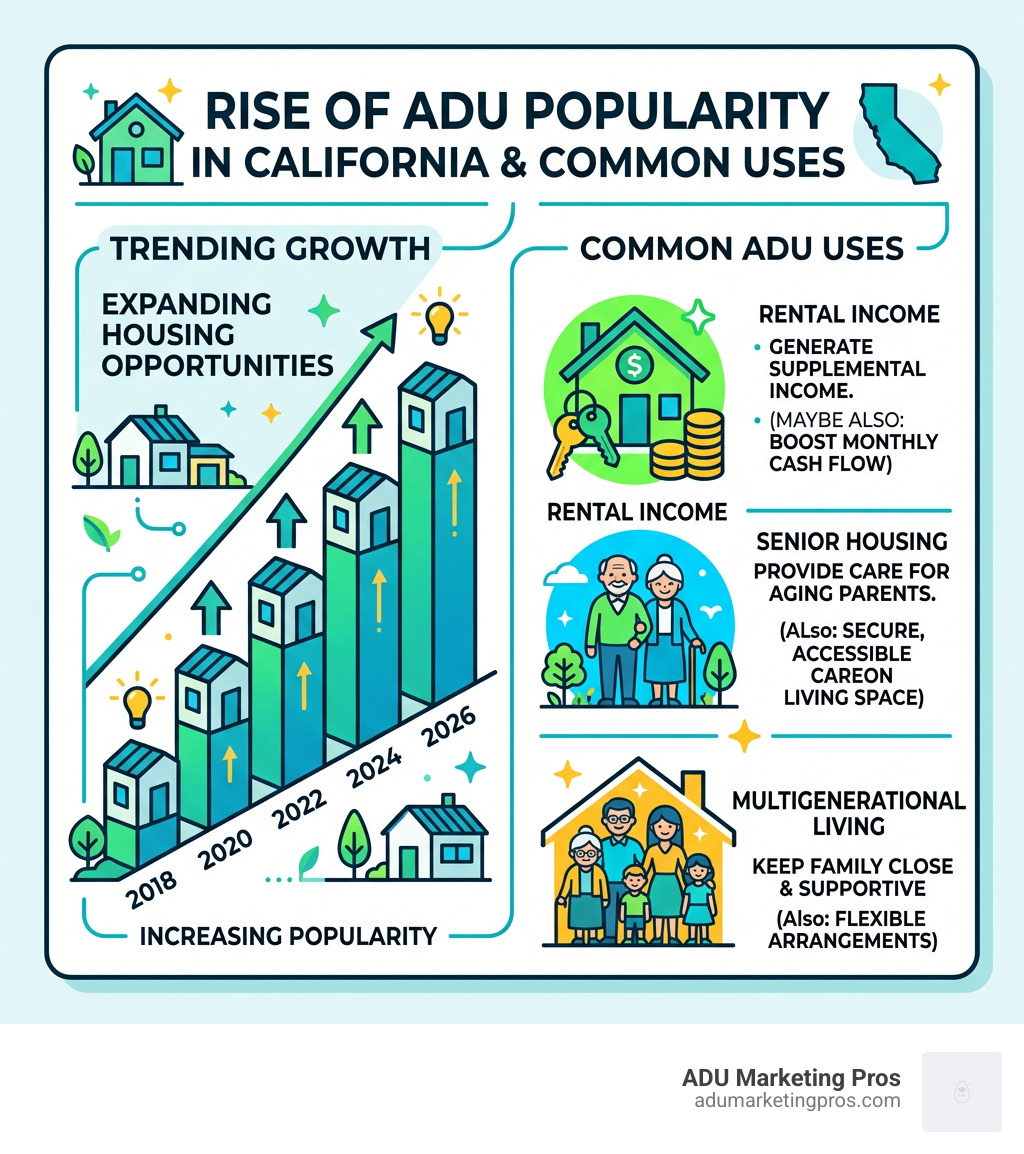
ADUs are going mainstream — and fast. Across California, homeowners are building granny flats to house aging parents, generate rental income, or give adult children an affordable place to land while saving for their own home. This shift is driven by legislative changes like SB 1069 and AB 2299, which have stripped away many of the bureaucratic hurdles that once made these projects nearly impossible. However, while the legal path is clearer, the financial path remains complex.
But here’s what most people don’t realize: building a granny flat is a six-figure investment. The idea that you can convert a garage for $20,000 is one of the most common — and costly — misconceptions in the ADU space. In reality, once you factor in architectural fees, structural engineering, utility hookups, and modern building codes, even a modest unit can quickly exceed $150,000.
Why Strategy Matters
That gap between expectation and reality is exactly why choosing the right financing strategy matters so much. The good news? There are more funding paths available today than ever before, from tapping your home’s equity to specialized renovation loans that lend against your property’s future value after the ADU is built. This guide is designed to help you navigate these waters, ensuring you don’t over-leverage your primary residence while still achieving your construction goals.
Whether you’re a homeowner exploring your options or an ADU firm helping clients navigate the funding maze, this guide breaks down every major financing route — clearly, with no fluff.
Simple guide to Granny flat financing terms:
Understanding ADUs and the Need for Granny Flat Financing
Before we dive into the checkbook, we need to define what exactly we are building. An Accessory Dwelling Unit (ADU), affectionately known as a granny flat, is a self-contained living space located on the same lot as a primary residence. To legally qualify, these units must have their own entrance, a kitchen (including a sink and stove), a sleeping area, and a full bathroom.
The Three Main Types of ADUs
- Detached ADUs: These are standalone structures, often built in the backyard. They offer the most privacy but are typically the most expensive due to the need for new foundations and utility lines.
- Attached ADUs: These share at least one wall with the primary residence. They can be more cost-effective for heating and cooling but require careful architectural integration.
- Junior ADUs (JADUs): These are smaller units (max 500 sq. ft.) created within the existing walls of a primary residence, such as a converted bedroom. They have more relaxed requirements for bathrooms and kitchens but must be owner-occupied.
In high-cost areas like San Jose, Sunnyvale, and the San Francisco Bay Area, these units have become a lifeline. We see families using them for “in-home” senior care, providing a compassionate alternative to expensive nursing homes that can cost tens of thousands of dollars a month. Others look toward granny flat designs to create rental income that helps offset rising California mortgages. In many cases, the monthly rent from an ADU can completely cover the mortgage of the primary home, leading to a state of “house hacking” that provides long-term financial security.
The Cost Reality Check
Whether you are looking at modular-granny-flats-california or a prefab-granny-flat-california, the construction costs are real. Because a granny flat requires all the same expensive infrastructure as a standard home—plumbing, electrical, roofing, and foundations—without the “cheap” square footage of extra hallways or large bedrooms to balance the cost, the price per square foot often surprises homeowners. In fact, the price per square foot for an ADU is often 20-30% higher than a standard home. This is why securing professional granny flat financing is rarely an “extra” step; it is the foundation of the entire project. Without a clear funding roadmap, projects often stall during the permitting phase, leading to wasted architectural fees and lost time.
Leveraging Home Equity: HELOCs and Cash-Out Refinancing
If you have lived in your home for several years, especially in appreciating markets like Palo Alto or Mountain View, you likely have a “hidden” bank account: your home equity. Tapping into this is often the most straightforward path to funding because you are borrowing against an asset you already control.
Home Equity Lines of Credit (HELOC)
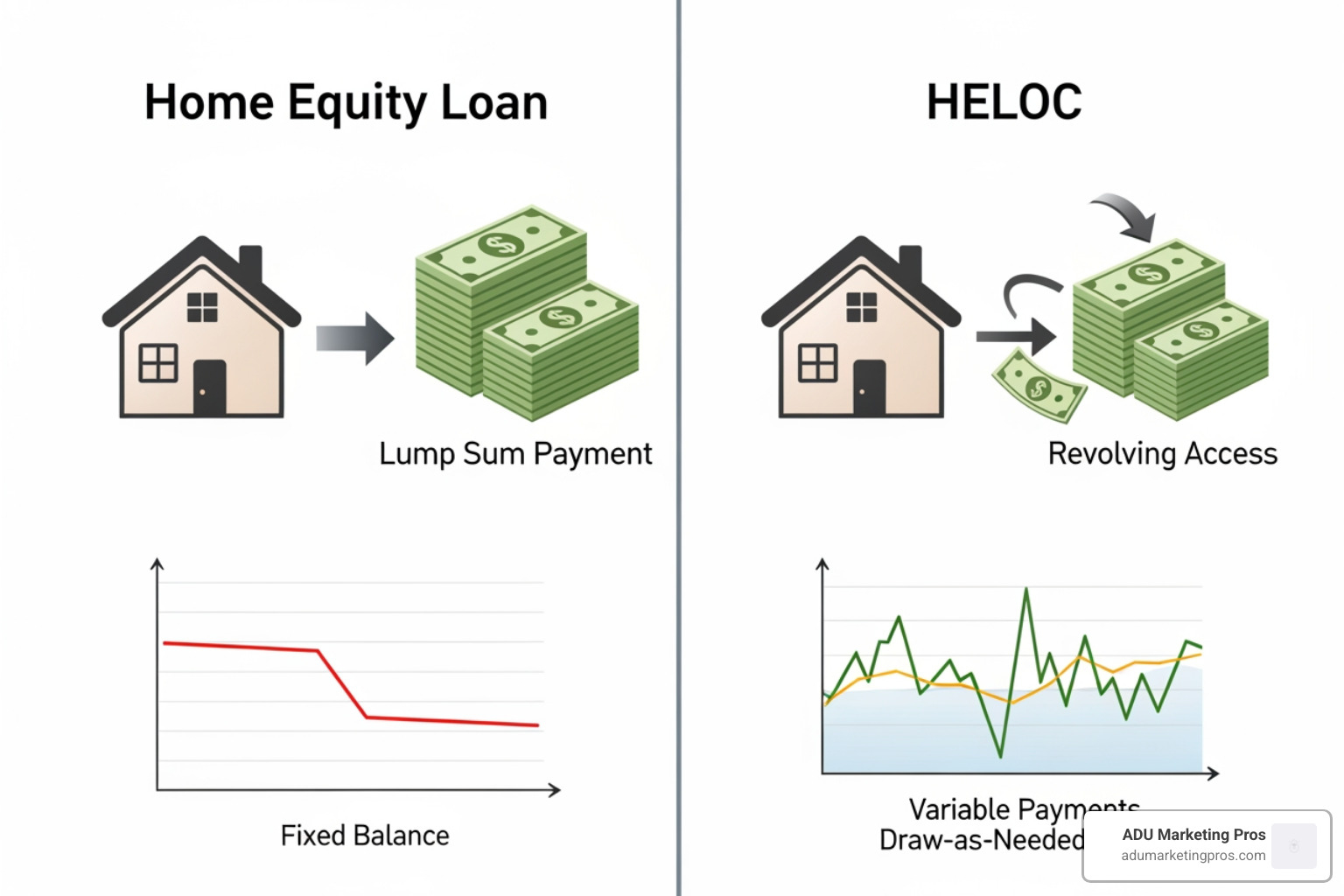
A HELOC works much like a credit card secured by your home. You are granted a credit limit based on your equity—typically requiring you to keep at least 10% to 20% equity in the primary residence.
- Pros: You only pay interest on what you actually draw. If your ADU project hits a delay, you aren’t paying for money sitting in a bank account. Lender fees are often low (frequently $500 or less). This flexibility is vital for ADU projects where contractor payments are made in stages (draws).
- Cons: Rates are usually variable, meaning they can rise over time. In a rising interest rate environment, a HELOC can become significantly more expensive than originally planned.
Cash-Out Refinance
This involves replacing your current mortgage with a new, larger loan and taking the difference in cash.
- When to use it: This is an excellent option if current adu-loan-rates are lower than your original mortgage rate. It allows you to lock in a fixed rate for the entire amount, providing long-term predictability.
- The Trade-off: If you currently have a “unicorn” interest rate from a few years ago (e.g., 3%), you might be better off leaving that mortgage untouched and using a HELOC or a second mortgage for the ADU instead. Refinancing a 3% loan into a 7% loan just to access $200,000 is often a poor financial move.
Home Equity Loans (Second Mortgages)
Unlike a HELOC, a Home Equity Loan provides a lump sum at a fixed interest rate. This is ideal for homeowners who have a fixed-price contract with a builder and want to know exactly what their monthly payment will be from day one. It sits “behind” your first mortgage, meaning you don’t have to touch your primary low-interest rate.
For a deeper dive into these specifics, check out our guide on adu-financing-options.
Future-Value Funding: Construction and Renovation Loans
What if you don’t have $200,000 in equity yet? This is a common hurdle for newer homeowners or those in areas where property values haven’t skyrocketed. This is where many homeowners get stuck, but there is a clever solution: lending against the future value of your home.
Specialized lenders, such as the Umpqua construction loan department, offer loans based on the “As-Completed Value” (ACV). An appraiser looks at your current home plus your ADU blueprints and estimates what the whole package will be worth once finished. This allows you to borrow against the value you are creating, rather than just the value you currently have.
Fannie Mae HomeStyle and Freddie Mac ChoiceRenovation
These are “renovation mortgages” that allow you to bundle the purchase (or refinance) of a home with the costs of building an ADU. They are government-backed, which often means lower interest rates and more flexible credit requirements.
| Feature | Fannie Mae HomeStyle | Freddie Mac ChoiceRenovation |
|---|---|---|
| Max Renovation Cost | Up to 75% of “As-Completed” value | Up to 75% of “As-Completed” value |
| Down Payment | As low as 5% (Owner-Occupied) | Competitive conventional rates |
| Property Types | 1-4 unit properties | 1-4 unit properties |
| Lending Basis | Lesser of ACV or purchase + costs | Based on appraised ACV |
The Mechanics of Construction Loans
Construction loans are unique because the money isn’t handed to you in a lump sum. Instead, the lender manages a “draw schedule.” As your builder completes specific milestones (e.g., foundation poured, framing finished, roof installed), the lender sends an inspector to verify the work and then releases the next chunk of funds. This protects both you and the lender from contractor abandonment or mismanagement.
These programs are particularly useful for prefab-granny-flats-in-california-grannys-got-a-brand-new-pad because they provide “one-time close” financing. This means you don’t have to apply for two separate loans (one for construction and one for the permanent mortgage), which saves significantly on closing costs. You can read more about the mechanics of these in our article on construction-loans-for-adu.
Government Grants and State-Specific Incentive Programs
California is currently one of the most ADU-friendly states in the country, and several programs exist to help residents bridge the funding gap. These programs are designed to increase housing density without the need for massive high-rise developments.
The CalHFA ADU Grant
The California Housing Finance Agency (CalHFA) has historically offered grants (up to $40,000 in previous iterations) to help low-to-moderate-income homeowners with “pre-development” costs. These are the “soft costs” that often kill a project before it starts, including:
- Architectural drawings and renderings
- Soil reports and land surveys
- City permit fees and impact fees
- Environmental assessments
While funding cycles vary and the grant program often runs out of money quickly due to high demand, you can check current availability at the ADU Grant – California Housing Finance Agency | CalHFA website. Even if the grant is currently closed, it is worth preparing your paperwork for the next round of funding.
CalHome and Disaster Assistance
For those in Los Angeles or wildfire-affected areas, programs like CalHome provide deferred-payment loans. These are often targeted at households earning below 120% of the Area Median Income (AMI). For example, in Los Angeles County, the 2020 limit for a 4-person household was $92,750. These loans can reach up to $150,000 with incredibly favorable terms, sometimes including interest forgiveness after a set period if the unit is rented to low-income tenants.
Local Municipal Incentives
Many cities are now offering their own incentives. For instance, the City of San Jose has a “Pre-Approved ADU Program” where homeowners can choose from a library of pre-vetted designs. While this isn’t direct cash, it can save you $10,000 to $15,000 in architectural and plan-check fees, effectively acting as a form of financing. Similarly, some jurisdictions waive “impact fees” for ADUs under 750 square feet, which can save upwards of $20,000 in certain Bay Area zip codes.
Explore more about these incentives in our resources on adu-funding-grants and the accessory-dwelling-unit-grant-program.
Navigating Costs, Eligibility, and Tax Implications for Granny Flat Financing
Let’s talk numbers. In California markets like San Francisco or San Jose, a high-quality ADU typically costs between $150,000 and $300,000. This range depends heavily on whether you are doing a garage conversion (cheaper) or a ground-up detached build (more expensive).
Eligibility and Credit
To qualify for most granny flat financing, you’ll generally need:
- Credit Score: A minimum of 620 for FHA-backed loans, though 680-720+ will secure the best rates. Construction lenders are often stricter than standard mortgage lenders because the collateral ( the ADU) doesn’t exist yet.
- Debt-to-Income (DTI): Lenders want to see that your total monthly debt payments (including the new ADU loan) don’t exceed 43-45% of your gross income. Some portfolio lenders may allow up to 50% if you have significant cash reserves.
- Equity: For equity-based loans, you usually need to leave 10-20% “skin in the game.” This means your total loan-to-value (LTV) ratio cannot exceed 80-90%.
The Tax Man Cometh
Building an ADU is a major value-add, but it does have tax implications that you must discuss with a professional:
- Property Taxes: Your primary home won’t be reassessed in its entirety (thanks to Proposition 13 in California), but the new ADU will be. Typically, the tax increase is based on the construction cost of the unit. If you spend $200,000, expect your property tax bill to increase by roughly 1% of that value ($2,000/year).
- Depreciation: If you rent the unit, you can often depreciate the cost of the structure over 27.5 years. This is a non-cash expense that can provide a significant tax shield for your rental income, often resulting in tax-free cash flow for the first decade.
- Interest Deductions: Interest on loans used to “substantially improve” your home is often tax-deductible, but the rules changed with the 2017 Tax Cuts and Jobs Act. Always consult a CPA to see how this applies to your specific loan type.
- Capital Gains: Adding an ADU can complicate the $250,000/$500,000 capital gains exclusion when you sell your home, especially if a portion of the property was used for business (rental).
For a full breakdown of the financial journey, see from-loans-to-investments-navigating-adu-financing.
Frequently Asked Questions about Granny Flat Financing
Can I use rental income to qualify for granny flat financing?
This is a “maybe” that depends on the lender. Traditional Fannie Mae and Freddie Mac rules generally do not allow you to use projected rent from a yet-to-be-built ADU to qualify for the loan. However, some specialized portfolio lenders and credit unions may consider 75% of the projected market rent to help you meet DTI requirements. If you are buying a property that already has a permitted ADU, you can almost always use that existing rental income to help qualify for the mortgage.
What are the credit requirements for granny flat financing?
While you can find FHA options with scores as low as 620, most construction and renovation lenders prefer to see a score of 680 or higher. Lenders will also require a “construction-certified” appraisal and a detailed contract from a licensed builder. Working with an Umpqua construction-certified loan officer can help ensure your documentation meets these strict standards. They will look for a “fixed-price” contract to ensure the project won’t run out of money halfway through.
How does “as-completed” value affect my loan amount?
This is the “secret sauce” of ADU building. Instead of looking at what your house is worth today, the lender looks at what it will be worth tomorrow. If your home is worth $800,000 today and the appraiser determines the ADU adds $200,000 in value, your loan is based on a $1,000,000 valuation. This allows you to borrow much more than a standard home equity loan would permit, often covering 100% of the construction costs.
Are there specific loans for prefab or modular ADUs?
Yes, but they can be trickier. Some lenders are hesitant to fund prefab projects because they require large upfront payments to the factory before anything is built on-site. However, many modern prefab companies have partnered with lenders to create “milestone-based” financing that fits the factory production schedule. Always ask your prefab provider if they have a preferred lender list.
Can I finance an ADU on an investment property?
Yes, but expect higher interest rates and lower LTV limits. Lenders view investment properties as higher risk. You will typically need at least 25-30% equity in the investment property to qualify for an ADU construction loan.
What happens if construction costs exceed the loan amount?
This is why a “contingency fund” is vital. Most lenders require a 10-20% contingency built into the loan. If you hit a rock during excavation or lumber prices spike, this fund covers the difference. If you don’t use it, the money simply stays with the lender and isn’t added to your final mortgage balance.
Conclusion
Navigating granny flat financing can feel like a full-time job, but it is the most critical hurdle to clear. By matching your current equity, credit profile, and long-term goals (whether that’s housing family or retiring on rental income) to the right loan product, you can turn a backyard dream into a concrete reality. The financial landscape for ADUs is evolving rapidly, with new products entering the market every quarter as banks realize the stability and value these units provide.
Before you apply, we always recommend three steps:
- Check Zoning and Feasibility: Ensure your city (like Sunnyvale or Menlo Park) allows the size and type of ADU you want. Check for easement issues or utility capacity that could add unexpected costs.
- Get a Real, Detailed Quote: Skip the “online estimators” and get a detailed bid from a contractor that includes site prep, utility trenching, and finishes. A “ballpark” figure is the enemy of a good loan application.
- Talk to an ADU Specialist: Traditional banks often don’t “get” ADUs and may try to shoehorn you into a product that doesn’t fit. Look for lenders who specialize in secondary dwellings and understand the “as-completed” appraisal process.
At ADU Marketing Pros, we are dedicated to helping the firms that build these homes reach the right clients and helping homeowners understand the true potential of their property. If you’re ready to learn more about the units themselves, check out more info about modern prefab granny flats to see how the latest technology is making these builds faster and more affordable than ever. Your backyard is more than just a lawn—it’s a financial asset waiting to be unlocked.