
Most Affordable Tiny Home Builders: A Quick 2026 Cost Guide
The most affordable tiny home builders in North America can provide functional entry-level housing from approximately $24,900 to $29,900 for basic panelized units, cabin shells, or flat-pack DIY kits. For homebuyers seeking fully finished living spaces complete with a dedicated bathroom, functional kitchenette, sleeping loft, and turn-key mechanical systems, budget-friendly manufactured models typically fall between $45,000 and $85,000.
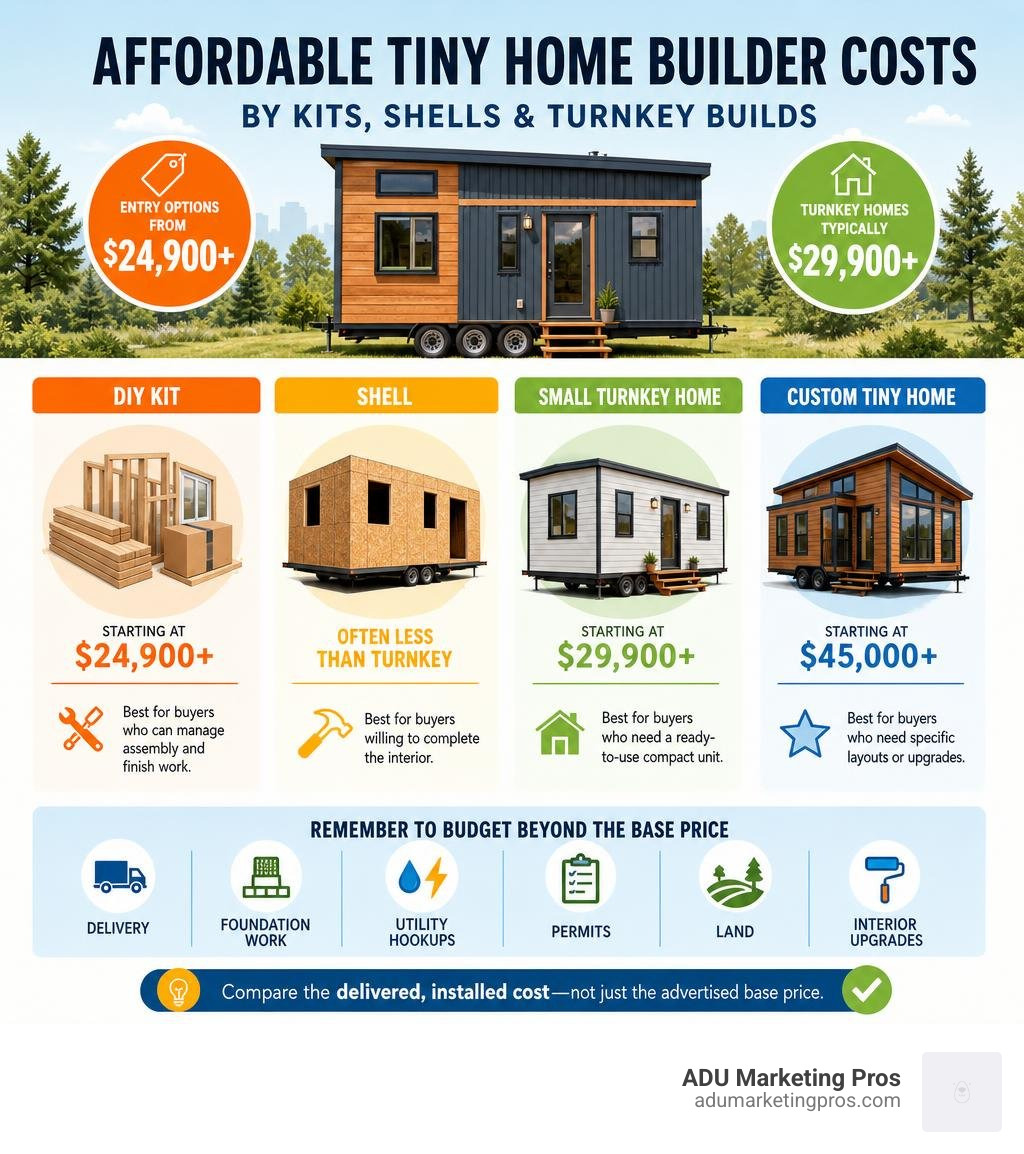
Navigating the micro-housing market requires balancing low upfront sticker prices with long-term structural durability. Before selecting floor plans or aesthetic trims, smart buyers compare fundamental construction pathways to match their personal skills, site constraints, and total budget:
| Build type | Typical starting cost | Best for |
|---|---|---|
| DIY kit | About $24,900+ | Buyers who can manage assembly and finish work |
| Shell | Often less than turnkey | Buyers willing to complete the interior |
| Small turnkey home | About $29,900+ | Buyers who need a ready-to-use compact unit |
| Custom tiny home | About $45,000+ | Buyers who need specific layouts or upgrades |
A rock-bottom factory price represents only one component of your overall capital outlay. Transportation logistics, foundation excavation, local building permits, municipal utility connections, and interior furniture quickly influence your real expenditure. The strongest value comes from selecting standardized production layouts, confirming detailed inclusions in written contracts, and comparing the total installed expense rather than promotional factory baseline prices.
I’m Jock Breitwieser, and in this comprehensive guide, I will walk you through the top budget-conscious manufacturers, compare structural formats, break down hidden installation fees, and highlight the certifications required to protect your investment.
Explore related resources and directories across our network:
- Review verified craftsmanship across best tiny home builders.
- Examine verified ratings in our roundup of top rated tiny home builders.
- Discover modular self-assembly options through our guide to tiny home kits.
Top 8 Most Affordable Tiny Home Builders in North America
Finding reputable manufacturers capable of delivering structural integrity, thermal efficiency, and transparent pricing demands rigorous vetting. We assessed builders across the United States and Canada based on baseline costs, engineering standards, material sourcing, warranty protections, and delivery logistics.
The comparison table below outlines baseline costs, typical interior dimensions, primary construction methodologies, and shipping regions for leading value-focused manufacturers:
| Builder | Starting Price | Size Range (sq. ft.) | Primary Build Type | Shipping Reach |
|---|---|---|---|---|
| Incredible Tiny Homes | $29,900 | 128 – 400 | Turnkey Panelized & Wood | Nationwide US |
| Wolf Valley Tiny Homes | Custom Quote | 160 – 960 | Turnkey & Cabin Shells | Free within 150 miles (TX) |
| Amish Built Cabins | $24,900 | 200 – 1,200+ | DIY Kits & Barndominiums | Nationwide US |
| Compact Homes | $25,900 | 160 – 320 | Steel Container Conversions | US & Canada |
| Cocoon Homes | $55,000 | 170 | Turnkey Studio Cabins | Select US Regions |
| XtremeADU | Custom Quote | 200 – 800+ | Flat-Packed Net-Zero Kits | Nationwide US |
| Liberation Tiny Homes | $45,000 | 150 – 400 | Shells & Turnkey Custom | Continental US |
| Rocky Mountain Tiny Houses | $30,000 | 120 – 350 | Handcrafted Custom & Shells | Continental US & Canada |
Incredible Tiny Homes: Industry Benchmark for Sub-$30,000 Dwellings
Operating out of Morristown, Tennessee, Incredible Tiny Homes has established itself as an industry benchmark for ultra-low-cost micro-housing. Their standout entry-level product, the Incred-I-Box, begins at $29,900 for an 8×16-foot footprint (128 square feet). Built using prefabricated steel panels with integrated closed-cell spray foam insulation, these models bypass conventional lumber framing labor to deliver substantial savings directly to budget-conscious homeowners.
For buyers requiring additional living space, their expanded 224-square-foot units start around $44,900, while fully finished traditional wooden models such as the Charleston (300 sq. ft.) and the Amanda (400 sq. ft.) range from $84,900 to $164,900. Incredible Tiny Homes equips their units with standard standard electrical service panels, metal standing-seam roofing, residential vinyl windows, and customizable off-grid solar and composting add-ons, making them a practical path to mortgage-free living.
Wolf Valley Tiny Homes: Texas Turnkey Cabins with Regional Delivery Perks
Based in Texas, Wolf Valley Tiny Homes specializes in functional, rustic cabins, modular layouts, and weather-sealed structural shells. Their catalog spans from compact 10×20-foot guest suites to expansive 20×48-foot multi-bedroom modular dwellings. Every structure utilizes heavy-duty custom steel chassis, engineered framing lumber, fiber-cement exterior siding, and dual-pane low-E windows for dependable thermal control.
A standout cost advantage of Wolf Valley is their regional logistics model: they offer free delivery within a 150-mile radius of their manufacturing center. By providing both bare-bones dried-in shells and fully finished turn-key homes, Wolf Valley enables buyers to manage their interior finishing budgets independently while ensuring the structural core meets strict residential standards.
Amish Built Cabins: Heavy-Timber DIY Packages and Barndominiums
For hands-on builders aiming to cut contractor labor expenses, Amish Built Cabins supplies precision-notched timber frames, modular cabin shells, and rugged steel barndominiums. Entry-level packages like their Lakeside Haven Tiny Home Kit start at $24,900, whereas expansive structural kits such as the Prairie Rose Barndominium begin at $54,900.
These kits incorporate traditional mortise-and-tenon Amish woodworking paired with contemporary insulation channels, pre-cut roof trusses, and heavy-duty structural posts. Designed for straightforward on-site assembly, a small crew can erect the primary structural shell in under two weeks, creating a durable foundation for a rural retreat, primary residence, or detached accessory unit.
Compact Homes: Rugged Steel Shipping Container Dwellings
Shipping Container Homes | Tiny Homes on Wheels | Compact Living specializes in modular conversions built from Corten steel intermodal shipping containers. Standard 20-foot turn-key container conversions begin at $25,900, providing an exceptionally rigid, fire-resistant, and storm-proof footprint. Larger 40-foot configurations, offering up to 320 square feet of conditioned living space, start at $42,900.
Each build incorporates code-compliant closed-cell spray foam insulation, mini-split heat pump climate controls, modular kitchenettes, and pre-plumbed wet baths. Compact Homes provides turn-key delivery across the United States and Canada, with units arriving ready for crane placement onto concrete piers or gravel foundations.
Cocoon Homes: Turnkey Permitted Studio Units
Cocoon Tiny Home Studio | 100 Series Floor Plans crafts precision-engineered micro-studios tailored for seamless zoning integration and accessory dwelling use. Their flagship 100 Series studio measures 20 feet long by 8.5 feet wide (170 square feet), with prices starting at $55,000 for single-occupancy layouts and $62,000 for expanded dual-bed configurations.
Cocoon studios are engineered to travel on standard roadways without requiring oversize transport permits. Despite their compact footprint, they optimize daily usability through integrated storage millwork, elevated sleeping lofts, residential-grade induction appliances, quartz countertops, and dedicated heating and cooling systems.
XtremeADU: Fast-Assembly Net-Zero Modular Systems
Headquartered in Lake Benton, Minnesota, Tiny Homes | Lake Benton, MN | XtremeADU, LLC designs panelized modular tiny home kits engineered for extreme four-season weather. Utilizing advanced structural insulated panels (SIPs), these flat-packed building kits assemble on-site in 3 to 4 weeks following foundation prep, significantly reducing on-site construction schedules.
XtremeADU emphasizes net-zero energy design, incorporating zero-formaldehyde interior materials, continuous thermal envelopes without thermal bridging, and integrated conduits for seamless solar panel connection. Their precision kits allow owner-builders and general contractors to achieve superior air tightness and drastically lower utility bills in cold-climate regions.
Liberation Tiny Homes: Modern Architectural Detailing
Operating out of Lancaster County, Pennsylvania, Liberation Tiny Homes combines architectural styling with accessible pricing tiers. Standard finished builds typically range from $45,000 to $85,000, with large 40-foot gooseneck models reaching $100,000 or more for comprehensive luxury layouts.
Liberation also provides partially completed structural shells for buyers seeking to tackle their own electrical wiring, plumbing, and interior cabinetry. Exploring our curated directory of best tiny house builders illustrates how Liberation’s balance of clear wood sidings, modern farmhouse aesthetics, and solid structural craftsmanship delivers lasting property value.
Rocky Mountain Tiny Houses: Alpine Custom Craftsmanship
Located in Durango, Colorado, Rocky Mountain Tiny Houses builds custom tiny homes engineered specifically for alpine environments and severe sub-zero winters. With baseline pricing spanning $30,000 to $85,000, founder Greg Parham emphasizes functional, hand-crafted design incorporating reclaimed barn timber, thick SIP insulation, and robust standing-seam metal exteriors.
Their team provides multiple build tiers, from certified towable chassis and dry-in weather-tight shells to turn-key, off-grid cabins equipped with secondary wood stoves and greywater filtration systems. Their cold-climate building science ensures reliable year-round performance on mountain properties.
Cost Factors: Kits vs. Shells vs. Turnkey Tiny Homes
Understanding the manufacturing tiers of tiny homes clarifies why initial purchase prices vary drastically between builders. Choosing the right stage of completion determines whether your overall investment remains budget-friendly or exceeds your initial estimates due to unplanned contracting costs.
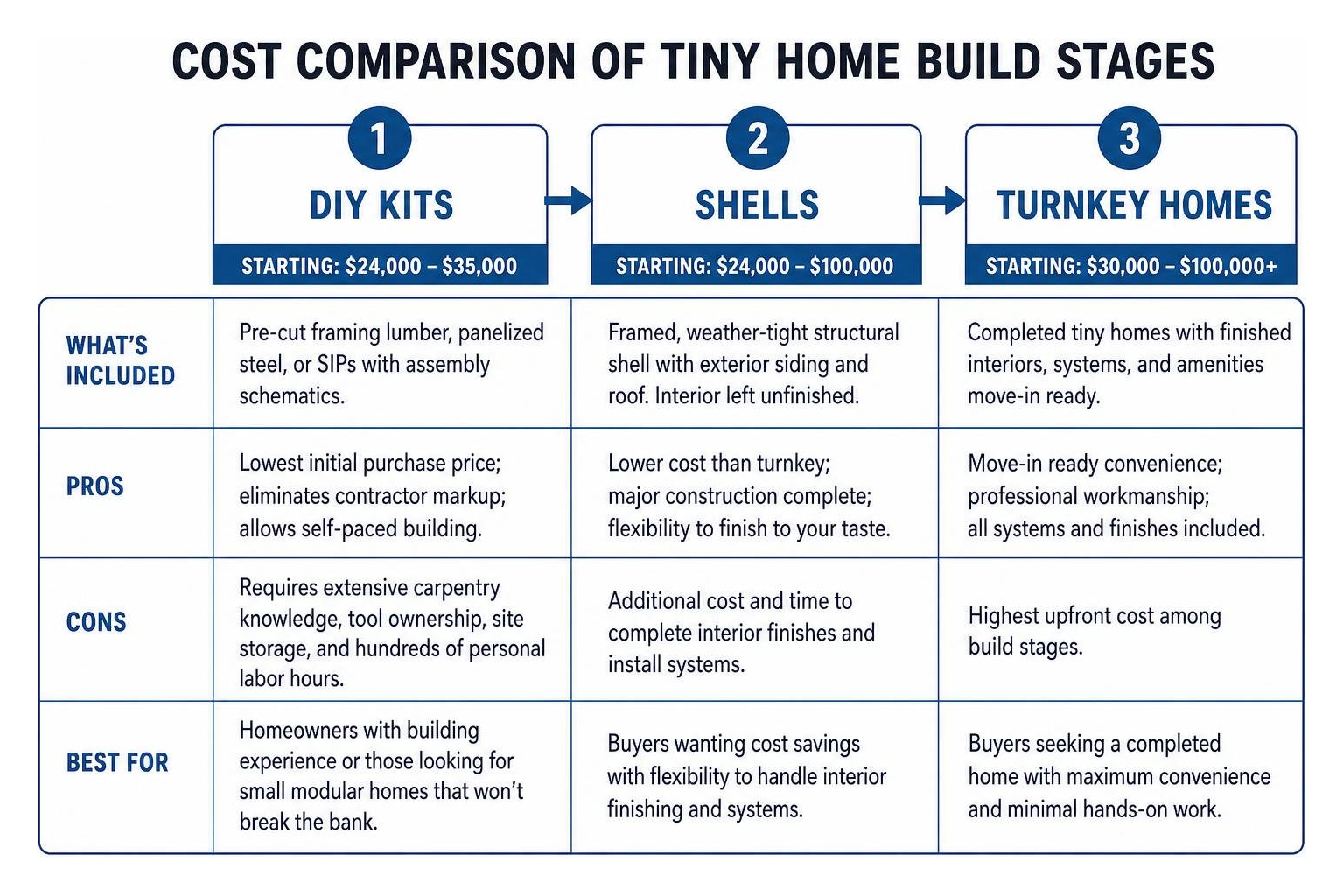
DIY Kits (Starting: $24,000 – $35,000)
Tiny home kits provide pre-cut structural lumber, SIPs, or pre-engineered steel framing packages accompanied by assembly hardware and structural blueprints.
- Advantages: Delivers the lowest initial capital purchase price, avoids builder labor markups, and allows homeowners to construct on their own schedule.
- Drawbacks: Requires substantial carpentry skills, extensive tool sets, safe on-site weather-protected storage, and between 400 to 800 hours of physical labor.
- Ideal Use Case: Experienced DIY builders and property owners seeking small modular homes that won’t break the bank through sweat equity.
Structural Shells (Starting: $30,000 – $50,000)
A structural shell consists of a certified trailer chassis or subfloor, full exterior framing, exterior sheathing, moisture barriers, roofing, windows, and entry doors. The interior space remains open studs ready for mechanical rough-ins.
- Advantages: The exterior envelope is completely dried-in and warrantied against water penetration, eliminating the weather risks of DIY framing.
- Drawbacks: Buyers must fund and complete rough-in electrical, plumbing lines, insulation, drywall or paneling, fixtures, appliances, and cabinetry, which typically adds $15,000 to $35,000 in materials and specialized labor.
- Ideal Use Case: Semi-handy buyers seeking cheap little homes who want a professionally engineered building envelope but can manage finishing trades independently.
Turnkey Builds (Starting: $45,000 – $95,000+)
Turnkey tiny homes arrive completely finished from the production facility, including fully operational bathrooms, functional kitchen cabinetry, lighting fixtures, heating and cooling equipment, and interior trim.
- Advantages: Fully move-in ready immediately following utility hookups; eligible for standardized RV or personal lending; backed by full manufacturer warranties.
- Drawbacks: Higher upfront purchase price and less flexibility to alter plumbing routes or interior layouts after delivery.
- Ideal Use Case: Homeowners who need an immediate backyard guest dwelling, rental ADU, or permanent downsized residence without construction delays.
Hidden Costs and Financing Options for Budget Tiny Living
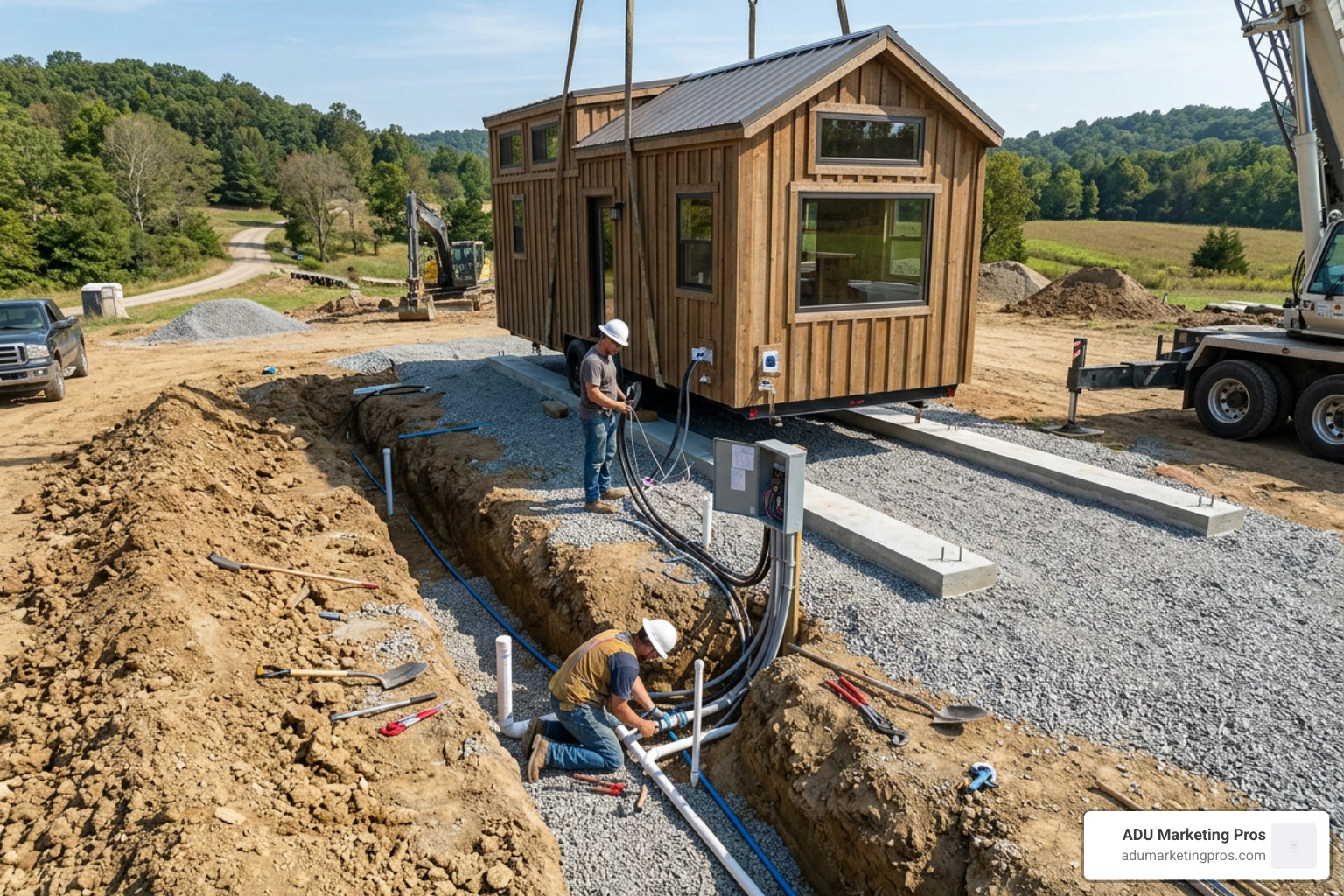
A critical mistake when planning a micro-housing project is budgeting solely for the unit’s factory purchase price while neglecting on-site development expenses. Depending on local municipal zoning mandates, utility access, and soil topography, auxiliary site work frequently adds 25% to 50% to your total project cost.
Evaluating realistic tiny home prices requires factoring in these core site-development line items:
- Permits and Municipal Plan Review ($1,000 – $7,000): Municipal application fees vary based on whether your structure is permitted as a permanent Accessory Dwelling Unit (ADU), a Park Model RV (PMRV), or a modular residential dwelling.
- Site Grading and Foundation Construction ($3,000 – $10,000): Proper ground leveling, compacted gravel pads, reinforced concrete footings, or engineered continuous foundation slabs must be completed prior to delivery.
- Utility Trenching and Connections ($2,500 – $8,500): Trenching and connecting municipal sewer or private septic systems, running water lines below the local frost line, and establishing 50-amp to 100-amp electrical service requires licensed trade labor.
- Delivery Freight and Pilot Escorts ($1,500 – $5,000): Heavy hauling rates average $3.00 to $5.50 per highway mile, with additional charges for units exceeding standard 8.5-foot travel widths that require oversize transit permits and pilot escort vehicles.
Financing Options for Affordable Tiny Homes
Because traditional 30-year residential mortgages rarely apply to movable or unattached tiny homes, buyers utilize alternative financing methods. Exploring how to finance your tiny home helps identify the best lending vehicle for your situation:
- RV Loans: Applicable to certified RVIA or NOAH builds. These loans offer 10- to 15-year repayment terms with competitive interest rates comparable to major recreational vehicle financing.
- Personal Unsecured Loans: Provide rapid approval without requiring the tiny home as loan collateral. Repayment terms typically span 3 to 7 years with interest rates based on creditworthiness.
- Home Equity Loans and HELOCs: Existing property owners adding a backyard tiny home can leverage primary home equity to secure low fixed or variable interest rates with tax-advantaged interest potential.
- Manufacturer Direct In-House Financing: Select production builders maintain partnerships with specialty chattel lenders to offer fixed down-payment installment programs.
Critical Safety Certifications
When evaluating economical builders, never compromise on certified engineering standards. Uncertified tiny homes frequently face insurance denials, commercial RV park restrictions, and municipal building permit rejections. Look for these core certifications:
- RVIA Certification: Confirms the structure complies with strict fire, electrical, heating, and plumbing safety standards established under ANSI A119.5 or NFPA 1192 codes.
- NOAH Certification: Involves documented third-party inspections at critical build stages (framing, rough-ins, insulation, and final commissioning) to verify structural and electrical integrity.
- IRC Appendix AQ / Q Compliance: Mandatory for tiny homes installed on permanent foundations, ensuring minimum ceiling clearances, compliant loft access stairways, and emergency egress windows.
Frequently Asked Questions About Affordable Tiny Homes
What is the average cost of an affordable tiny home in 2026?
A dependable budget tiny home in 2026 ranges between $45,000 and $75,000 for a completed, turnkey unit spanning 160 to 300 square feet. Basic minimalist shells and self-assembly panel kits can be acquired for $24,900 to $35,000, while expansive multi-bedroom modular units and high-end gooseneck models average $85,000 to $125,000. Reviewing the true cost of tiny homes offers detailed insights into material supply expenses, factory overhead, and regional labor rates.
Can you legally install an affordable tiny home as a backyard ADU?
Yes, provided your local municipal zoning ordinance permits detached Accessory Dwelling Units (ADUs). Many states and progressive municipalities have passed legislation allowing detached backyard living units by right. Permanent installations must adhere to local residential building codes and foundation standards, while movable tiny homes on wheels (THOWs) generally require RVIA or NOAH certification and direct hookups to approved municipal water and sewer services. Always consult your municipal planning department regarding property setbacks, lot coverage limits, and utility connection rules.
What are the most common pitfalls when buying from low-cost builders?
The most frequent mistakes when choosing an economical builder include:
- Overlooking Transport and Site Costs: Failing to budget for heavy freight, wide-load escorts, site leveling, and utility hookups.
- Working with Uncertified Builders: Purchasing uncertified builds that cannot obtain property insurance, park placement, or municipal occupancy permits.
- Misunderstanding Included Equipment: Assuming standard pricing includes appliances, mini-split heat pumps, or delivery when they are cataloged as optional upgrades.
- Underestimating Interior Finishing Expenses: Purchasing a dry-in shell without calculating the real retail cost of certified electrical work, plumbing fixtures, cabinetry, and insulation.
- Proceeding Without Milestone Contracts: Commencing construction without clear milestone payment schedules, written production timelines, and comprehensive manufacturer warranty terms.
Conclusion: Choosing the Right Tiny Home for Your Budget and Lifestyle
Transitioning to a tiny home delivers financial independence, lower environmental impact, and freedom from high housing overhead. Whether you choose an entry-level panelized build from Incredible Tiny Homes, a fast-assembly modular kit from Amish Built Cabins, or a rugged steel container conversion from Compact Homes, align your budget with verified third-party certifications and realistic on-site development expenses.
For homeowners seeking to unlock backyard property value, create secondary rental income, or navigate regional zoning regulations, explore top tiny house builders in California to discover high-performance accessory housing designs tailored to your land and lifestyle goals.