
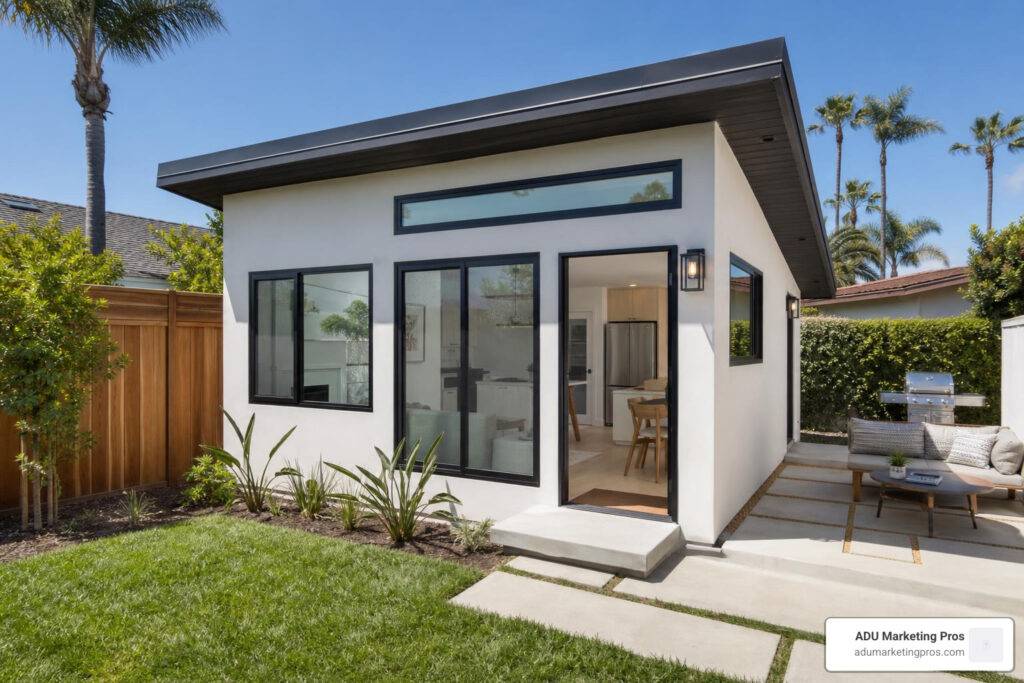
Why San Diego ADU Financing Is One of the Most Important Decisions You’ll Make as a Homeowner
San Diego ADU financing is the single biggest hurdle standing between most homeowners and a completed accessory dwelling unit — and knowing your options upfront can save you tens of thousands of dollars.
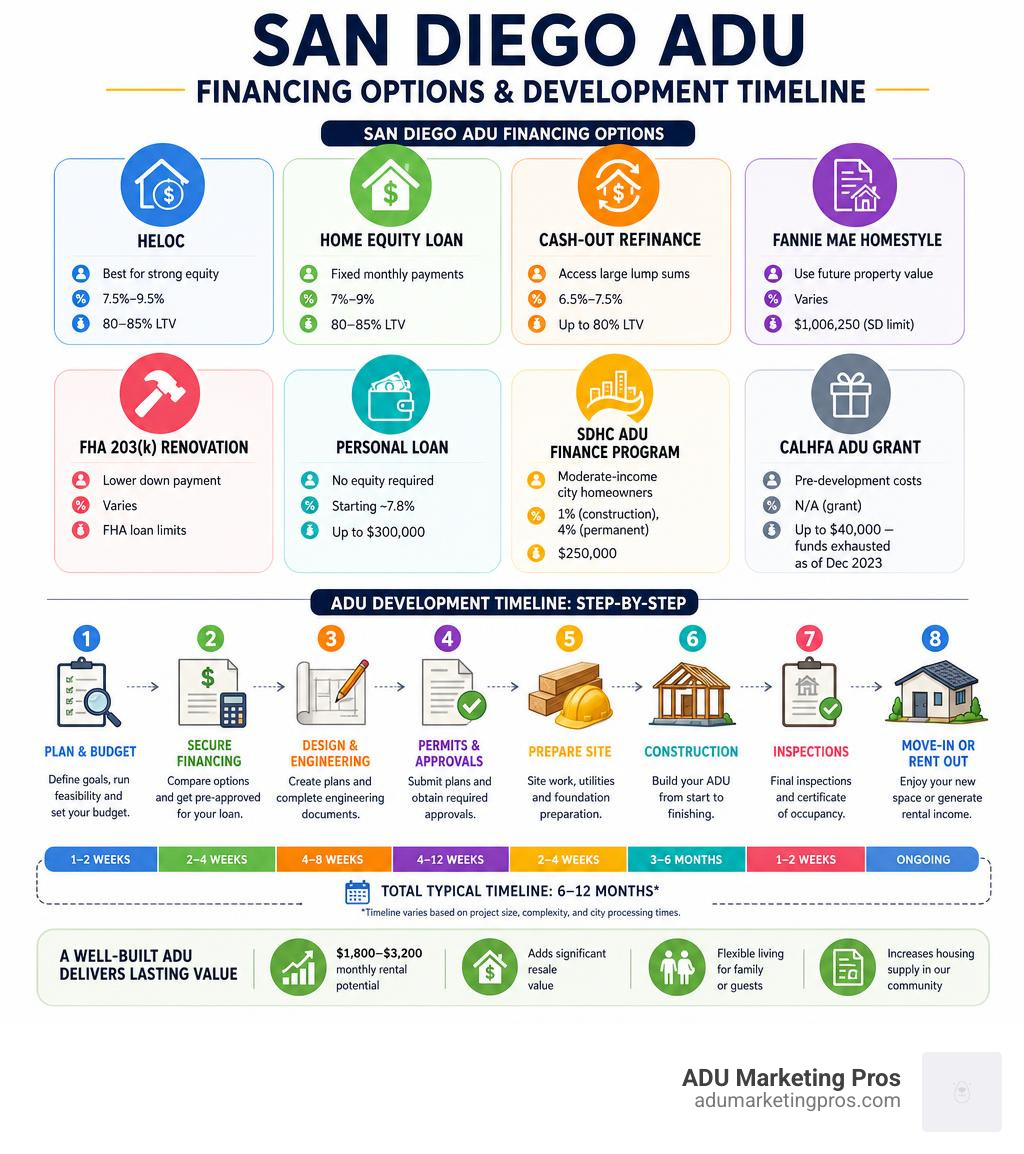
Here’s a quick snapshot of the main funding sources available right now (May 2026):
| Financing Option | Best For | Typical Rate | Max Amount |
|---|---|---|---|
| HELOC | Homeowners with strong equity | 7.5%–9.5% | 80–85% LTV |
| Home Equity Loan | Fixed monthly payments | 7%–9% | 80–85% LTV |
| Cash-Out Refinance | Accessing large lump sums | 6.5%–7.5% | Up to 80% LTV |
| Fannie Mae Homestyle | Using future property value | Varies | $1,006,250 (SD limit) |
| FHA 203(k) Renovation | Lower down payment | Varies | FHA loan limits |
| Personal Loan | No equity required | Starting ~7.8% | Up to $300,000 |
| SDHC ADU Finance Program | Moderate-income city homeowners | 1% (construction), 4% (permanent) | $250,000 |
| CalHFA ADU Grant | Pre-development costs | N/A (grant) | Up to $40,000 — funds exhausted as of Dec 2023 |
San Diego’s ADU market has exploded. Permits across the county jumped 247% between 2020 and 2024, rising from roughly 1,150 to nearly 4,000 per year. By 2024, nearly one in five new housing permits issued in the city was for an ADU. This surge is driven by progressive state laws that have stripped away local zoning barriers, making it easier than ever to build secondary units on single-family lots.
The reason is simple: a well-built ADU can rent for $1,800 to $3,200 per month in San Diego, add significant resale value, and help house aging family members — all on a lot you already own. In a city where the median home price consistently hovers near record highs, maximizing the utility of your existing land is one of the smartest financial moves you can make.
But a turnkey detached ADU typically costs $300,000 to $450,000 in today’s market. That’s not a decision you finance on a credit card. Understanding which loan product fits your equity position, income, and timeline is what separates a project that gets built from one that stalls on a spreadsheet. Choosing the wrong financing vehicle can lead to high interest payments, project delays, or even running out of funds mid-construction.
This guide walks you through every realistic financing path available to San Diego homeowners right now — including government programs most people don’t know exist.
Essential san diego adu financing terms:
Understanding the Cost of Building an ADU in San Diego
Before we dive into how to pay for your granny flat, we need to talk about what you are actually paying for. We have seen too many homeowners start shopping for loans based on a “guesstimate,” only to find themselves underfunded halfway through the framing phase.
In San Diego, the cost of building an accessory dwelling unit is highly dependent on your lot’s topography, utility access, and the type of unit you build.
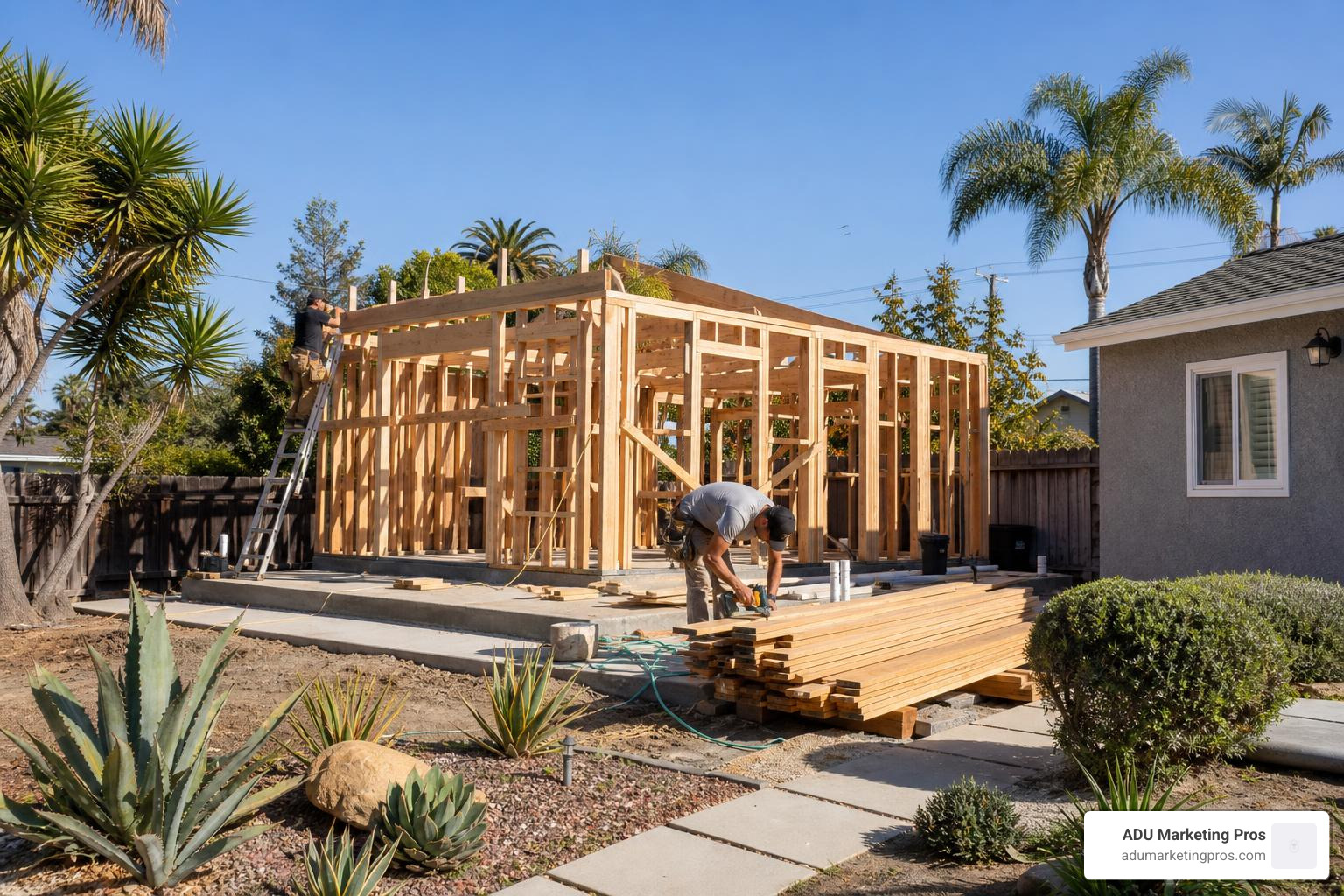
To help you establish a realistic budget, let’s break down the typical expenses. You can also dive deeper into our dedicated guide on ADU Cost San Diego to see a more granular breakdown.
Key ADU Pre-Construction Expenses
Before a single piece of lumber arrives on your property, you will need to fund several pre-construction phases:
- Design & Architectural Plans: $5,000 to $15,000 (depending on whether you use pre-approved template plans or hire a custom architect).
- Permitting & Impact Fees: $6,500 to $21,000. While California has waived certain impact fees for units under 750 square feet, you will still pay plan check and building permit fees. Read more about this in our guide on ADU Permits San Diego.
- Engineering & Environmental Reports: $2,000 to $5,000 for structural engineering, Title 24 energy calculations, and soils reports if your lot is sloped.
- Utility & Infrastructure Modifications: $5,000 to $20,000. Upgrading your electrical panel to 200 amps or trenching new sewer and water lines can add significant upfront expenses. Sloped lots (common in neighborhoods like Del Cerro and Allied Gardens) can easily add 10% to 25% to your overall site preparation costs.
Comparing Costs: Garage Conversion vs. Detached ADU
While a detached unit offers complete privacy, a garage conversion or Junior ADU (JADU) is often the most cost-effective path. Here is how the numbers stack up in San Diego for May 2026:
| Cost Category | JADU / Garage Conversion (approx. 300–400 sq. ft.) | Detached ADU (approx. 600–1,200 sq. ft.) |
|---|---|---|
| Average Cost Range | $80,000 – $150,000 | $300,000 – $450,000+ |
| Average Cost Per Sq. Ft. | $250 – $375 | $300 – $450+ |
| Site Prep & Trenching | Minimal | High (requires foundation, grading, utility runs) |
| Permit Fees | Lower (typically under $7,000) | Higher (up to $21,000 depending on size) |
| Timeline to Complete | 3 to 6 months | 6 to 10 months |
Understanding these cost differences is critical because your choice of ADU type directly dictates the type of financing you should pursue. A garage conversion can often be funded with a personal loan or a smaller HELOC, whereas a detached ADU almost always requires a more robust home equity product or a specialized construction loan.
Primary Options for San Diego ADU Financing
Now that you have a realistic view of the costs, let’s look at the actual loan products. Most homeowners do not pay cash for an ADU; instead, they mix and match equity products, construction loans, or personal financing to fund their builds.

To compare all your pathways at a high level, check out our comprehensive breakdown of ADU Financing Options. Let’s analyze the most common strategies.
Leveraging Home Equity for San Diego ADU Financing
If you have lived in your San Diego home for more than a few years, you have likely benefited from the region’s massive equity gains. Utilizing a Home Equity ADU strategy is often the cheapest way to borrow money because your home serves as collateral.
- Home Equity Line of Credit (HELOC): A HELOC acts like a credit card secured by your home. You only pay interest on the money you draw, which is perfect for paying contractors in phases. Rates are typically variable (currently hovering between 7.5% and 9.5% in early 2026). The approval process is fast — often 2 to 4 weeks. This flexibility makes it the most popular choice for homeowners who want to manage cash flow dynamically during construction.
- Home Equity Loan (Second Mortgage): Unlike a HELOC, a home equity loan gives you a lump sum upfront with a fixed interest rate and fixed monthly payments. This protects you from rising rates but means you pay interest on the entire amount from day one. It is ideal for homeowners who prefer predictable monthly expenses and have a fixed-price contract with their builder.
- Cash-Out Refinance: If your current first mortgage has a high interest rate, a cash-out refinance allows you to replace your existing loan with a new, larger mortgage and take the difference in cash. However, if you locked in a historically low mortgage rate (e.g., 3% in 2021), we highly recommend avoiding a cash-out refinance. Replacing a 3% rate with a 6.5% rate on your entire primary mortgage to get $200,000 in cash is incredibly expensive over the long term.
For a deeper dive into these options, you can read the detailed breakdown on ADU Financing in San Diego: Every Loan Option Explained (2026) – IL Total Design And Build.
Construction Loans and Renovation Loans
What if you don’t have enough equity in your home yet? This is a common issue for recent homebuyers in high-value neighborhoods like Clairemont or North Park.
The solution is a renovation loan, which bases the loan amount on the future post-construction value of your property rather than its current value. To explore this path, check out our guide on Construction Loans for ADU.
- Fannie Mae Homestyle Renovation Loan: This conventional loan allows you to borrow up to 97% of the project’s “as-completed” value for primary residences (or up to 85% for investment properties). The conforming loan limit for the San Diego area is highly accommodating (exceeding $1 million), making this an excellent vehicle for large detached builds.
- FHA 203(k) Renovation Loan: Backed by the Federal Housing Administration, this loan is ideal for buyers with lower credit scores or smaller down payments. It allows you to wrap both your primary mortgage and the ADU construction costs into a single loan based on the future appraised value. You can find out more about setting up these specialized products at ADU Financing in San Diego, CA – Renovation Financing & Consultants – SD203K.com.
Key Requirements for Securing San Diego ADU Financing
Securing an ADU loan is not much different from getting a primary mortgage, but lenders will scrutinize your project plan more closely. To qualify for the best rates, you will typically need:
- A Strong Credit Score: A FICO score of 740+ gets you the best rates, while 680 is generally the minimum required for renovation and home equity products.
- Sufficient Equity Margin: For equity-based loans, most lenders require you to keep at least 15% to 20% equity in your home after the loan is drawn (meaning a maximum combined Loan-to-Value ratio of 80% to 85%).
- Detailed Project Documentation: Lenders will not hand over $300,000 based on a handshake. You must provide a complete floor plan, structural elevations, a detailed line-item budget, and a signed contract with a licensed California builder.
Using Future Rental Income to Qualify
Can you use the money your ADU will make to help you qualify for the loan to build it? Yes, but it depends on the loan type and the lender.
Under current FHA guidelines, lenders can consider up to 50% of the projected rental income from a new ADU to help you meet debt-to-income (DTI) requirements. For existing ADUs, FHA allows up to 75%.
Freddie Mac also offers flexible programs for 1-to-3 unit properties that allow you to count ADU rental income without a long “seasoning” period. This is incredibly helpful if your current income is slightly too low to support the new monthly loan payment on its own.
Understanding how these rules apply is crucial, especially when navigating local zoning and tenancy regulations. Learn more about the local framework in our guide on San Diego ADU Laws.
Government Programs and Grants for San Diego Homeowners
If traditional bank loans feel too expensive or out of reach, you may qualify for specialized government-backed programs designed to incentivize affordable housing production.
The SDHC Accessory Dwelling Unit Finance Program
The San Diego Housing Commission (SDHC) offers one of the most aggressive municipal ADU programs in the country. It is specifically designed to help low-to-moderate-income homeowners build wealth while expanding the city’s rental inventory.
Here are the key details of the Accessory Dwelling Units (ADU) – SDHC program:
- The Loan Structure: A construction-to-permanent loan of up to $250,000.
- Unbelievable Interest Rates: You pay a 1% fixed interest rate during the construction phase. Once construction is complete, the loan converts to a 4% fixed interest rate permanent loan.
- Amortization & Terms: The permanent loan features a 15-year term with a 30-year amortization schedule (with the remaining balance due at the end of the 15 years).
- Income Limits: Eligible households can earn up to 150% of San Diego’s Area Median Income (AMI), which currently allows household incomes up to $236,600 to qualify.
- The Catch (Affordability Covenant): In exchange for these below-market rates, you must agree to rent the ADU to a tenant making 80% or less of the AMI for a period of seven years. The rent you charge is capped at 30% of the tenant’s income limit, and you cannot rent the unit to family members during this period.
- Technical Assistance: The SDHC doesn’t just hand you money; they also provide free technical assistance, matching you with an ADU consultant who helps manage pre-design, permitting, and builder selection.
For historical context on how this program evolved from its initial pilot phase, you can read the official announcement: San Diego Housing Commission Launches Pilot Program to Help Homeowners with Low Income Build Accessory Dwelling Units – SDHC.
State-Level Grants and the CalHFA Program Status
Many homeowners search the web looking for the famous CalHFA ADU Grant Program, which previously provided up to $40,000 to cover pre-development costs like design, permits, and soil tests.
We must clear up some outdated information: the CalHFA ADU Grant program fully exhausted its funding as of December 28, 2023.
While the state legislature occasionally discusses renewing the fund, there are currently no active state-level CalHFA grants available for new applicants. We advise homeowners to ignore blogs claiming this free money is readily accessible in 2026. Keep an eye on the official ADU Grant Program – CalHFA page for any future legislative updates or re-allocations.
Frequently Asked Questions about San Diego ADU Financing
Does building an ADU in San Diego increase my property taxes?
Yes, but not in the way most people fear. Under California’s Proposition 13, adding an ADU will not trigger a reassessment of your entire property.
Instead, the county tax assessor will perform a “blended assessment.” They will assess the value of the new ADU construction (typically based on the cost to build it) and add that specific amount to your existing property tax bill. For example, if your home is assessed at $700,000 and you build a detached ADU valued at $250,000, your new tax basis will be $950,000. Your primary home’s tax basis remains protected.
Can I use future ADU rental income to qualify for a loan?
Yes, but you must work with a lender that supports renovation-specific underwriting. Conventional HELOCs and second mortgages generally do not allow you to use projected rental income. However, FHA 203(k) loans, Fannie Mae Homestyle loans, and certain portfolio lenders will allow you to count 50% to 75% of the projected rent (verified by an appraiser’s market rent study) to help lower your debt-to-income ratio.
What is the fastest way to secure ADU funding in San Diego?
If you have sufficient equity in your home, a HELOC is the fastest traditional route, typically taking 2 to 4 weeks to fund.
If you do not have equity or want to avoid putting your home up as collateral, unsecured personal loans from specialized home improvement lenders can fund in as little as 24 to 48 hours for amounts up to $300,000. While personal loans do not require appraisals or equity, they do carry higher interest rates (starting around 7.8% for excellent credit) and shorter repayment terms. You can read more about no-equity personal loans at ADU Financing in San Diego, CA: Fund Your Build – HFS Financial.
Can I build an ADU if my property is governed by an HOA?
Yes. Under California Assembly Bill 670, homeowners associations (HOAs) cannot completely prohibit the construction of ADUs or JADUs on single-family lots. However, HOAs are still permitted to enforce reasonable aesthetic guidelines, provided they do not unreasonably increase the cost of construction or delay the project. It is always best to submit your plans to your HOA board early in the design phase to avoid disputes.
What happens if my construction costs exceed my approved loan amount?
This is a common risk known as a budget overrun. To protect yourself, you should always build a 10% to 15% contingency fund directly into your initial loan request. If you are using a construction loan, lenders often require a contingency reserve before approving the draw schedule. If you run out of money without a contingency, you may have to secure a secondary personal loan or pay out-of-pocket to complete the build.
Conclusion
Navigating the landscape of san diego adu financing requires a careful balance of your current home equity, your long-term financial goals, and a realistic understanding of local building costs. Whether you leverage your home’s equity through a HELOC, utilize a forward-looking renovation loan, or qualify for the San Diego Housing Commission’s low-interest program, securing your funding is the true foundation of a successful build.
By taking the time to analyze your financial position, gather detailed project documentation, and select the right loan product, you can transform your backyard into a source of steady rental income, multi-generational housing, or long-term wealth.
At ADU Marketing Pros, we specialize in helping ADU builders, designers, and architects connect with qualified homeowners who are ready to build. If you are a construction or architecture firm looking to stand out in California’s competitive housing market, we can help you attract high-value leads through targeted, data-driven digital marketing.
Explore our specialized ADU Marketing Solutions to learn how we help industry professionals scale their operations and dominate the local market.