
Why Tiny Home Foundation Options Matter More Than Most Builders Expect
When embarking on a small-scale construction project, the excitement usually centers on the interior design, the clever storage solutions, or the off-grid solar array. However, the most critical decision you will make happens before the first wall is framed. tiny home foundation options fall into several main categories, each suited to different needs, climates, and legal requirements. Choosing the wrong one isn’t just a minor inconvenience; it can lead to structural failure, legal eviction, or a total loss of investment.
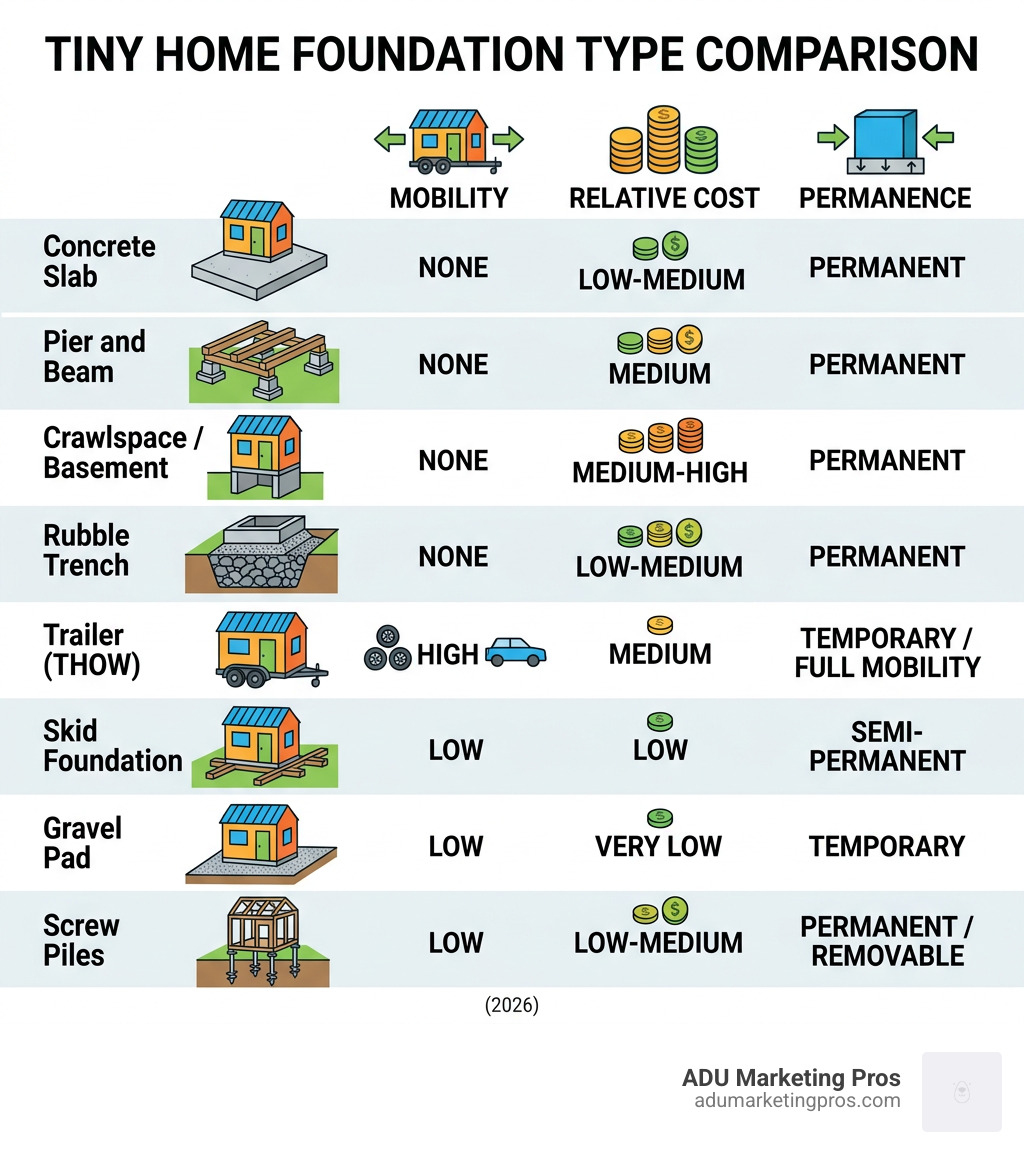
| Foundation Type | Best For | Mobility | Relative Cost |
|---|---|---|---|
| Concrete slab | Permanent, flat sites | None | Low–Medium |
| Pier and beam | Sloped, flood-prone, or uneven terrain | None | Medium |
| Crawlspace / basement | Storage needs, utility access | None | Medium–High |
| Rubble trench | Eco-conscious, high-drainage sites | None | Low–Medium |
| Trailer (THOW) | Full mobility, temporary living | High | Medium |
| Skid foundation | Semi-permanent, easy relocation | Low | Low |
| Gravel pad | Park models, temporary setups | Low | Very Low |
| Screw piles | Wooded, sloped, or frost-heavy areas | Low | Low–Medium |
The typical tiny home is just 186 square feet. That’s small — but the foundation underneath it is just as critical as any full-sized home. Maybe more so, because a small structure has less tolerance for shifts, settling, or uneven support. In a 2,500-square-foot home, a quarter-inch of settling might go unnoticed in a far corner. In a tiny home, that same quarter-inch can cause the front door to jam, the loft stairs to creak, and the plumbing to lose its necessary pitch.
Here’s the problem: nearly one in five small-footprint dwellings run into unexpected foundation issues that cost time and money to fix. And most of those problems were avoidable. Many DIY builders assume that because the house is light, the ground doesn’t need much preparation. This is a dangerous myth. Soil compaction, moisture content, and local frost lines apply the same physical laws to a tiny house as they do to a skyscraper.
Your foundation affects everything — safety, financing, legal classification, energy efficiency, and long-term value. Whether you’re planning a permanent residence or a moveable retreat, picking the wrong base can mean structural damage, permitting headaches, or a home that a lender won’t touch. This guide breaks down every major foundation type clearly, so you can match the right option to your site, budget, and goals.
Easy tiny home foundation options word list:
Comparing the Best Tiny Home Foundation Options for Stability
When we talk about stability, we’re talking about more than just keeping the floor level so your morning coffee doesn’t slide off the table. A stable foundation protects your investment from the unique environmental pressures of California, from the shifting clay soils of the East Bay to the seismic rumbles we all know and love in San Jose and San Francisco. Stability is the intersection of engineering and geology.
Choosing between tiny home foundation options starts with one big question: do you want to move it later, or is this its forever home? This decision dictates the engineering requirements and the materials used. A home on wheels requires a heavy-duty steel chassis, while a home on a slab requires rebar and high-PSI concrete.
Before we dig any holes, we always recommend a geological survey. While it sounds fancy, it’s essentially just making sure you aren’t building on a sinkhole or “marshmallow” soil that will swallow your ADU. In regions like the San Francisco Bay Area, site topography can vary wildly—one lot might be flat as a pancake, while the next is a 30-degree slope. A survey identifies the “bearing capacity” of the soil, which tells you how many pounds per square foot the earth can support without compressing.
| Feature | Slab | Pier & Beam | Skid | Trailer (THOW) |
|---|---|---|---|---|
| Permanence | High | High | Semi-Permanent | Low |
| Seismic Resistance | Good | Moderate | Low | High (flexible) |
| Best Terrain | Flat | Sloped | Flat/Level | Flat |
| Storage Potential | None | High (Crawlspace) | Low | None |
Understanding the difference between an adu vs tiny house is vital here. In California, an ADU (Accessory Dwelling Unit) is generally a permanent structure on a fixed foundation, whereas a “tiny home” could technically be on wheels. The foundation you choose dictates which set of rules you have to follow. If you choose a slab, you are building an ADU. If you choose a trailer, you are building a THOW. The legal implications for where you can park or build are massive.
Permanent Foundations for Real Property Value
If you want your tiny home to be an asset that grows in value, a permanent foundation is the way to go. When you anchor a house to the land, it stops being “personal property” (like a car) and starts being “real property” (like a house). This is a fundamental shift in the eyes of the law and the tax assessor. Real property appreciates with the land, whereas personal property typically depreciates like a vehicle.
This shift is huge for land ownership and property appreciation. In competitive markets like Los Angeles or San Diego, small houses for sale on permanent foundations are much easier to sell because they qualify for traditional 30-year mortgages. Most banks won’t touch a tiny home on wheels with a ten-foot pole because they can’t easily foreclose on something that can be driven away in the middle of the night! Furthermore, permanent foundations allow for higher appraisal values, which is essential if you ever plan to use the equity in your home for a loan.
Permanent foundations also make utility hookups—water, sewer, and power—much more straightforward. You aren’t “camping”; you’re living in a permitted, grid-connected home. This means no more dragging hoses or dealing with RV-style black water tanks. You have a standard sewer connection that meets all health and safety codes.
Mobile and Semi-Permanent Tiny Home Foundation Options
For those who value the freedom to relocate, Tiny Homes on Wheels (THOWs) are the gold standard. These are often RVIA-certified, meaning they meet specific safety standards for recreational vehicles. This certification is crucial for insurance and for staying in certain tiny home villages or RV parks.
However, “mobile” is a relative term. Research shows that tiny homes are actually only moved an average of four times in their lifetime. Even so, if you’re working with tiny house builders california, they will tell you that even a wheeled home needs a “parking foundation.” You can’t just leave it on rubber tires forever. Sunlight deteriorates the rubber, and the weight can cause the trailer frame to bend over time.
Semi-permanent options like skids or gravel pads offer a middle ground: they provide a solid, level surface that prevents sinking but allow you to move the structure if your life plans change. These are particularly popular for people who are renting land or who live in jurisdictions where permanent tiny homes are still in a legal gray area. By using a semi-permanent base, you can argue that the structure is temporary, which sometimes bypasses the stricter building codes required for permanent dwellings.
Site Assessment: Soil, Frost Lines, and Environmental Loads
In our experience at ADU Marketing Pros, the biggest mistakes happen before the first bag of concrete is even opened. You have to “listen” to your land. Every plot of earth has a story to tell about how it handles water, weight, and weather. Ignoring these signals is the fastest way to a cracked foundation.
Site assessment involves looking at the bearing capacity of your soil. Is it sandy, rocky, or full of expansive clay? In many parts of California, clay soil is a major factor; it expands when wet and shrinks when dry, which can crack a poorly designed slab. This “heaving” action can exert thousands of pounds of pressure on your foundation. We recommend builders review regional maps to understand exactly what they are standing on. The USDA Web Soil Survey is an incredible, free resource that provides detailed data on soil types across the United States.
Drainage and slope management are equally critical. If your site is at the bottom of a hill in Sunnyvale, you need a foundation that won’t turn into an aquarium every time we get a heavy winter rain. This might mean installing French drains, swales, or choosing a pier foundation that lifts the home above the potential water flow.
How Soil and Climate Dictate Your Tiny Home Foundation Options
While we don’t deal with the deep “permafrost” of the Midwest, California still has frost line depth requirements in certain mountain regions like Big Bear or the Sierras. Even in coastal areas like Palo Alto, the “frost line” (the depth to which the ground freezes) determines how deep your footings must go to prevent seasonal heaving. If your footings are too shallow, the freezing water in the soil will literally lift your house out of the ground.
Soil type also dictates your insulation needs. For example, a concrete slab can feel like an ice cube in the winter if not properly handled. Following foundation insulation guidance ensures you aren’t losing all your heat through the floor. This usually involves placing rigid foam insulation under the slab and around the perimeter. Vapor barriers are also non-negotiable—a 6-mil to 10-mil poly sheet can be the difference between a cozy home and a moldy nightmare. Without a vapor barrier, moisture from the earth will wick through the concrete and rot your flooring from the bottom up.
Calculating Structural Loads for Safety
Safety isn’t just about the foundation holding up the house; it’s about the foundation holding the house down. In high-wind areas, a tiny home can act like a sail. If it isn’t properly anchored, it can literally be blown off its base.
- Dead Loads: The weight of the structure itself (walls, roof, appliances, and the foundation). This is a constant force.
- Live Loads: The weight of people, furniture, and your collection of vintage records. This force changes as you move around the house.
- Wind Loads: In coastal areas or canyons, wind can exert thousands of pounds of lateral and uplift pressure. Your foundation must have anchors that tie the frame to the base.
- Snow Loads: Relevant if you’re building in the mountains near Southern California or the Sierras. Snow is incredibly heavy; a foot of wet snow can add thousands of pounds to your roof, which the foundation must ultimately support.
- Seismic Activity: This is the big one for us. Your foundation must be able to withstand lateral (side-to-side) movement. In California, this often means extra rebar and specific “hold-down” brackets that keep the walls attached to the foundation during a quake.
When working with tiny house builders in southern california, ensure they are accounting for these specific loads in their engineering plans. A “one size fits all” approach doesn’t work in a state with such diverse geography.
Deep Dive into Permanent Foundation Types
If you’ve decided to stay put, you have three main “flavors” of permanent foundations. Each has its own set of advantages and challenges, and the right choice often depends on your specific lot and budget.
The slab-on-grade is the most common for a reason. It’s a simple, flat bed of concrete, usually 4 to 6 inches thick, poured directly onto the ground (after proper site prep). One of the best perks? they can last up to 100 years when built correctly. Slabs also provide “thermal mass,” meaning they soak up heat during the day and release it at night, which is great for eco-friendly small homes looking to lower energy bills. However, slabs are permanent. Once the plumbing is set in the concrete, moving a toilet or a sink becomes a major construction project involving jackhammers.
Crawlspace and Basement Foundations
A crawlspace foundation raises the home about 18 to 36 inches off the ground using short perimeter walls. This is a favorite for san francisco tiny house builders because it allows for easy access to plumbing and electrical lines. If a pipe leaks, you just crawl under and fix it, rather than jackhammering your floor. It also provides a buffer against ground moisture and can be used for limited storage. The downside is that crawlspaces must be properly ventilated or encapsulated to prevent humidity buildup and mold.
Basements are rare in tiny home construction due to the high cost of excavation, but they offer incredible storage solutions for surfboards, kayaks, or seasonal gear. In a tiny home, every square inch of storage is gold. A basement can effectively double your usable space without increasing the home’s footprint. Just remember: in California, a basement must be waterproofed to the extreme to avoid moisture issues, and it must meet strict egress requirements (exits) to be considered a living space.
Rubble Trench and Eco-Friendly Alternatives
For the environmentally conscious, the rubble trench is an ancient technique that’s making a comeback. Instead of a massive concrete wall, you dig a trench and fill it with crushed stone or recycled concrete. A small concrete “grade beam” is then poured on top to support the walls. It provides excellent drainage and uses significantly less concrete, which has a high carbon footprint. Many architects in southern california who design tiny houses are exploring these low-impact options to meet strict sustainability goals. Rubble trenches are particularly effective in areas with high groundwater because the stones allow water to flow freely under the house rather than pooling against the foundation.
Semi-Permanent and Mobile Foundation Solutions
Not everyone wants to pour 20 tons of concrete. If you’re renting land, living in a temporary location, or want to keep your options open for a future move, semi-permanent solutions are your best friend. These options provide the stability you need without the permanence of a slab.
Gravel pads are the unsung heroes of the tiny home world. They provide a level, stable surface and excellent drainage. A proper gravel pad involves removing the topsoil, laying down a geotextile fabric to prevent weeds and soil mixing, and then compacting several layers of crushed stone. Companies like Site Prep have shown that a well-constructed gravel pad can support a park model tiny home for decades. This is often the first step when you find land for sale in southern california for tiny houses. It’s affordable, fast to install, and easy to remove if you ever leave the site.
Pier and Beam vs. Screw Piles
If your land looks more like a hiking trail than a parking lot, you need piers. These allow you to build on slopes without the massive expense of leveling the entire site.
- Pier and Beam: Concrete posts (piers) are set into the ground, and wooden or steel beams are laid across them. It’s great for uneven terrain and provides excellent airflow under the home. You can find a good guide on leveling these blocks to ensure your home stays true. The main challenge is ensuring the piers are deep enough to reach stable soil.
- Screw Piles: These are essentially giant metal screws (helical piers) that are twisted into the earth using hydraulic machinery until they hit solid ground or reach a specific torque. They are incredibly fast to install—often in just a few hours—and are a popular choice for a tiny house san francisco project where heavy equipment might not fit in a tight backyard. They are also eco-friendly because they can be unscrewed and removed with almost zero impact on the land.
Cost-Effective Tiny Home Foundation Options for DIYers
For the DIY crowd, a skid foundation is often the most approachable. Using pressure-treated lumber (usually 4x4s or 6x6s), you build a “sled” that the house sits on. While you might see shed foundation builders using this for storage units, the principles apply to tiny homes too—just ensure you use mobile home tie-downs to keep the wind from turning your home into a kite. Skids allow the home to be dragged onto a flatbed trailer for relocation, making them a great semi-mobile option.
Gravel costs are also very DIY-friendly. While a professional might charge more for the equipment and labor, you can often prep a gravel pad yourself for around $2.40 per square foot in materials. It’s a weekend project that provides a solid foundation for years to come.
Costs, Permits, and Building Codes for Tiny Foundations
Let’s talk about the “unfun” part: paperwork and money. In the world of tiny homes, the foundation is often where the legal rubber meets the road. Your choice of foundation determines whether your home is a “house,” a “recreational vehicle,” or an “accessory structure.”
Zoning laws in California are some of the most complex in the country. However, things are changing rapidly. The PERMANENT FOUNDATIONS GUIDE FOR MANUFACTURED HOUSING is a great resource for understanding how the federal government views these structures, but local rules always win. You must check setbacks (how far the home must be from the property line), height restrictions, and specific places in southern california that allow tiny houses. Some cities require a permanent foundation for any dwelling, while others have created special zones for tiny homes on wheels.
Budgeting for Your Foundation Project
How much should you set aside? Foundation costs can vary wildly based on your location and the complexity of the site. Here are some rough estimates:
- Gravel Pad: Expect to pay $5-$9 per square foot for professional installation. This includes excavation, fabric, and stone.
- Concrete Slab: A simple pad for a 20-foot home might run you $1,500 to $3,500, depending on excavation fees, rebar requirements, and local labor rates. In high-cost areas like the Bay Area, expect to pay at the higher end of that range.
- Piers/Screw Piles: These can vary, but hiring a “bobcat” operator to install a dozen screw piles might cost around $500 to $1,000 for the labor plus the cost of the piles themselves (which can be $200-$400 each).
Don’t forget long-term maintenance. A trailer needs tire checks, brake maintenance, and rust prevention, while a slab is mostly “set it and forget it.” However, if a slab cracks due to poor soil prep, the repair costs can be astronomical.
Navigating Building Codes and Inspections
In San Jose and the surrounding Bay Area, you’ll likely deal with the IRC (International Residential Code). Appendix E of the 2015 IRC specifically addresses manufactured homes and foundations. This appendix provides the standards for anchoring and support that most inspectors will look for.
You’ll need utility permits for sewer and water, and most municipalities will require a structural engineering sign-off for anything permanent. This ensures the foundation can handle the seismic loads common in California. Local San Jose regulations have become much more “ADU-friendly” lately, with streamlined permitting processes, but you still have to play by the rules to ensure your home is legal, insurable, and safe for occupancy.
Frequently Asked Questions about Tiny Home Foundations
What is the cheapest foundation for a tiny home?
The cheapest option is almost always a DIY gravel pad. At roughly $2.40 per square foot for materials, it’s significantly less expensive than concrete. However, keep in mind that “cheap” doesn’t always mean “best.” If you’re in a flood zone or on a steep hill, the extra investment in piers or a slab will save you thousands in repairs later. A cheap foundation that fails is the most expensive mistake you can make.
Can I move a tiny home from a trailer to a permanent foundation?
Yes! This is a common path for many builders. You can start with a Tiny House on Wheels (THOW) for flexibility, and later “set” it on a permanent foundation like concrete blocks or a perimeter wall. This requires proper disconnection of the trailer, structural support during the lift, and ensuring the new foundation meets local building codes for permanent dwellings. You will also need to ensure the home’s frame is compatible with the new anchoring system.
How thick should a concrete slab be for a tiny house?
For most tiny homes and park models, a concrete slab should be at least 4 to 5 inches thick. This ensures it can handle the concentrated weight of the structure without cracking. We also recommend making the pad at least 2 to 3 feet wider and longer than the home itself to provide a stable perimeter and room for a small “patio” area or utility access. Always use rebar or wire mesh to provide tensile strength to the concrete.
Do I need a permit for a gravel pad?
In many jurisdictions, a gravel pad is considered “landscaping” or a “temporary improvement” and may not require a building permit. However, if you plan to park a tiny home on it and connect to utilities, the use of the pad will likely require a permit. Always check with your local planning department to avoid fines.
How do I prevent my tiny home from blowing away in high winds?
If you are on a trailer, you must use heavy-duty auger anchors and tie-down straps. If you are on a slab or piers, you must use anchor bolts that are embedded in the concrete and bolted to the home’s sill plate or steel frame. This is a critical safety step in coastal and canyon areas.
Conclusion
Choosing the right tiny home foundation options is the literal groundwork for your success. It is the silent partner in your home’s longevity, safety, and value. Whether you’re building a sleek, modern ADU in Mountain View or a cozy, rustic retreat in Menlo Park, the foundation you choose today determines the lifespan and resale value of your home tomorrow. Don’t cut corners on the one part of the house you can’t easily change later.
At ADU Marketing Pros, we know that the construction world is competitive and that homeowners are looking for experts they can trust. We help firms stand out by focusing on this kind of deep technical expertise and clear communication. If you’re a builder or architect looking to reach more homeowners who value quality over the lowest price, we’re here to help you grow your brand and your business.
Ready to take the next step in your tiny house journey and build something that lasts? More info about tiny house builders in California