
California’s Tiny Home and Land Market: What Buyers Need to Know Right Now
Tiny homes with land for sale in California represent one of the most exciting — and fastest-growing — segments of the state’s real estate market right now. For decades, the “California Dream” was synonymous with sprawling suburban ranch homes and manicured lawns. However, as the housing crisis has intensified and the cost of living has skyrocketed, a new dream has emerged: one of simplicity, sustainability, and financial freedom. This shift isn’t just about downsizing; it’s about reclaiming time and resources in a state that often demands too much of both.
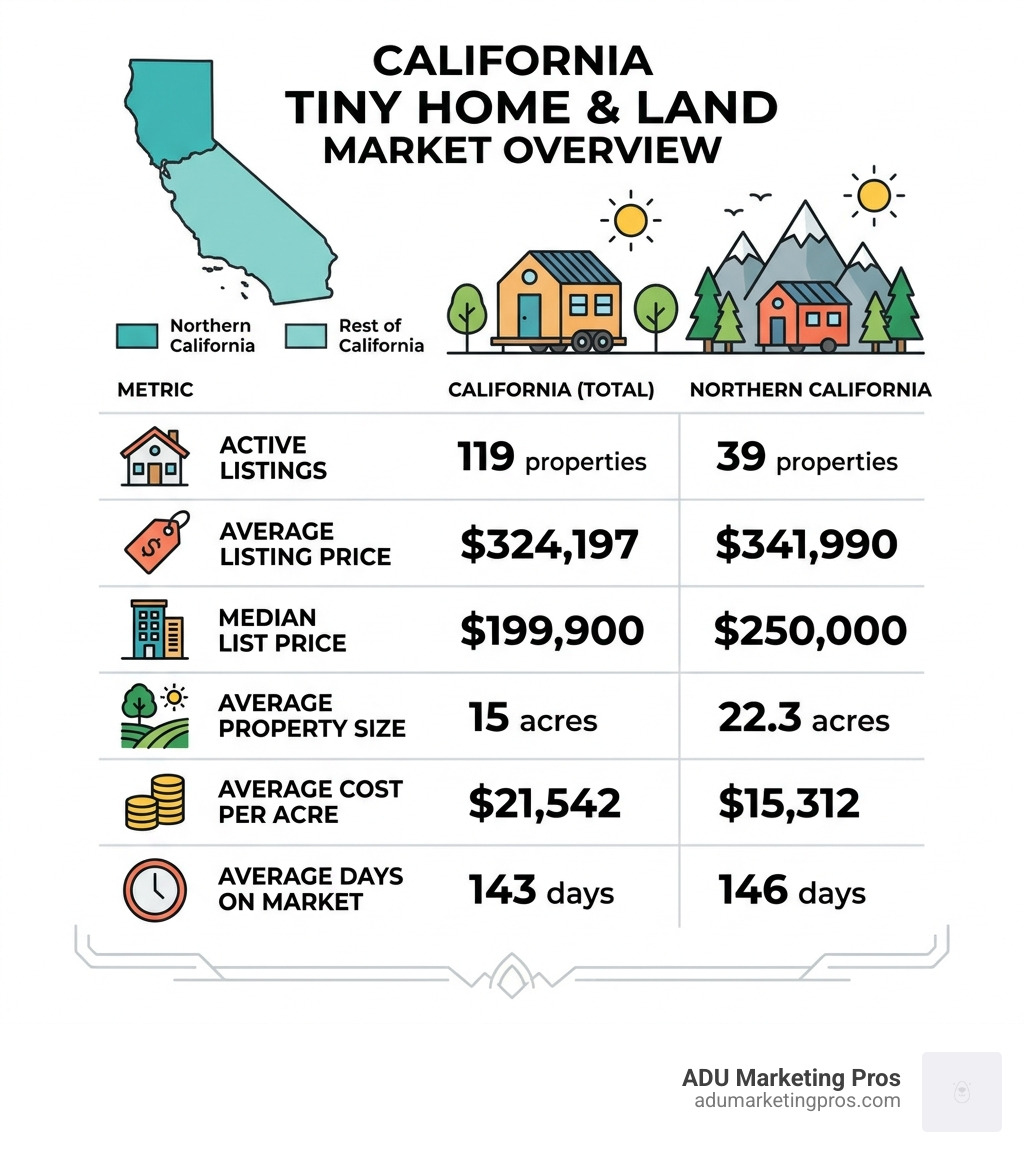
Here’s a quick snapshot of what the market looks like today:
| Metric | California | Northern California |
|---|---|---|
| Active listings | 119 properties | 39 properties |
| Average listing price | $324,197 | $341,990 |
| Median list price | $199,900 | $250,000 |
| Average cost per acre | $21,542 | $15,312 |
| Average property size | 15 acres | 22.3 acres |
| Average days on market | 143 days | 146 days |
The Evolution of the Tiny Home Movement in the Golden State
Properties range from small desert lots under $10,000 to sprawling multi-acre woodland retreats pushing past $1 million. There’s real variety here — whether you want a prefab tiny home on wheels, a move-in-ready cabin, or raw land to build your dream compact home from scratch. The movement has evolved from a niche hobby for DIY enthusiasts into a legitimate real estate sector supported by specialized builders and evolving legislation.
California’s housing affordability crisis has pushed more buyers toward the tiny home lifestyle. Pair that with remote work flexibility and a growing appetite for self-sufficient, off-grid living, and it’s easy to see why demand for these properties keeps climbing. We are seeing a diverse group of buyers entering this space: young professionals looking for their first home, retirees wanting to downsize without losing their connection to nature, and investors looking for unique short-term rental opportunities.
Navigating the Complexity of the Market
But the market has quirks. Zoning laws vary wildly by county, and even by specific parcel. Financing can be tricky, as traditional mortgages often don’t apply to non-traditional structures. And not every listing labeled “tiny home land” is what it seems; some may lack legal access or water rights, which are critical in the California landscape.
This guide breaks down everything you need to know — from the most affordable regions and featured listings to zoning rules, utilities, and financing tips — so you can find the right property with confidence. We will explore the nuances of different regions, the technical requirements for utilities, and the legal hurdles you must clear to make your tiny home dream a reality.
Explore more about tiny homes with land for sale in california:
The Current Market for Tiny Homes with Land for Sale in California

When we look at the landscape of tiny homes with land for sale in California, we see a market defined by diversity and resilience. Currently, there are approximately 119 properties specifically categorized as tiny homes with land. The total acreage represented by these listings is about 1,791 acres, suggesting that while the homes are small, the lifestyles they offer are often expansive. This “small house, big land” philosophy is a cornerstone of the California tiny home experience.
The average listing price across the state sits at $324,197. While that might sound high for a “tiny” house, in California, you aren’t just buying four walls; you’re buying the dirt beneath them, which in many cases is the most valuable asset. The average cost per acre for these packages is roughly $21,542, but this figure is heavily skewed by high-value coastal properties and large inland tracts.
Current Market Overview for Tiny Homes with Land for Sale in California
If you are looking for a bargain, the median list price of $199,900 is a more encouraging figure for budget-conscious buyers. This median price reflects the abundance of desert and mountain properties that offer a lower barrier to entry. We’ve noticed that properties tend to stay on the market for an average of 143 days. This is significantly longer than the 30-60 day average seen in traditional residential real estate, which gives buyers a bit more breathing room to conduct due diligence, perform soil tests, and verify zoning before committing.
Inventory trends show a mix of “land-ready” parcels and existing structures. We are seeing more price drops lately—some ranging from $12,000 to $26,000—indicating that sellers are becoming more realistic about valuations as interest rates for land loans remain elevated. For those specifically looking near major hubs, you can find more land for sale in Southern California for tiny houses that offers a blend of accessibility and seclusion, often within a two-hour drive of Los Angeles or San Diego.
Regional Price Variations and Acreage
Geography is the biggest factor in what you’ll pay. As a general rule, the closer you get to the Pacific Ocean or a major tech hub, the more you’ll pay per square inch. Coastal land remains the most expensive per dollar, often requiring complex permitting through the California Coastal Commission. Conversely, Northern California offers a more rugged value proposition, with a median price of $10,900 per acre for raw land in counties like Siskiyou or Modoc.
High-demand areas often cluster near California’s crown jewels—our national parks. Properties near Yosemite, Joshua Tree, and Lassen Volcanic National Park are perennial favorites for those looking to build short-term rentals or vacation retreats. These areas benefit from a steady stream of tourism, making a tiny home a viable income-generating asset. If you’re interested in regions that have paved the way for this lifestyle, check out places in Southern California that allow tiny houses to see where local governments are most welcoming and where the infrastructure for tiny living is already established.
Top Regions for Affordable Tiny Home Land Packages
For those of us on a quest for affordability, certain counties stand out as beacons of opportunity. The search for tiny homes with land for sale in California often leads buyers away from the coast and into the heart of the state’s diverse interior. Kern County often lists the lowest entry points, with some small parcels starting as low as $7,000. These are often raw land deals that require a visionary approach to utilities and access. Riverside and San Bernardino counties offer vast desert expanses that are perfect for off-grid enthusiasts who want to harness the power of the sun. If you are looking for more greenery, Butte and Trinity counties provide a mountainous backdrop at a fraction of the cost of the Bay Area. To get started on your build, it helps to consult tiny house builders in California who understand these specific terrains and the unique challenges they present.
Northern California Opportunities
In Northern California, the market is slightly more premium but offers significantly more land. With an average property size of 22.3 acres, you aren’t just buying a home; you’re buying a kingdom. This region is ideal for those seeking true privacy and a connection to the old-growth forests and river systems of the north.
- Plumas County: Known for its “Lost Sierra” feel, offering properties like 32-acre retreats. It is a haven for outdoor enthusiasts who want to be near world-class hiking and fishing.
- Siskiyou & Tehama: These areas offer the lowest cost per acre, ideal for those who want a massive buffer of privacy. The views of Mt. Shasta are a significant draw for buyers in this region.
- San Francisco Bay Area: While land is scarce, there are unique opportunities for tiny house San Francisco options, often involving smaller “infill” lots or ADU-ready properties in the surrounding hills of the East Bay or Santa Cruz mountains.
Southern California and Desert Gems
Southern California isn’t just beaches and traffic. Los Angeles and San Diego counties have surprisingly robust listings for tiny home land, though they often lean toward “recreational” use or require strict adherence to ADU guidelines. The High Desert, particularly around Joshua Tree and Landers, has become a mecca for the “Stargazer” tiny home aesthetic. These areas are perfect for tiny house builders in Southern California who specialize in heat-efficient, off-grid designs that can withstand the extreme temperature swings of the Mojave.
The Central Valley and Foothills
Often overlooked, the Sierra Foothills (counties like Amador, Calaveras, and Tuolumne) offer a middle ground. You get the proximity to the mountains and the gold-country charm without the extreme isolation of the far north. These areas are increasingly popular for “Park Model” tiny homes that serve as secondary residences or high-end vacation rentals.
Featured Tiny Homes with Land for Sale in California
When browsing tiny homes with land for sale in California, it’s helpful to see what your money actually buys. The market currently ranges from “fixer-upper” trailers on half an acre to “smart cabins” with lake memberships. The diversity of the inventory means that whether you have $50,000 or $800,000, there is likely a property that fits your vision. If you’re overwhelmed by the options, exploring small houses for sale can provide a middle ground between a 200-square-foot THOW and a traditional mansion.
Featured Listings: Tiny Homes with Land for Sale in California
Here are a few standout properties that represent the current market and illustrate the range of possibilities available to buyers today:
- 6651 Hearst Willits Rd, Willits, CA 95490: View Listing. An 80-acre woodland retreat featuring a 400 sq ft home for $580,000. This property is a masterclass in “preparedness” living, featuring its own water source and significant timber value. It’s perfect for someone looking to disappear into the Mendocino wilderness.
- 23398 Soili Rd, Grass Valley, CA 95949: View Listing. A 5.3-acre lot listed at $199,000. While the land is the star, a Park Model tiny home is available separately, making it a “phased” development opportunity. This allows a buyer to secure the land first and then move the home on-site once permits are finalized.
- 22860 Fuller Rd, Twain Harte, CA 95383: View Listing. A “Smart Cabin” for $499,900. At 812 sq ft, it’s on the larger side of tiny, but it comes with Alexa integration, high-end finishes, and exclusive lake access. This is a prime example of the “luxury tiny” trend.
- 1060 Little Bear Rd, Blairsden, CA 96103: View Listing. A 32-acre “off-grid oasis” for $800,000, including a 600 sq ft tiny home and fully paid-off solar. This property offers a turnkey solution for someone who wants the off-grid lifestyle without the headache of building from scratch.
High-End and Large Acreage Properties
For those with a larger budget, the high-end of the tiny home market focuses on land potential and environmental stewardship. The Blairsden and Willits listings mentioned above are perfect examples. These aren’t just homes; they are “legacy properties.” They often come with pre-approved plans for a larger primary residence, allowing the tiny home to eventually serve as an ADU (Accessory Dwelling Unit) or a guest house. This is where architects in Southern California who design tiny houses can help you visualize a multi-structure estate that grows with your needs over time. Investing in large acreage also provides a hedge against future development, ensuring your tiny home remains surrounded by nature.
Navigating Zoning and Legal Requirements for Tiny Homes with Land for Sale in California
This is where the dream often meets the reality of bureaucracy. In California, “tiny home” is a broad term that covers everything from a Tiny House on Wheels (THOW) to a foundation-backed Accessory Dwelling Unit (ADU). Understanding the difference is critical for legal residency, as the state treats a structure on wheels very differently than one bolted to the ground. For a deep dive into these distinctions, read our guide on ADU vs tiny house regulations.
Understanding Local Ordinances and State Laws
Zoning codes like “3R” or “Residential” will dictate what you can build. While state laws like SB 9 and SB 10 have made it easier to add units to existing lots, raw land development still falls under county-specific jurisdiction.
- Mendocino and Plumas Counties: Generally more lenient toward seasonal or recreational structures, but still require strict adherence to fire safety codes and environmental impact assessments.
- San Bernardino: Has specific pathways for tiny homes in desert regions, recognizing the need for affordable housing in the High Desert.
- San Jose and San Francisco: These cities have become leaders in ADU legislation, making it easier to place a tiny home in a backyard than on a remote mountain. If you’re building in the city, working with San Francisco tiny house builders is a must to navigate the complex permitting process, which can involve multiple departments from planning to public works.
Utilities and Infrastructure: The Hidden Costs
Buying raw land means you are essentially the utility company. You’ll need to account for several critical factors that can add tens of thousands of dollars to your project cost:
- Water: Is there a well? Does it have a healthy flow rate? In many parts of California, drilling a new well can cost $20,000 to $50,000 with no guarantee of hitting water.
- Septic: You’ll likely need an Onsite Sewage Disposal System (OSSE). Soil “perc” tests are mandatory to ensure the ground can handle a leach field.
- Fire Safety: This is huge in California. Most counties require a “defensible space” around the home and may mandate fire-resistant upgrades like Hardyboard siding, metal roofing, and tempered double-pane windows.
- Power: Solar is popular and often the only option for remote lots, but grid-tied is often required for traditional financing. For more on compact living systems and how to integrate them into your design, see our resources on small houses.
The Permitting Timeline
Don’t expect to move in overnight. Even for a tiny home, the permitting process in California can take anywhere from six months to two years. This includes environmental reviews, fire marshal approvals, and building inspections. Factor these timelines into your budget and living arrangements.
Essential Features and Financing for Tiny Home Properties
Living small doesn’t mean living “less.” In fact, many tiny home owners find that by reducing their square footage, they can afford much higher-quality materials and more advanced technology. Modern tiny homes are often more tech-forward than their full-sized counterparts, utilizing space-saving innovations and energy-efficient systems that make compact living feel luxurious. Features like mini-split HVAC systems, tankless water heaters, and remote-controlled fireplaces are standard in high-end listings.
Financing Your Tiny Home and Land
Financing tiny homes with land for sale in California can be an uphill battle. Most traditional lenders won’t touch a THOW because it’s technically an RV and depreciates differently than real estate. However, if the home is on a permanent foundation, you may qualify for a construction-to-permanent loan.
- Cash is King: Many land listings specify “Cash or Land Loan only.” Sellers are often wary of the long closing times associated with non-traditional financing.
- Land Loans: These typically require a higher down payment (20-30%) and have higher interest rates than standard mortgages. Lenders like Farm Credit or local credit unions are often more open to these deals.
- Appraisal Challenges: It’s hard to find “comps” (comparable sales) for a 400-square-foot home on 80 acres. This can stall the loan process, as the appraiser may struggle to justify the value of the structure relative to the land.
Purchase Tips and Due Diligence
Before you sign the closing papers, we recommend three non-negotiables to protect your investment:
- NHD Report: A Natural Hazard Disclosure will tell you if the land is in a high fire, flood, or seismic zone. This will significantly impact your insurance costs and building requirements.
- Soil Testing: Essential if you plan on installing a septic system. If the soil doesn’t “perc,” you may be forced to install an expensive alternative system or be unable to build a permanent residence at all.
- Access Roads: Ensure the property has a legal easement. “Landlocked” parcels are cheap for a reason—you can’t legally get to them without trespassing, and you won’t be able to get a building permit without proof of legal access.
The Reality of Off-Grid Living
If you choose an off-grid property, be prepared for a lifestyle change. You’ll need to monitor your battery levels, manage your water usage more carefully, and potentially deal with road maintenance after heavy rains. For many, this level of involvement with their home’s systems is a rewarding part of the tiny home journey, but it requires a proactive mindset.
Frequently Asked Questions about Tiny Homes in California
Can I legally live in a tiny home on wheels in California?
It depends entirely on the county and city. Many jurisdictions, like Los Angeles and San Diego, now allow them as “caregiver units” or ADUs on lots with an existing primary residence. However, placing a THOW on raw land as a primary residence is still prohibited in many areas unless the land is zoned for an RV park. Always check local zoning before buying land specifically for a THOW.
What is the average cost of land for a tiny home in Northern California?
The median price is approximately $10,900 per acre for raw land. However, if the land already has a well, septic system, and power pole, the price can jump significantly. Proximity to major highways and water sources also plays a massive role in valuation.
Do I need a permit to put a tiny home on my own land?
Yes. Whether it’s a permanent structure or a THOW, you will almost certainly need a placement permit, utility connection permits, and potentially a specialized zoning permit. Even “temporary” structures often require a permit if they are occupied for more than a certain number of days per year.
How do I insure a tiny home in a high-fire zone?
This is a major challenge in California. Many traditional insurers have pulled out of high-risk areas. You may need to look into the California FAIR Plan, which is the state’s “insurer of last resort.” Be prepared for higher premiums and strict requirements for vegetation management around your home.
Can I use a composting toilet in my California tiny home?
While popular in the tiny home community, composting toilets are not legal in all California counties. Most building departments require a connection to a sewer or a permitted septic system. Some counties allow them as a secondary option, but rarely as the primary waste system for a permitted dwelling.
Conclusion
The search for tiny homes with land for sale in California is more than just a real estate transaction; it’s a journey toward independence and a more intentional way of life. Whether you’re looking for a 32-acre off-grid oasis in Plumas County, a desert retreat in Joshua Tree, or a smart cabin in Twain Harte, the opportunities are there if you know where to look and what questions to ask. The market is complex, but the rewards of owning your own piece of the Golden State—without the crushing debt of a traditional mortgage—are immeasurable.
As the state continues to evolve its housing laws, we expect to see even more opportunities for tiny living. The barriers are high, but the community of builders, architects, and homeowners is growing every day, sharing knowledge and pushing for more inclusive zoning.
At ADU Marketing Pros, we are passionate about the future of California housing. While we specialize in helping ADU construction and architecture firms grow their businesses through specialized digital marketing, we also believe that every Californian deserves a path to homeownership—no matter how small that home may be. If you’re a builder looking to dominate this niche and connect with the thousands of buyers searching for these properties, explore our ADU marketing solutions to see how we can help you attract high-quality leads in this competitive and rewarding market.