
New ADU laws in California: What builders need to know in 2026
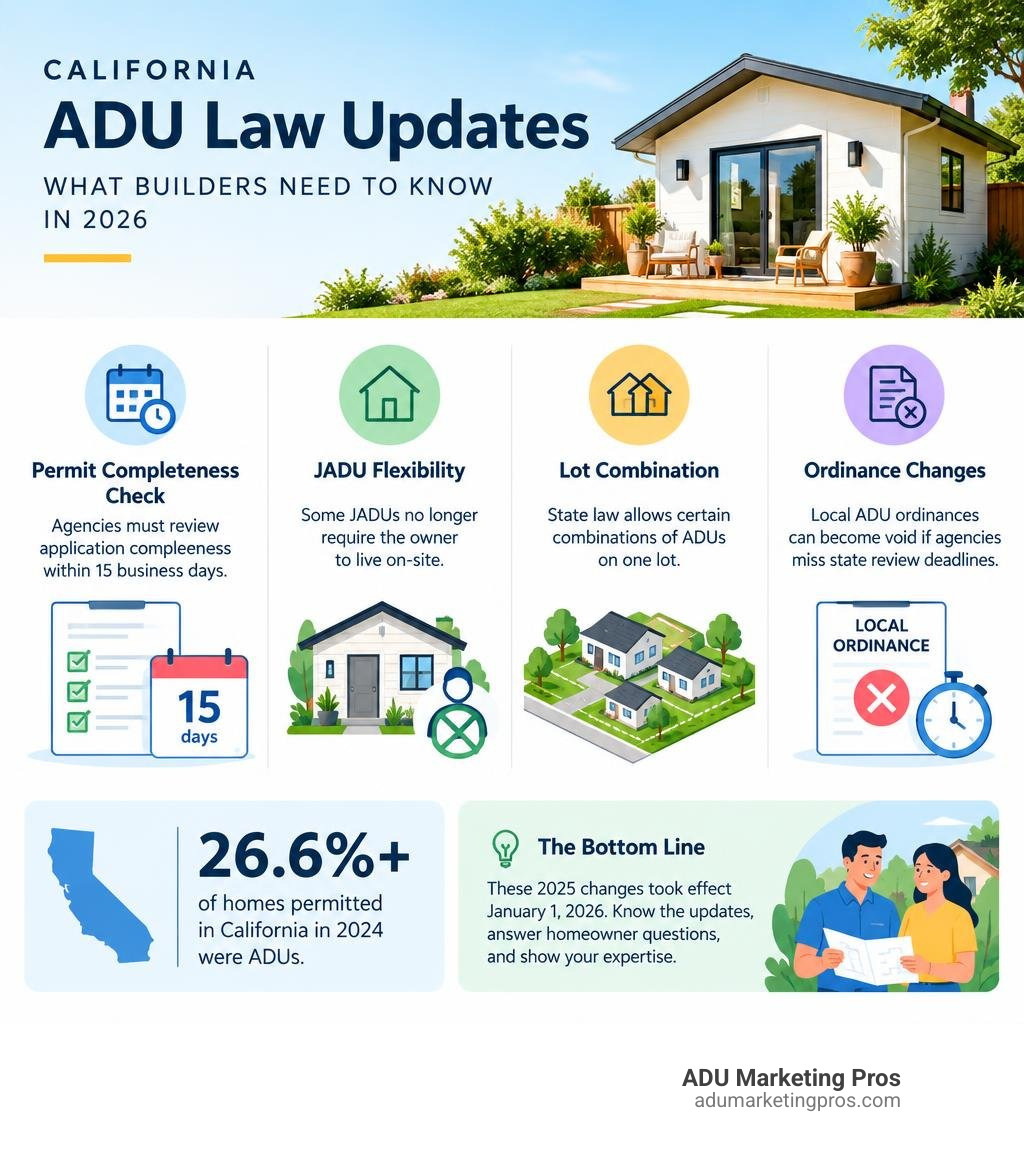
The new ADU laws California enacted in 2025 are now shaping projects in 2026. Builders should know four changes: agencies must check application completeness within 15 business days; some JADUs no longer require the owner to live on-site; state law expressly allows certain combinations of ADUs on one lot; and local ADU ordinances can become void if agencies miss state review deadlines. Most of these changes took effect January 1, 2026.
The market is worth watching: ADUs made up more than 26.6% of homes permitted statewide in 2024, according to California’s ADU Handbook. For builders and architects, clear answers to homeowner questions can show expertise before the first sales call.
I’m Jock Breitwieser, and this guide breaks down the updates worth putting in your sales toolkit.
Quick New ADU laws California terms:
Navigating the New ADU Laws California Builders Must Master in 2026
California’s housing supply crisis has driven the most ambitious zoning and land-use transformations in modern American history. Between 2016 and 2022, the volume of ADUs permitted annually skyrocketed by 15,334%, totaling 83,865 units during that span. Permitting momentum expanded further through 2024, surging from 1,336 permits in 2016 to 30,354 permits statewide—a 20-fold rise that cemented ADUs as more than one-quarter of California’s residential building pipeline.
To organize this legislative wave, the state recodified its core ADU statutes under SB 477, relocating them from scattered sections into a dedicated chapter: California Government Code Sections 66310 through 66342. This structural renumbering gives contractors, architects, and planning professionals a centralized, unified statutory framework for all secondary unit regulations statewide.
Mastering the mechanics of navigating California ADU laws is no longer just a technical necessity for planning desks—it is the ultimate sales closing tool. When your design-build firm proves to a hesitant homeowner in San Jose, Palo Alto, Los Angeles, or San Diego that municipal gatekeepers cannot arbitrarily block their project, trust is established instantly. Homeowners routinely approach builders burdened with fears of bureaucratic red tape, unexpected multi-year review delays, and hostile planning commissions. When builders demonstrate fluency in state preemption, those sales objections dissolve.
Under the ACCESSORY DWELLING UNIT HANDBOOK March 2026 issued by the California Department of Housing and Community Development (HCD), the state has expanded the statutory authority of its Housing Accountability Unit. HCD directly polices local planning departments to prevent unlawful delays, giving builders the legal backing necessary to move projects forward swiftly. When prospective clients ask whether their city can stonewall their construction, position this state oversight directly in your consultations: explain that local building departments are strictly bound by state mandates, backed by state enforcement units that discipline non-compliant jurisdictions.
How New ADU Laws in California Streamline Permitting and Approval Timelines
Permitting gridlock has long been the primary friction point causing homeowners to cancel contracts or delay signing design agreements. New legislation directly dismantles municipal foot-dragging by standardizing strict review benchmarks under SB 543 and AB 1332.
The review rules under SB 543 establish concrete timeframes across every stage of the application workflow:
- 15-Business-Day Completeness Review: Within 15 business days of application receipt, the local agency must provide a formal determination of completeness. If deemed incomplete, the planning official must deliver an itemized list detailing every missing element with explicit statutory explanations.
- 15-Business-Day Resubmittal Review: Once an applicant submits revised plans addressing the specified deficiencies, the agency has only 15 business days to review the resubmittal.
- 60-Day Ministerial Approval Shot Clock: Agencies must ministerially approve or deny a complete application for an ADU or JADU within 60 calendar days without subjective design hearings or discretionary reviews.
- 30-Day Fast-Track for Pre-Approved Plans: Under AB 1332, municipalities must establish a pre-approved ADU plan registry. Utilizing these plans cuts the agency’s mandatory ministerial review window down to just 30 days.
- 60-Business-Day Appeal Process: If a building department issues an improper denial or completeness rejection, applicants can invoke a standardized appeal process yielding a final written decision within 60 business days.
In your initial discovery calls, integrate these exact statutory turnarounds into your pitch on California ADU permits. Highlighting these statutory clocks provides clients with genuine confidence in your delivery timelines. When homeowners ask, “How long will permitting take?”, turn their anxiety into a sales conversion point by presenting an exact, visual permit milestone timeline backed by Government Code Section 66314.
Invalidation Penalties for Non-Compliant Local Ordinances Under SB 9
Historically, restrictive jurisdictions attempted to curb backyard development by delaying updates to their local ADU ordinances or passing restrictive local rules that clashed with state legislative intent. The passage of SB 9 (Chapter 510, Statutes of 2025) amended California Government Code Section 66326 to strip bad-faith jurisdictions of their regulatory discretion.
As detailed in the official Bill Text – SB-9 Accessory Dwelling Units: ordinances., cities and counties must submit copies of newly adopted local ADU ordinances to HCD within 60 days of passage. If state regulators issue written findings indicating the ordinance violates state law, the local government has a strict 30-day cure window to either amend the language or adopt a detailed justification resolution.
If the city fails to comply within 30 days, the local ADU ordinance is rendered null and void by operation of state law. When an ordinance is voided, the jurisdiction cannot enforce its local restrictions and must process all applications under California’s baseline statutory standards. Educating your clients on how to master California ADU zoning laws proves that uncooperative local councils cannot unilaterally override state-mandated property rights.
When prospective clients express concern that their local city council or neighborhood HOA is notoriously anti-ADU, leverage this in your marketing collateral. Create localized case studies and email nurture sequences illustrating how state law preempts local opposition, reassuring prospects that their permits cannot be denied due to municipal politics.
Key Property Standards: Unit Sizes, Impact Fee Exemptions, and Sprinkler Rules
The latest revisions clarify the core architectural standards governing standard accessory units versus Junior ADUs (JADUs), establishing predictable statewide baselines for site planning, structural dimensions, and municipal utility charges.
A major point of clarity under SB 543 is the explicit statutory definition of square footage as interior livable space, which excludes exterior framing, overhangs, and unfinished utility closets. This enables architects to maximize usable floor plans while remaining compliant with California ADU requirements. By calculating square footage from interior finished surfaces, design teams can provide clients with larger living areas, expanded kitchen layouts, and functional multi-bedroom options within statutory size caps.
Development impact fees remain fully exempt on all ADUs under 750 square feet. For units of 750 square feet or greater, local fees must be charged proportionally against the square footage of the primary home. Furthermore, SB 543 clarified that all ADUs and JADUs measuring 500 square feet or less of interior livable space are completely exempt from school impact fees statewide. When homeowners ask, “How much will city fees add to my build budget?”, ADU firms should leverage these exemption tiers in sales consultations by modeling precise fee comparisons between a 749-square-foot model and an 800-square-foot model, positioning your firm as a cost-optimizing partner.
JADU Owner-Occupancy and Short-Term Rental Mandates Under AB 1154
Junior Accessory Dwelling Units—defined as units of no more than 500 square feet contained entirely within the footprint of an existing or proposed single-family home or attached structure—have received critical updates under AB 1154.
- Targeted Owner-Occupancy Rules: Owner-occupancy is now only mandatory if the JADU shares sanitation facilities (a bathroom) with the primary home. If the JADU incorporates its own private bathroom, the owner is free from any requirement to live on-site.
- Standard ADU Freedom: Under AB 976, standard attached and detached ADUs remain permanently free of owner-occupancy requirements.
- Short-Term Rental Bans: State law maintains that ADUs approved under Section 66323 and all JADUs must be rented for terms longer than 30 consecutive days, protecting neighborhood long-term rental stock.
When pitching real estate investors or multi-generational families in areas like San Jose, Sunnyvale, or Los Angeles, utilize these nuances to showcase how clients can rent out both the main house and an independent JADU simultaneously without living on the parcel. In your lead magnets and investor webinars, feature financial calculators demonstrating dual-rental cash flow yields under the updated AB 1154 guidelines.
Fire Sprinkler and Utility Triggers for Single-Family and Multifamily Builds
Confusion regarding fire safety requirements often derails early-stage customer discussions and causes budget panic. Official technical bulletins issued by CAL FIRE and the Office of the State Fire Marshal (OSFM) provide unambiguous guidelines for builders and building officials:
- No Retrofit Triggers: Constructing an attached or detached ADU cannot trigger a mandate to retrofit fire sprinklers into an existing primary home.
- Sprinkler Parity Rule: Fire sprinklers are only required inside the ADU if the primary residential structure already contains an active fire sprinkler system.
- Occupancy Continuity: The addition of an ADU does not change an existing structure’s Group R occupancy classification from R-3 to R-2 without specific, written life-safety findings based on substantial evidence.
- Access and Utilities: All new builds must comply with standard local emergency access and water supply requirements, but utility providers cannot charge unreasonable connection or capacity fees for conversion units.
Incorporate these clear fire safety parameters into your initial consultation deck to reinforce your command of California ADU regulations. When prospects ask, “Will building an ADU force me to spend tens of thousands retrofitting sprinklers into my main house?”, use this statutory clarity in your proposal presentations to immediately eliminate a major financial objection and accelerate contract signings.
Maximizing Density: Multi-Unit Combinations, Condo Conversions, and Unpermitted Amnesty
Maximizing allowable unit counts on residential lots creates compelling upsell opportunities for builders. SB 543 formally codified stacking permissions under Government Code Section 66323, providing clear mathematical formulas for parcel densification.
On standard single-family residential parcels, builders can legally deliver a triplex configuration by combining:
- One converted ADU (within existing garage or house envelope),
- One interior JADU (up to 500 square feet), and
- One brand-new detached ADU (up to 800 square feet with 4-foot setbacks and 16 to 18-foot heights).
For multifamily properties, SB 1211 expanded building allowances. Property owners can convert existing interior non-livable spaces (such as storage rooms, basements, or carports) into ADUs up to 25% of the total existing unit count. In addition, owners can construct up to eight detached ADUs on parcels with existing multifamily dwellings, capped only by the total number of primary units already on the property.
Furthermore, state law prevents cities from imposing replacement parking mandates when garages, carports, or uncovered parking spaces are converted into ADUs. Reference our comprehensive breakdown of California ADU parking requirements when discussing site layout options with prospective clients. When multifamily property owners ask how they can optimize rental yield on underutilized parking areas, package SB 1211 multi-unit ADU site assessments into high-value feasibility proposals.
AB 1033 Separate Condominium Sales and Local Adoption Status
One of California’s most transformative legislative shifts is AB 1033, which enacted Government Code Section 66342 to allow the separate sale of ADUs as condominiums.
While state law establishes the legal mechanism for separate conveyance, local adoption remains the gating factor. A growing number of forward-thinking jurisdictions have adopted local implementing ordinances, including:
- San Jose (the state’s pioneer municipality adopting its ordinance in June 2024),
- City of San Diego and unincorporated San Diego County,
- Berkeley, San Francisco, Santa Monica, San Pablo, and Sebastopol.
Executing separate condo sales requires adherence to the Subdivision Map Act, creation of a formal Homeowners Association (HOA), and obtaining explicit approvals from existing mortgage lienholders. Builders who highlight California ADU incentives alongside condo conversion pathways can unlock high-margin opportunities for clients looking to build for family or cash out equity.
When homeowners ask, “Can I build an ADU and sell it separately from my house?”, ADU firms operating in adopting cities should create dedicated landing pages and sales collateral outlining the condo mapping process. Position your company as a turnkey developer capable of handling both architectural construction and subdivision coordination.
AB 2533 Amnesty Protocols for Unpermitted Pre-2020 Units
Thousands of unpermitted garage conversions and backyard structures exist across regions like Los Angeles, the Inland Empire, and the San Francisco Bay Area. Under AB 2533, the state significantly broadened legal amnesty for these structures:
- Qualifying Construction Window: Covers unpermitted ADUs and JADUs constructed prior to January 1, 2020.
- Mandatory Legalization Standard: Local agencies cannot deny a permit to legalize an unpermitted pre-2020 structure solely based on non-compliant zoning or building code infractions, unless the jurisdiction proves the condition poses a substandard life-safety hazard.
- Code Enforcement Protections: Agencies are prohibited from levying punitive inspection fines while a property owner is actively seeking legalization.
When property owners ask how to resolve code enforcement notices or legalize an inherited bootleg unit, ADU design-build firms should offer structured “Amnesty Feasibility Audits.” Promote these packages across localized search campaigns to capture high-intent homeowners seeking code compliance and structural modernization.
Specialized Opportunities: Coastal Zones and Disaster Recovery Rebuilding
Special regional frameworks create lucrative niches for experienced contractors. Recent legislation provides accelerated pathways within coastal overlays and disaster-affected zones, as highlighted when Governor Newsom Signs Four New Accessory Dwelling Unit Bills.
Leveraging New ADU Laws California Enacted for Coastal and Disaster Zones
Under AB 462, two major regulatory roadblocks were resolved:
- Coastal Development Permit (CDP) Streamlining: In coastal areas governed by a certified Local Coastal Program (LCP), local planning agencies must process and decide completed ADU CDP applications within a strict 60-day shot clock. Furthermore, direct administrative appeal rights to the California Coastal Commission for compliant ADUs have been eliminated.
- Disaster Recovery Rebuilding Exemption: Detached ADUs are now legally permitted to receive a final Certificate of Occupancy before the primary residence is fully rebuilt, provided the primary residence was substantially damaged or destroyed in a Governor-declared state of emergency on or after February 1, 2025.
Contractors serving high-cost coastal markets or communities affected by wildfires can market ADUs as permanent, fast-tracked interim housing solutions. When displaced homeowners or coastal property owners ask whether complex environmental reviews will stall their secondary dwelling, highlight these AB 462 statutory exemptions in your marketing campaigns and local community workshops to capture high-urgency rebuild contracts.
Frequently Asked Questions About Recent California ADU Legislation
How do the latest California ADU laws affect detached garage conversions?
Under Government Code Section 66323, converting an existing detached garage into an ADU is protected by automatic ministerial approval. Local agencies cannot enforce side or rear setbacks beyond existing physical dimensions, cannot require replacement vehicle parking, and must process structural demolition permits concurrently with the ADU building permit.
What ADU firms should do in sales and marketing: When homeowners ask about converting their garage, emphasize in your consultations that they will not lose property utility or face parking replacement penalties. Create targeted “Garage Conversion Quick-Start Guides” in your marketing funnels to capture homeowners seeking cost-effective secondary living space.
Can builders construct both an attached JADU and a detached ADU on the same lot?
Yes. Under SB 543 and Government Code Section 66323, single-family residential parcels are entitled to construct both an interior JADU (up to 500 square feet) within the primary home’s footprint and a newly constructed detached ADU (up to 800 square feet with 4-foot rear and side setbacks and height limits of 16 to 18 feet).
What ADU firms should do in sales and marketing: When prospects inquire about maximizing their lot potential, present a “Triplex Density Consultation” showing how pairing an interior JADU with a detached ADU doubles their rental cash flow. Use 3D site-plan renderings in sales pitches to illustrate how both units fit comfortably on standard residential parcels.
What happens if a local city council rejects an ADU application based on subjective design guidelines?
State law mandates that local jurisdictions evaluate ADU applications solely against objective, measurable development standards. If a local agency issues a denial based on subjective preferences or fails to provide an itemized statutory justification within 60 calendar days, the builder or homeowner can file a formal complaint with the HCD Housing Accountability Unit and initiate a formal appeal.
What ADU firms should do in sales and marketing: When a hesitant prospect asks if their city can arbitrarily reject their design, assure them in your sales deck that state law strictly limits municipal discretion. Highlight your firm’s track record of navigating state preemption rules to position your team as fearless regulatory advocates.
Conclusion
Closing high-value custom ADU projects requires more than standard architectural renderings—it demands complete regulatory mastery. When your team can clearly explain how SB 543 accelerates permitting, how AB 1154 unlocks new JADU rental options, and how SB 9 prevents local overreach, prospective clients see you as a trusted advisor rather than just another contractor.
At ADU Marketing Pros, we focus exclusively on helping ADU builders and architects turn their technical and regulatory expertise into consistent revenue growth. Located in San Jose, we help design-build firms across California stand out in an increasingly crowded market through specialized positioning, authority-building content, and high-intent customer acquisition.
Ready to dominate your local market and sign more design-build clients? Partner with ADU Marketing Pros and explore our proven specialized ADU marketing strategies today.