
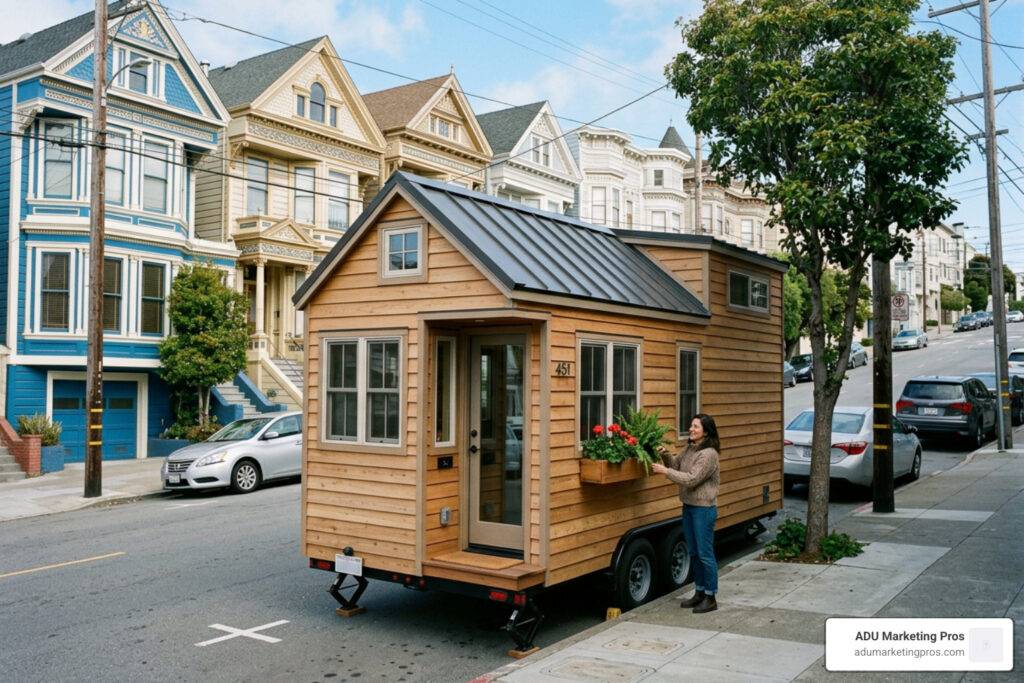
Why San Francisco Tiny Houses Are Changing the Way the City Thinks About Space
San Francisco tiny houses are no longer a fringe idea — they’re one of the most talked-about housing solutions in a city where the average rent tops $3,000 a month and nearly 8,000 adults experience homelessness on any given night.
Here’s a quick look at the main tiny house options in San Francisco:
| Type | Who It’s For | Example | Typical Cost |
|---|---|---|---|
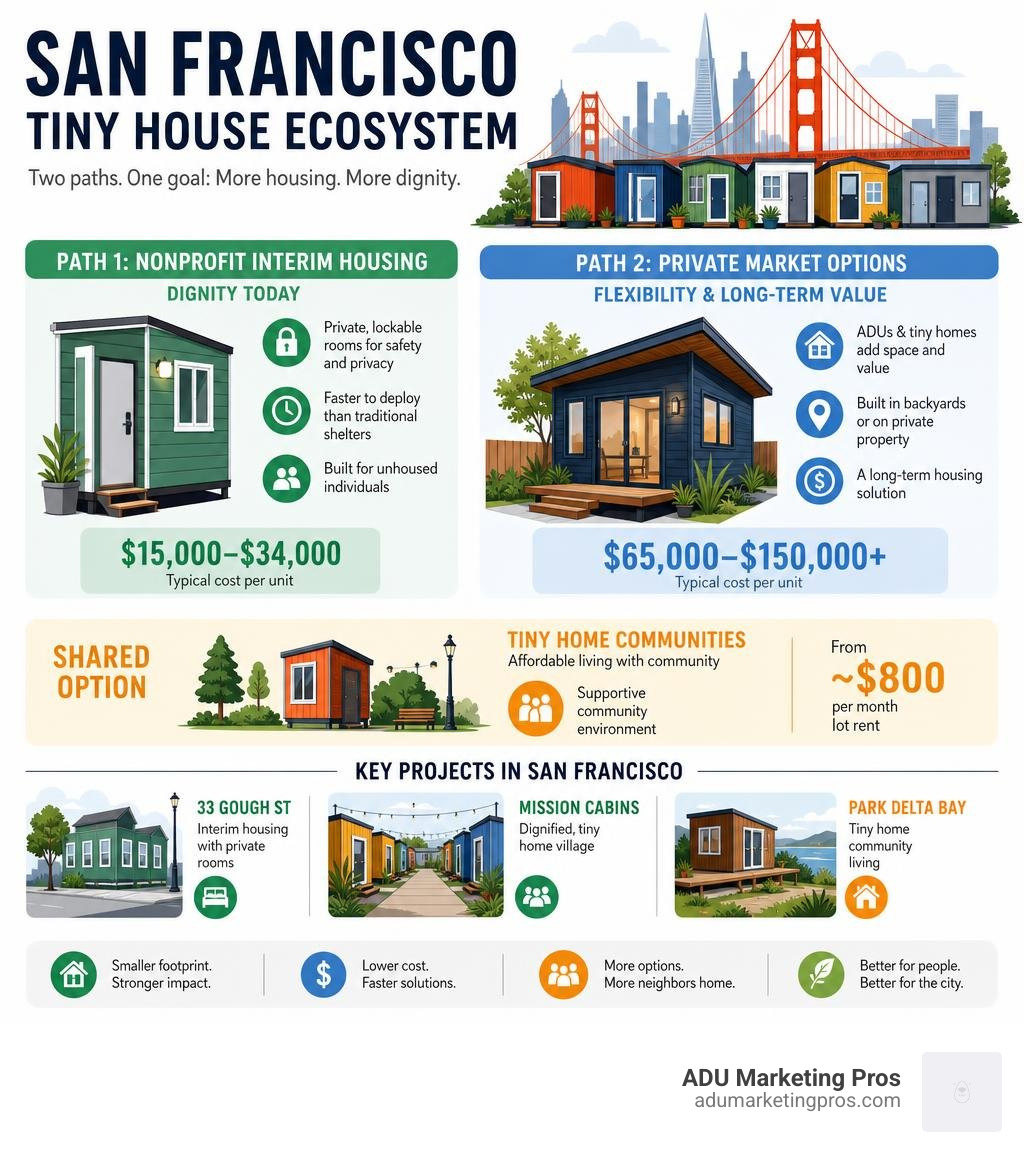
| Nonprofit interim housing | Unhoused individuals | 33 Gough St, Mission Cabins | $15,000–$34,000/unit |
| Private-market tiny homes | Homeowners, renters | Backyard ADUs, THOWs | $65,000–$150,000+ |
| Tiny home communities | Budget-conscious residents | Park Delta Bay | From ~$800/month lot rent |
San Francisco has been quietly running two very different experiments with small-footprint living — one aimed at ending street homelessness, and one aimed at giving homeowners and renters more affordable options in one of the world’s most expensive cities.
On one side, nonprofits like DignityMoves have built villages of private, lockable rooms as a faster and cheaper alternative to traditional congregate shelters. On the other, private builders and ADU developers are helping homeowners unlock the value of underused backyard space with compact, code-compliant structures.
Both worlds share the same core idea: you don’t need a lot of square footage to live with dignity.
Twenty-three years ago, tiny homes as a housing policy were considered a fringe concept. Today, San Francisco has multiple operating villages, a growing ADU market, and real data on what works — and what doesn’t.
Easy san francisco tiny houses glossary:
- are tiny houses legal in california
- tiny homes with land for sale in california
- tiny house land for sale in california
The Dual Landscape of San Francisco Tiny Houses
In our work at ADU Marketing Pros, we closely monitor how local municipalities adapt to density. In San Francisco, the tiny house movement has branched into two distinct, parallel tracks. The first is a rapid, nonprofit-led response to the homelessness crisis, utilizing modular, temporary units to create safe, interim shelter. The second is the private residential market, where homeowners use backyard cottages and accessory dwelling units (ADUs) to maximize their property value and create multi-generational living spaces.
Understanding the difference between these two tracks is crucial. While both utilize small-footprint architectural design, they operate under completely different regulatory, financial, and structural frameworks. If you are exploring how micro-living fits into the local landscape, check out our comprehensive guide on More info about tiny house options.
Nonprofit-Led Interim Supportive Housing
The most visible public-facing tiny house projects in the city are temporary, supportive communities designed to bridge the gap between unsheltered homelessness and permanent housing. Organizations like DignityMoves have pioneered this model. Rather than forcing individuals into massive, open-layout congregate shelters where privacy is nonexistent, these projects offer individual, lockable cabins.
Projects like the DignityMoves San Francisco Village demonstrate that when unhoused individuals are given a private space with a door that locks, they can stabilize much faster. This interim housing model acts as a dignified stepping stone, offering a secure environment where residents can access case managers, mental health services, and addiction support without the constant survival stress of living on the streets.
Private-Market San Francisco Tiny Houses and ADUs
On the residential side, private-market san francisco tiny houses are taking the form of backyard cottages, detached home offices, and in-law units. As land prices in the San Francisco Bay Area continue to skyrocket, homeowners are realizing that their backyards are goldmines of untapped potential. Building a compact unit on your lot can generate substantial rental income, accommodate aging parents, or provide space for adult children returning home.
Because San Francisco has strict building codes and high seismic safety requirements, many homeowners opt for a permanent, code-compliant Detached ADU San Francisco rather than a tiny house on wheels. These permanent structures blend seamlessly into historic neighborhoods while providing modern amenities. If you’re looking to add a flexible living space to your property, converting a garage or constructing a dedicated In-Law Unit San Francisco is one of the smartest financial investments you can make in today’s market.
Cost-Efficiency and Siting of Tiny House Villages
One of the strongest arguments for scaling tiny house villages is their incredible cost-efficiency compared to traditional municipal projects. Traditional navigation centers and congregate shelters in San Francisco are notoriously expensive to build and operate, often costing the city hundreds of thousands of dollars per bed. Tiny house villages, by contrast, leverage prefabricated modular construction to keep costs remarkably low.
| Metric | Tiny House Village (e.g., 33 Gough) | Traditional Congregate/Navigation Shelter |
|---|---|---|
| Average Cost Per Unit/Cot | $15,000 – $34,000 | $70,000+ |
| Privacy Level | High (Private lockable room) | Low (Open-room bunk beds/cots) |
| Outreach Acceptance Rate | Nearly 100% accepted | ~10% accepted (1 in 10) |
| Key Features | Pets allowed, secure storage, couples accommodated | Pets/storage rarely allowed, couples separated |
Comparing Unit Costs and Project Budgets
The financial data from recent San Francisco projects is eye-opening. The interim supportive housing site at 33 Gough Street, built by DignityMoves in partnership with Tipping Point and the city, provides 70 private rooms. The construction cost per cabin was just $34,000. Even when you factor in the extensive site preparation, utility hookups, and shared community facilities, the total project cost came out to $332,000 per unit. While that might sound high at first glance, it is a fraction of the cost of building permanent supportive housing or traditional city-led navigation centers, which frequently exceed $700,000 per unit in the Bay Area.
Similarly, the BOSS Cubez Mission Cabins project in the Mission District provides 60 tiny home units housing up to 68 adults. The individual cabins cost approximately $15,000 to construct, with the total project budget—including shared restrooms, laundry facilities, community spaces, and security infrastructure—averaging about $30,000 per person. By utilizing flat-packed modular panels, these projects can be assembled rapidly, saving months of expensive labor.
Siting and Zoning Challenges for San Francisco Tiny Houses
Finding land for tiny house villages in a dense, built-out city is a massive challenge. To circumvent this, developers and city officials look for underutilized spaces, such as vacant commercial parking lots, parcels slated for future development that are currently sitting empty, or transit-adjacent land. For example, the Mission Cabins site was built on a former parking lot behind the 16th Street BART station.
To address zoning and regulatory hurdles, California allows cities to declare a “shelter crisis,” which waives certain non-safety building code reviews and streamlines the permitting process. This allows temporary villages to be set up on leased private land for a designated period (typically 2 to 5 years) before the land is reclaimed for permanent development.
For private homeowners looking to build in their backyards, navigating these rules is different but highly feasible. State laws have significantly eased zoning restrictions, making it much simpler to build a Granny Flat San Francisco without needing discretionary zoning approvals.
Operational Models, Services, and Resident Outcomes
What happens inside a tiny house village is just as important as how it is built. Unlike traditional shelters that simply offer a place to sleep for the night, tiny house villages are designed as therapeutic, trauma-informed environments. By focusing on the psychological needs of individuals who have experienced long-term homelessness, these communities help residents transition from a state of constant survival to one of stability and planning.
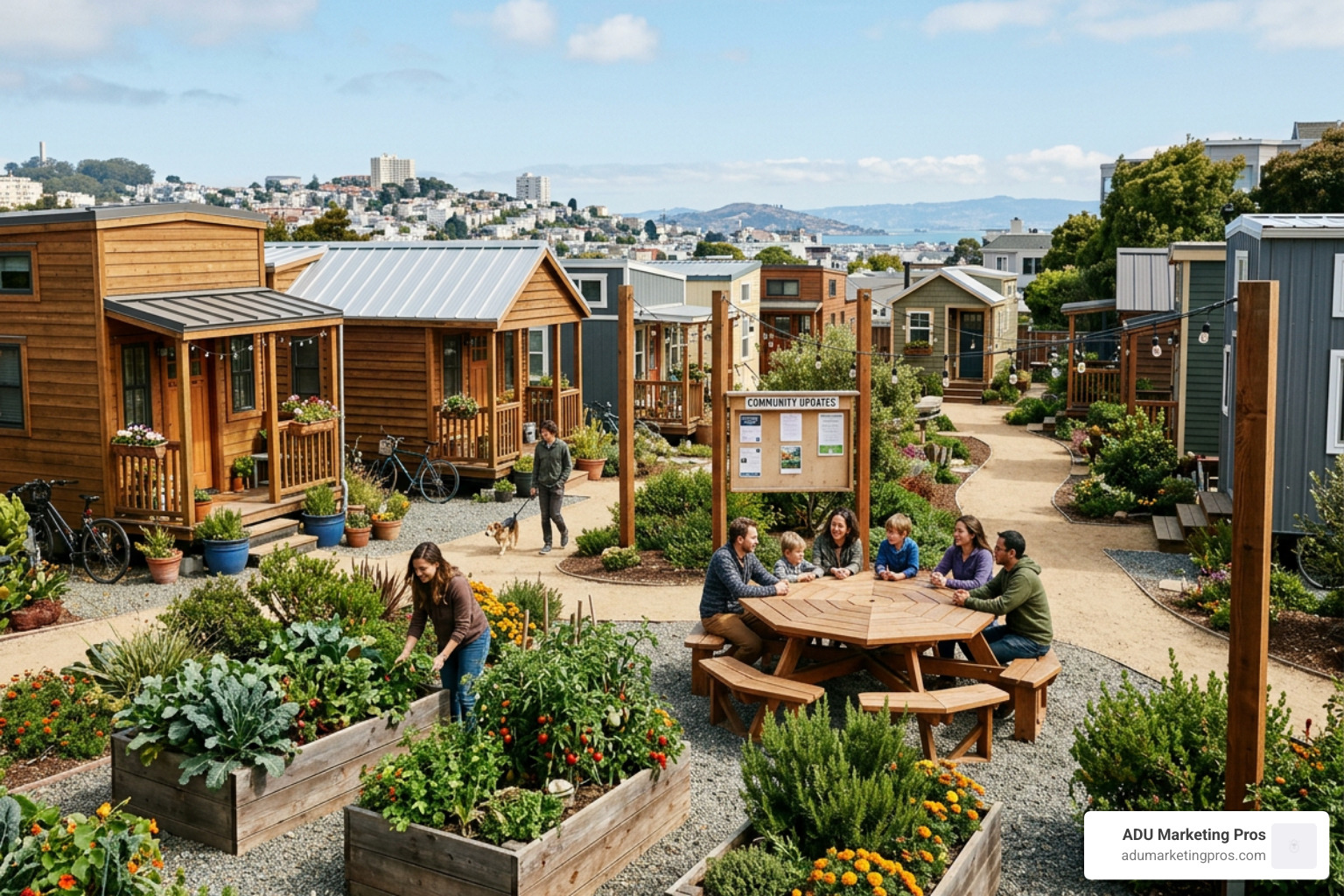
To foster a sense of belonging and support, these communities feature:
- 24/7 On-Site Security: Controlled entry points to ensure safety for all residents and staff.
- Professional Case Management: Dedicated social workers helping residents navigate job searches, medical care, and permanent housing.
- Shared Community Spaces: Dining halls, computer labs, outdoor gardens, and pet relief areas.
- Daily Meal Delivery: Nutritious meals provided directly to residents to ensure food security.
- On-Site Health Services: Mobile clinics providing physical and mental health resources directly to residents.
Dignified Amenities: Pets, Couples, and Storage
Traditional congregate shelters have notoriously low acceptance rates. Street outreach teams report that when they offer a bunk bed in a massive shared warehouse shelter, only about 1 in 10 people accept. The reasons are simple: traditional shelters rarely allow residents to bring their pets, force couples to separate into gender-segregated dorms, and offer almost no secure storage for personal belongings. For many unhoused individuals, their pet is their primary source of emotional support, and their partner is their only source of safety. Asking them to abandon these connections is often a non-starter.
According to the SFist Mission Cabins Report, the tiny house model directly addresses these pain points. Because each cabin is private and lockable, residents can keep their pets with them, couples can stay together in double cabins, and personal belongings can be locked away safely. At DignityMoves sites, outreach workers report that virtually no one turns down an offer for a private cabin. The sense of security and ownership over one’s space is a game-changer for individuals recovering from the trauma of living unsheltered.
Transition Success and Permanent Housing Pathways
The ultimate goal of interim tiny house villages is to help residents transition into permanent housing. The model is not designed as a permanent address, but rather as a highly effective stabilization runway. The average stay in these communities ranges from 30 to 180 days, though some residents remain up to eight months depending on their specific needs and the availability of permanent housing.
The outcomes speak for themselves. At the 33 Gough Street project, which opened in March 2022, over 250 people have moved through the community. Data shows that approximately one-third of residents successfully reunite with family or friends and reenter the traditional housing market after stabilizing. Another third transition into permanent supportive housing, while the remaining residents continue to work with case managers to find stable pathways forward. This multi-tiered success rate proves that when individuals are given a stable foundation, they can successfully navigate the path back to permanent housing.
For those looking to transition into independent, small-scale living on the private market, exploring Tiny Homes Bay Area for Sale is an increasingly popular next step.
Regulatory, Political, and Scaling Barriers
If tiny houses are so cost-effective and successful, why aren’t we building them on every empty lot? The reality is that scaling these projects in San Francisco requires navigating a complex minefield of regulatory, political, and labor challenges. While the benefits of micro-living are clear, the execution requires overcoming deeply entrenched systemic hurdles.
The Challenge of Neighborhood Opposition (NIMBYism)
First, neighborhood opposition—often referred to as NIMBYism (Not In My Backyard)—can be intense and politically organized. Even when projects are explicitly designed to transition people off the streets and into managed, safe environments, local residents and parent groups often raise concerns about safety, property values, and proximity to schools. For instance, the Mission Cabins project faced significant pushback from parents at nearby Marshall Elementary School. This friction resulted in the city installing large, obscure black gates around the facility to manage neighborhood concerns, secure the perimeter, and maintain a visual barrier between the community and the school.
Overcoming this opposition requires extensive community outreach, transparent communication, and real-world data showing that managed tiny home villages actually improve neighborhood safety and cleanliness compared to unmanaged street encampments.
Labor Standards and Construction Compliance
Second, labor and construction standards play a major role in project timelines and budgets. While tiny homes can be flat-packed and shipped easily from out-of-state manufacturers, assembling them within San Francisco’s jurisdiction requires strict compliance with local labor standards and prevailing wage laws. Successful projects have navigated this by partnering with local trade unions, ensuring that modular units are installed using skilled union labor. This collaboration not only ensures high-quality construction but also helps secure the political support necessary to move public projects forward through the city’s complex approval channels.
Navigating Private Backyard Regulations
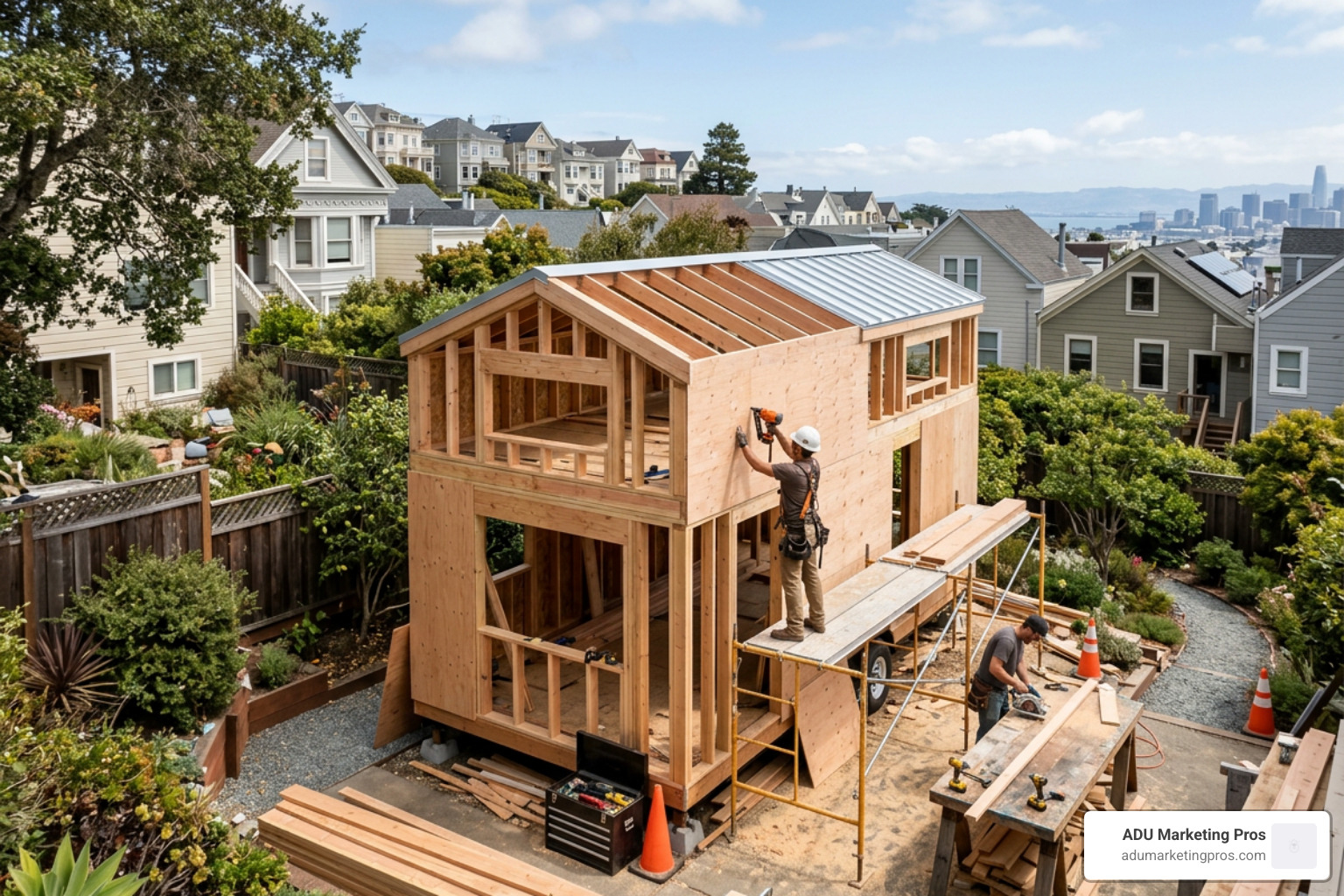
Additionally, navigating the building code for private backyard projects requires specialized expertise. Homeowners must deal with strict setback requirements, utility connection fees, and seismic safety standards that are unique to the Bay Area. If you’re a homeowner looking to build, finding the right builder is essential to avoid costly delays and code violations. Our Tiny House House Builders in the Bay Area Guide is a great resource to help you find qualified professionals who understand local regulations and can streamline the permitting process.
Frequently Asked Questions about San Francisco Tiny Houses
Can you legally live in a tiny house in San Francisco?
Yes, but the legality depends entirely on the type of tiny house and where it is located. Permanent tiny houses built on a foundation are legal as ADUs, provided they comply with local building codes, seismic standards, and setback requirements.
Tiny houses on wheels (THOWs) are more heavily regulated. In many parts of the Bay Area, parking a tiny house on wheels as a permanent residence is restricted unless it is located in a designated RV park or meets specific local ordinances that allow for movable tiny homes as ADUs. To ensure compliance, many builders design units to meet RVIA (Recreational Vehicle Industry Association) standards. For a deep dive into the local legal landscape, read our guide on Unlocking the Bay Area’s Tiny Home Scene.
Other legal projects, such as San Jose’s first tiny home village on private land, show how neighboring cities are also adjusting zoning laws to accommodate these innovative communities. If you are exploring options in nearby cities, you can check out Tiny Houses & Homes For Sale In Mountain View or look into the Halcyon Stay in Palo Alto for inspiration on high-end micro-living.
How much does it cost to build a tiny home in San Francisco?
For private homeowners, the cost to build a tiny home or backyard ADU in San Francisco typically ranges from $65,000 to over $150,000. Custom, high-end models—such as “The Val” by Tonys tiny homes which features downstairs sleeping, full-size kitchens, and NOAH safety certification—start around $65,000 before delivery and site prep.
If you are looking for a permanent backyard addition, choosing Prefab Homes San Francisco Bay Area can help keep costs predictable by minimizing on-site construction delays.
What is the difference between a tiny home and an ADU?
The primary difference lies in the foundation and the building code. A tiny home can be built on wheels (making it technically a recreational vehicle) or on a temporary foundation. An Accessory Dwelling Unit (ADU) is a permanent structure built on a concrete slab or pier-and-beam foundation that is permanently tied to the primary home’s utility connections.
ADUs must comply with the California Building Standards Code (including strict Title 24 energy efficiency and seismic rules), whereas tiny homes on wheels must meet RVIA safety standards. Because of these differences, ADUs add permanent appraised value to your property and are subject to property taxes, while movable tiny homes are typically taxed as personal property or vehicles. If you’re ready to design a permanent solution for your yard, working with experienced ADU Builders San Francisco Bay Area is the best way to ensure your project is built to last and fully compliant.
For those interested in unique designs, you can also read about the Mighty House: A new ‘tiny home’ for Bay Area’s exorbitant market.
Conclusion
Whether we are looking at the inspiring success of interim supportive housing projects like 33 Gough Street and Mission Cabins, or the thriving market for backyard cottages, tiny houses have proven they are here to stay. By rethinking how we use land, lower construction costs, and prioritize human dignity, San Francisco is showing the rest of the country that micro-living is a powerful tool for building a more flexible, inclusive, and resilient city.
As the city continues to evolve, the integration of both public supportive villages and private accessory dwelling units will be critical to addressing the housing shortage from multiple angles. These small-footprint structures represent more than just architectural trends; they are practical, scalable solutions to some of the most pressing urban challenges of our time.
At ADU Marketing Pros, we are proud to support the builders, architects, and innovators who are bringing these vital housing solutions to life. We specialize in helping ADU construction and design firms stand out in a highly competitive market, showcasing their technical expertise and driving high-quality leads to grow their businesses.
If you’re an ADU builder or architect looking to scale your operations in the San Francisco Bay Area, San Jose, Los Angeles, or San Diego, let’s work together to build your brand. Explore our tailored ADU Marketing Solutions today and let’s make a big impact together.