
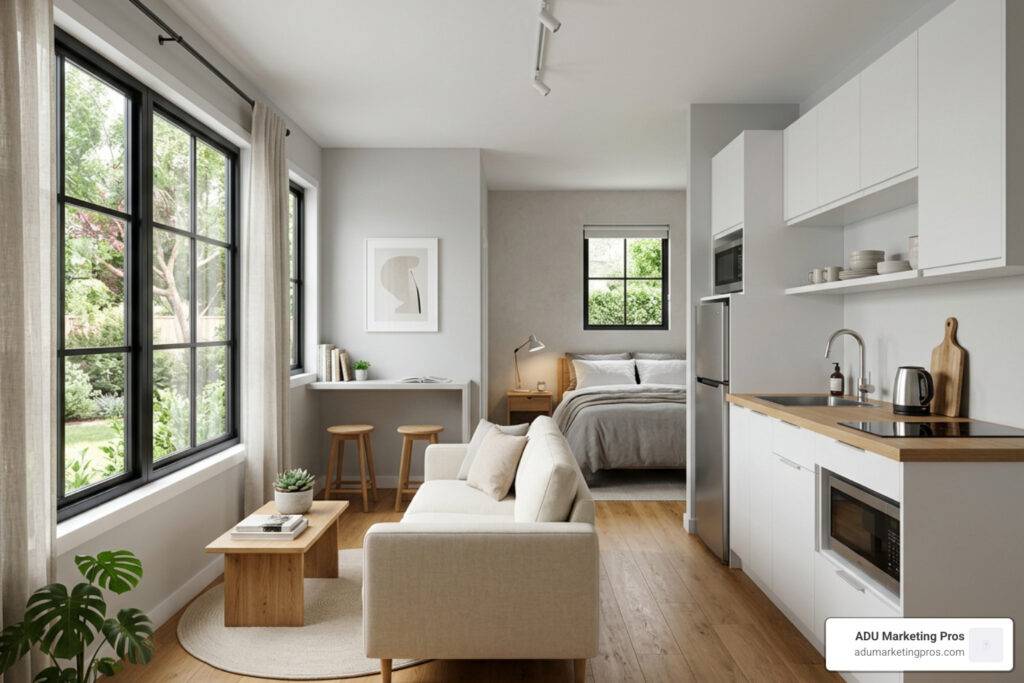
Why a 30 sqm Granny Flat Might Be the Smartest Small Build You’ll Ever Do
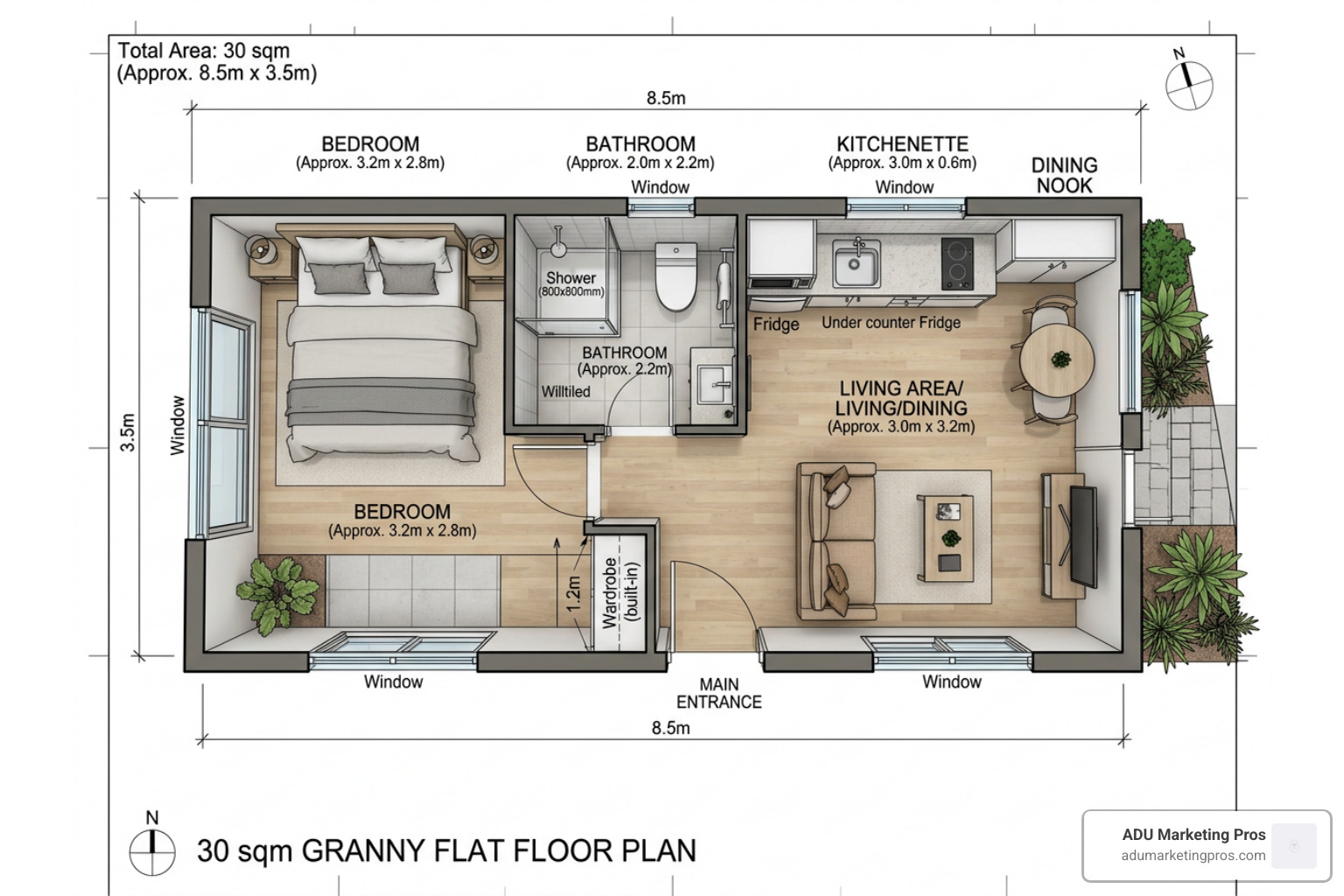
A 30 sqm granny flat is a self-contained secondary dwelling with a footprint of roughly 30 square metres — typically around 7,500mm long by 4,000mm wide. It fits one bedroom, a compact bathroom, a kitchenette, and a small living area all within a single, efficient layout.
Here’s what you need to know at a glance:
- Size: ~7.5m x 4.0m (30 square metres of internal floor space)
- Layout: One bedroom (separate from living area), bathroom, kitchenette, and living zone
- Cost: Roughly $80,000–$120,000 to build in Australia (basic build)
- Best for: Rental investment, elderly relatives, students, home offices, or guest accommodation
- Approval: Requires building permits; rules vary by council and state
- Key advantage: Most affordable entry point for a standalone secondary dwelling
Thirty square metres doesn’t sound like much. But done right, it’s enough space to live, work, sleep, and cook — without feeling like you’re camping.
The challenge isn’t the size itself. It’s knowing how to use every centimetre of it.
This guide walks you through everything: floor plans, real costs, legal requirements, smart design tricks, and the best use cases for a compact build like this. Whether you’re an investor looking for the most affordable secondary dwelling to add to a property, or a builder helping clients maximise a tight block, this is where to start.
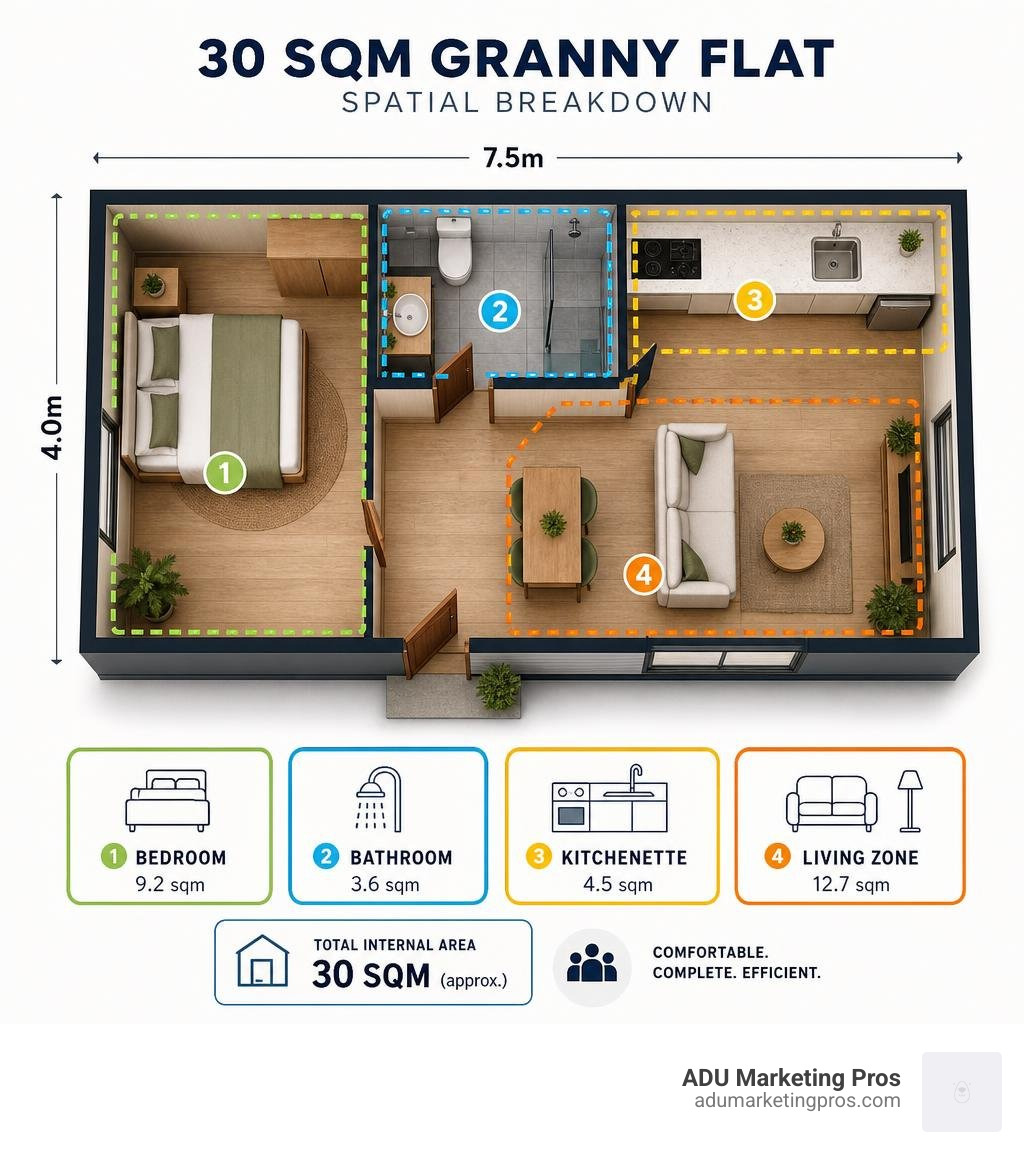
To make the most of this compact footprint, it helps to explore the best granny flat designs available today. Depending on your property layout, you might choose a freestanding structure or an attached granny flat to share existing walls and utilities. Working with a specialized granny flat architect can ensure you maximize every square inch while meeting all local zoning and building codes.
Understanding the 30 sqm granny flat: Dimensions and Comparisons
When we talk about small-space living, terminology can get a little crowded. In California, particularly in high-demand areas like Los Angeles, San Diego, and the San Francisco Bay Area, these structures are legally known as Accessory Dwelling Units (ADUs). Whether you call it a secondary dwelling, an in-law suite, a tiny home, or a 30 sqm granny flat, we are talking about a compact footprint of roughly 322 square feet.
Historically, spaces of this size were treated as simple micro-apartments or backyard storage sheds. However, the modern tiny home revolution has completely transformed how we view small footprints. Today, a 30 sqm layout is often referred to as the “investor special” because it represents the absolute sweet spot of affordability, high rental yield, and ease of construction. It is small enough to fit into almost any standard backyard in San Jose or Sunnyvale, yet large enough to offer a fully independent lifestyle.
To get a clear picture of how this size fits into the broader landscape of secondary dwellings, check out our comprehensive guide to studio layouts.
Comparing Small-Space Footprints
To help you visualise how a 30 sqm unit stacks up against larger options, we have broken down the key differences in the table below:
| Feature | 30 sqm (Approx. 322 sq ft) | 40 sqm (Approx. 430 sq ft) | 60 sqm (Approx. 645 sq ft) |
|---|---|---|---|
| Primary Layout | Compact 1-Bedroom or Studio | Spacious 1-Bedroom | 2-Bedroom / 1-Bath |
| Best Suited For | Students, retirees, single professionals, home offices | Couples, long-term renters | Small families, multi-generational living |
| Yard Space Required | Minimal; fits tight urban lots | Moderate backyard space | Large backyard or corner lot |
| Relative Build Cost | Lowest entry point | Mid-range | Higher investment |
| Construction Complexity | Low; highly compatible with prefab | Low to moderate | Moderate to high |
The Physical Footprint of a 30 sqm Granny Flat
Let’s look at the actual geometry. A typical 30 sqm granny flat is designed with a slightly narrow, rectangular footprint—measuring exactly 7,500 mm (7.5 metres) in length and 4,000 mm (4.0 metres) in width.
This specific aspect ratio is highly intentional. A width of 4 metres allows the structure to easily navigate narrow side-yards during delivery if you choose a prefabricated model. It also ensures that the building complies with standard setback requirements in cities like Palo Alto and Mountain View, where every inch of backyard space is highly contested.
Because of this narrow shape, the interior design must be linear and highly structured. Rather than having deep, square rooms that can feel dark and cave-like, a long, rectangular layout allows for multiple windows along the side walls, flooding the entire living space with natural light.
If you are curious about how these physical dimensions translate into rapid backyard installation, take a look at our guide on prefab home options.
How 30 sqm Compares to Larger Secondary Dwellings
The most common debate homeowners face is choosing between a true studio layout and a dedicated one-bedroom unit. In a studio, your living room, kitchen, and bedroom all share a single open space. While studios are highly efficient, they lack visual and psychological boundaries. Sleeping, working, and cooking in the exact same spot can feel claustrophobic over time.
The beauty of a 30 sqm granny flat is that it is just large enough to transition from a studio into a genuine one-bedroom home. By dedicating a separate space for the bedroom—even if it is partitioned by a sliding barn door or a partial privacy wall—you instantly elevate the living experience. The living room is freed from serving as a sleeping space, allowing residents to host guests without feeling like they are inviting them into their bedroom.
This separation of zones makes the 30 sqm model incredibly attractive to long-term tenants, such as graduate students in Stanford or retirees in Menlo Park, who demand privacy but do not need massive amounts of square footage.
To explore how creative floor plans can make small spaces feel twice their actual size, read more about our innovative granny flat designs.
Smart Floor Plans and Layouts for Compact Living
Designing a highly functional small home is an exercise in editing. In a compact space, you cannot afford to waste a single square inch on dead hallways or oversized entryways. Every square centimetre must serve a clear purpose, and in many cases, multiple purposes.
When we look at world-class small-space architecture, we see a heavy emphasis on soaring ceilings and generous glazing. For instance, the Dandall 30sqm design is a prime example of how a high gable ceiling and wide sliding glass doors can trick the brain into perceiving a small room as incredibly open and airy. By drawing the eye upward and outward toward a backyard garden or patio, the physical boundaries of the walls seem to disappear.
Optimizing the Kitchenette and Living Area
The golden rule of micro-living is to keep the main living zone open-plan. When designing the kitchen, we highly recommend avoiding U-shaped or wrap-around kitchen layouts. While they offer plenty of counter space, they eat up valuable floor area and make the living room feel like it is trapped inside a kitchen.
Instead, opt for a straight-line (linear) kitchenette or a compact L-shaped layout positioned against the far wall. This keeps the center of the room open for traffic.
Here are a few highly effective space-saving furniture strategies to keep in mind:
- Scale Down the Furniture: Oversized, deep-set sectional sofas will swallow a 30 sqm space whole. Choose sleek, apartment-scale furniture with raised legs to keep sightlines clear.
- Multi-Functional Pieces: Look for coffee tables that lift up to become dining tables, or sofas with built-in storage drawers underneath.
- Wall-Mounted Everything: Mount your television, reading lamps, and shelving units directly to the walls to keep your floor area completely clear.
- Fold-Down Desks: If the occupant needs a workspace, a fold-down wall desk can easily tuck away when the workday is done.
For more inspiration on why compact, independent backyard structures are taking over modern neighborhoods, check out our insights on backyard granny pods.
Designing a Separate Bedroom in a 30 sqm Granny Flat
To make a 30 sqm layout truly comfortable for long-term living, the bedroom needs to feel like a private sanctuary. However, standard swing doors require a lot of clearance space to open and close, which can severely limit where you place your bed and wardrobe.
To solve this, we love using cavity sliders (pocket doors) or stylish sliding barn doors. These doors slide parallel to the wall, requiring zero clearance space and allowing you to utilize every square inch of the bedroom floor.
Built-in floor-to-ceiling wardrobes are also non-negotiable in a small bedroom. By extending the storage all the way to the ceiling, you maximize vertical space for seasonal items, luggage, and extra linens.
If you want to see how transportable, timber-framed cabins master the art of built-in efficiency and structural durability, take a look at the innovative layout of the Tiny30 transportable cabin.
The Cost to Build a Compact Secondary Dwelling in 2026
Let’s talk numbers. Budgeting for any backyard build requires a clear understanding of the difference between “sticker price” and the “all-in cost.”
For a basic 30 sqm granny flat, construction costs typically start around $80,000 to $120,000 for a straightforward, entry-level build. However, because our primary service locations include high-cost metropolitan areas like San Jose, Sunnyvale, Palo Alto, and San Francisco, local labor rates, structural engineering requirements, and permitting fees can push these numbers higher.
To get a realistic baseline of pricing models—from basic DIY kits to fully custom architectural designs—explore our granny flat pricing guide. If you are planning a build in Silicon Valley, you will also want to read our detailed breakdown of the cost to build in San Jose.
Cost Breakdown: Basic vs. High-End Custom Builds
When planning your budget, it is helpful to see exactly where your money goes. A typical budget for a mid-range 30 sqm backyard home generally breaks down as follows:
- Site Preparation & Foundations: $15,000 – $25,000 (depending on soil type and yard slope)
- Structural Shell (Walls, Roof, Windows, Doors): $45,000 – $65,000
- Interior Fit-Out (Drywall, Flooring, Paint): $15,000 – $25,000
- Kitchenette & Compact Bathroom: $12,000 – $20,000
- Utility Connections & Council Permits: $8,000 – $15,000
To ensure your small build is highly livable, there are several standard inclusions you should expect from a quality builder:
- Reinforced Foundation: A 100mm engineered concrete slab or heavy-duty steel piers.
- Premium Insulation: High-performance wall and ceiling insulation to minimize heating and cooling costs.
- Durable Roofing: Quality metal roofing (such as Colorbond steel) with integrated gutter systems.
- Double-Glazed Windows: Essential for both thermal efficiency and soundproofing, especially in busy urban backyards.
- Smart Electrical: LED downlights, integrated smoke alarms, and plenty of power outlets with USB ports.
If you are wondering why backyard builds can carry a higher price tag per square foot than larger suburban homes, we dive deep into the logistics in our article on why granny flats are expensive.
Hidden Expenses and Money-Saving Strategies
If you want to keep your project on budget, you must watch out for hidden site costs. The most common budget-buster is site accessibility. If your backyard has a narrow driveway, overhead power lines, or mature trees, a builder may not be able to get standard machinery into the yard. This might require specialized compact equipment or even a crane to lift materials over your main house, which can add thousands to your bottom line.
Another factor is soil condition. If your property sits on reactive clay soil, you may require deeper concrete footings or additional steel reinforcement to ensure the structure doesn’t shift over time.
Fortunately, there are fantastic ways to save money:
- Choose a Standardized Design: Custom architectural plans are beautiful, but opting for a pre-engineered design saves massive amounts of time and money in the engineering phase.
- Use Standard Finishes: Stick to readily available, standard-sized fixtures, cabinetry, and appliances. Custom-sized items always carry a premium price tag.
- Consider Prefabricated Pods: Prefabricated modular units are built in a controlled factory environment, which eliminates weather delays and significantly reduces on-site labor costs.
For a closer look at budget-friendly secondary dwellings that won’t break the bank, check out our guide on affordable backyard granny pods.
Legal Requirements, Approvals, and Zoning Regulations
Building a secondary dwelling isn’t just about pouring concrete and framing walls; it is about navigating the legal landscape of your local municipality.
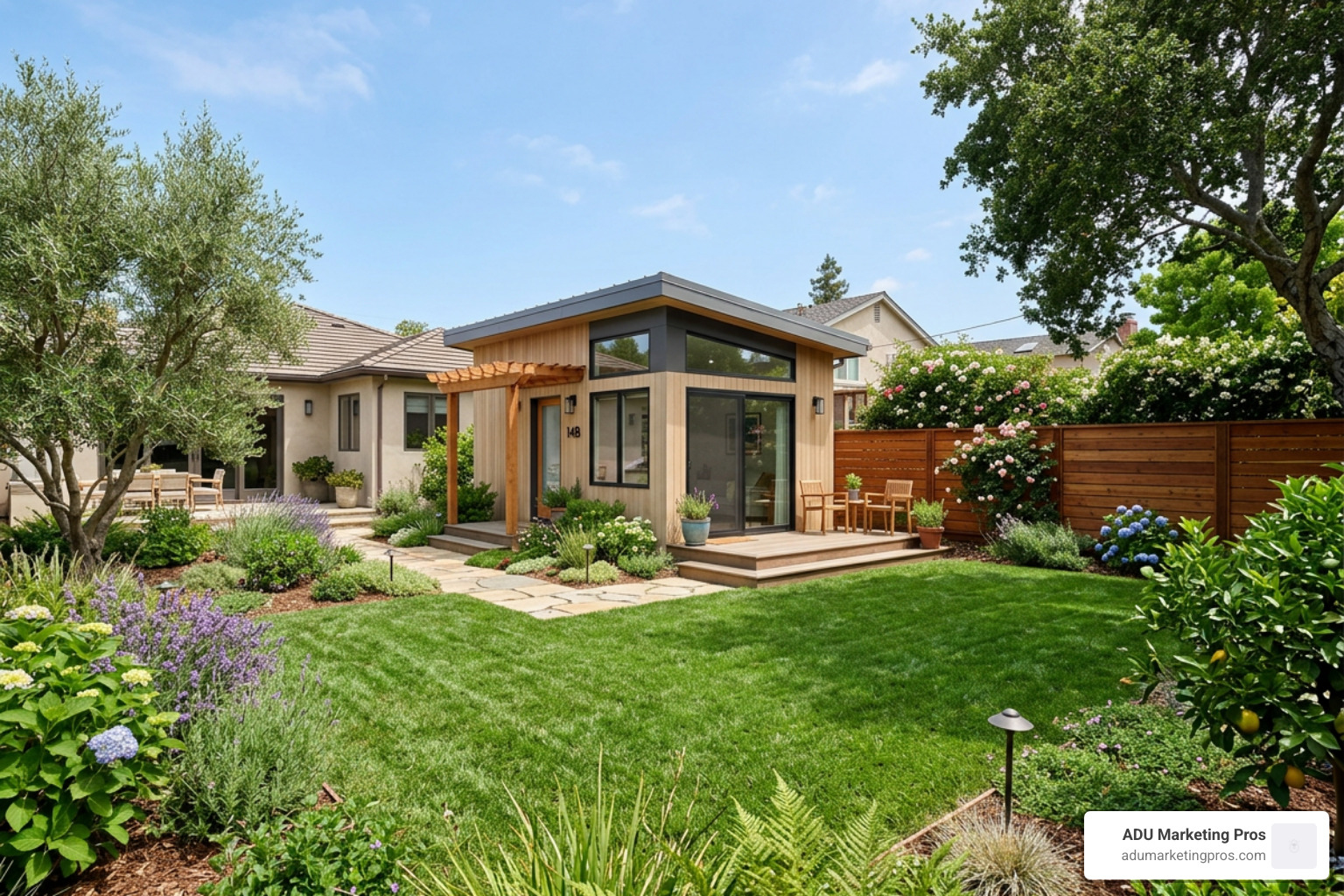
In California, state laws have evolved dramatically over the last few years to make building backyard homes much easier. However, cities like Los Angeles, San Diego, and Sunnyvale still maintain specific local guidelines regarding setbacks, height limits, and utility connections.
To understand how these state-wide regulations apply to your property, read up on the rules for Accessory Dwelling Units in Los Angeles, and check out the local zoning nuances in our guide to Sunnyvale ADU regulations.
Navigating Local Council and City Approvals
One of the greatest legal victories for homeowners in California is the elimination of minimum lot size requirements for ADUs. Historically, if your lot was under a certain size, you were completely barred from building a secondary unit. Today, as long as you can meet basic safety and setback requirements, you are generally permitted to build.
For a compact 30 sqm granny flat, the approval process is often incredibly streamlined. In many jurisdictions, these smaller units can qualify for ministerial “complying development” approvals. This means that if your design fits within a strict set of pre-determined criteria (such as staying under height limits and maintaining a 4-foot setback from side and rear property lines), your plans can be approved directly by a building inspector without going through lengthy, public city council hearings.
To learn more about maximizing your chances of a fast, stress-free permit approval, read our San Diego ADU ultimate guide.
Utility Connections and Site Accessibility
Before you sign a contract with a builder, you must map out how your new 30 sqm granny flat will connect to essential services:
- Sewer & Plumbing: Your unit will need to connect to your property’s main sewer line. Depending on the slope of your yard, this may require a simple gravity-fed line or a specialized macerating pump system.
- Electricity: You will need to decide whether to run a sub-panel from your main house’s electrical board or install a completely separate electrical meter. A separate meter is highly recommended if you plan to use the unit as a long-term rental property.
- Water & Gas: Most modern compact builds run entirely on electricity (using high-efficiency heat pumps and induction cooktops), which eliminates the need to run expensive gas lines to the backyard.
If you are considering an attached design rather than a freestanding backyard unit to simplify these utility connections, check out our guide on attached granny flats.
Key Benefits and Creative Use Cases
Why are so many homeowners investing in a 30 sqm granny flat? Because these compact spaces offer unparalleled lifestyle flexibility. They can effortlessly transition through different phases of your family’s life, serving as a rental property today, a home office tomorrow, and a cozy retirement cottage down the road.
To discover how modern, architectural design is redefining the backyard cottage, read our guide to modern backyard units.
Rental Property for Students and Retirees
With housing costs continuing to rise across California, compact secondary dwellings have become a vital source of affordable housing.
For property owners, a 30 sqm granny flat represents a powerful source of passive rental income. Because the build cost is relatively low, the return on investment (ROI) is often much higher than buying a traditional standalone investment property.
These units are particularly appealing to two massive demographics:
- College Students: Living near campus in cities like Palo Alto, Berkeley, or San Jose can be incredibly expensive. A stylish, private backyard cottage offers students a quiet place to study at a fraction of the cost of a traditional apartment.
- Retirees & Downsizers: Many older adults want to downsize their living space to reduce maintenance but don’t want to move into a massive, impersonal apartment complex. A backyard home allows them to live in a quiet, residential neighborhood close to community spaces.
If you are looking for a creative way to keep your extended family close while maintaining healthy boundaries, explore our guide on how to utilize a backyard flat for family members.
Home Offices, Guest Houses, and Creative Studios
The rise of remote work has forever changed how we utilize our homes. Trying to run a business or take video calls from a kitchen table or a noisy living room is a recipe for burnout.
A 30 sqm granny flat makes the ultimate backyard executive suite. It provides a physical boundary between your work life and your personal life. When you step out of your back door and walk a few paces to your private office, your brain instantly transitions into work mode.
When you aren’t using the space for work, it can easily double as a luxury guest suite for visiting friends and family, or a creative art and music studio.
For more information on designing the ultimate backyard workspace or guest retreat, read our guide to prefab guest suites.
Frequently Asked Questions about Compact ADUs
Can you comfortably fit a kitchen and bathroom in 30 sqm?
Absolutely. The key is smart zoning and choosing apartment-sized appliances. Instead of a massive double sink and a 30-inch range, opt for a single deep sink and a sleek two-burner induction cooktop.
In the bathroom, a walk-in shower with a frameless glass screen keeps the room looking open and spacious. Utilizing a wall-mounted vanity and a compact toilet will keep your floor space clear and easy to clean.
For more tips on layout planning, read our general granny flat guide.
Do I need council approval for a 30 sqm build?
Yes, in almost all urban and suburban areas of California, you will need to obtain a building permit before starting construction. However, because a 30 sqm unit is under the threshold where many heavy municipal fees kick in, the permitting process is usually much cheaper and faster than building a larger home.
To see a real-world example of how the permitting and construction process works in a major city, read about the San Diego permit process.
Is a prefab modular unit cheaper than a custom build?
In most cases, yes. Prefabricated modular homes benefit from economies of scale. Because they are built in a centralized facility, material waste is minimized, and labor is highly optimized.
Additionally, because the structural engineering has already been approved at the state level, modular units can often bypass some of the local architectural review processes, saving you weeks of waiting.
If you want to see a fantastic example of a modern, expandable modular unit that offers rapid installation and premium finishes, take a look at The Cove modular flat.
Conclusion
The future of housing is compact, efficient, and highly adaptable. A 30 sqm granny flat proves that you do not need a massive footprint to live a big, comfortable, and fulfilling life. By embracing smart zoning, vertical storage, and natural light, you can create a backyard oasis that adds massive value to your property and your lifestyle.
At ADU Marketing Pros, we specialize in helping ADU builders, designers, and modular home manufacturers connect with eager homeowners who are ready to transform their backyards. We believe in showcasing true industry expertise and high-quality craftsmanship, helping firms stand out in a competitive market.
If you are an ADU builder or architect looking to attract more high-quality clients and grow your business, discover how we can help you dominate your local market by exploring our ADU marketing solutions.