
Introduction
Qualifying for an accessory dwelling unit (ADU) grant requires property owners to meet rigorous baseline standards established by municipal, county, and state housing agencies. Primary criteria mandate holding clear fee-simple title to a residential parcel, committing to long-term owner-occupancy on-site, satisfying household income caps (frequently tied to 80% to 120% of the local Area Median Income), and signing recorded deed covenants that prohibit short-term vacation rentals. These public subsidy programs are designed to lower upfront financial hurdles by offsetting pre-development architectural fees, structural engineering assessments, utility infrastructure upgrades, and physical construction costs.
The widespread expansion of accessory dwellings—frequently referred to as backyard cottages, granny flats, casitas, carriage houses, or in-law suites—serves as one of the most effective urban planning mechanisms for addressing regional housing shortages. By enabling single-family and select multi-family residential parcels to accommodate secondary homes, municipal agencies introduce gentle neighborhood density without altering established architectural character. Simultaneously, these units empower homeowners to construct multi-generational living quarters for aging parents or adult children, or to generate steady, long-term rental income that bolsters middle-class wealth retention.
However, successfully navigating public financing requires understanding the vital distinctions between non-repayable cash grants, declining-balance forgivable loans, local development impact fee waivers, and conventional construction financing instruments. Public subsidy programs enforce meticulous compliance frameworks, stringent disbursement milestones, and mandatory occupancy audits.
At ADU Marketing Pros, we partner with builders, architects, general contractors, and structural engineers across California—including high-growth markets such as San Jose, San Francisco, Sunnyvale, Palo Alto, Mountain View, Menlo Park, Los Angeles, and San Diego—to analyze how shifting municipal zoning incentives, legislative mandates, and public equity programs affect residential development feasibility.
Understanding ADU Grant Programs and Funding Mechanisms in 2026
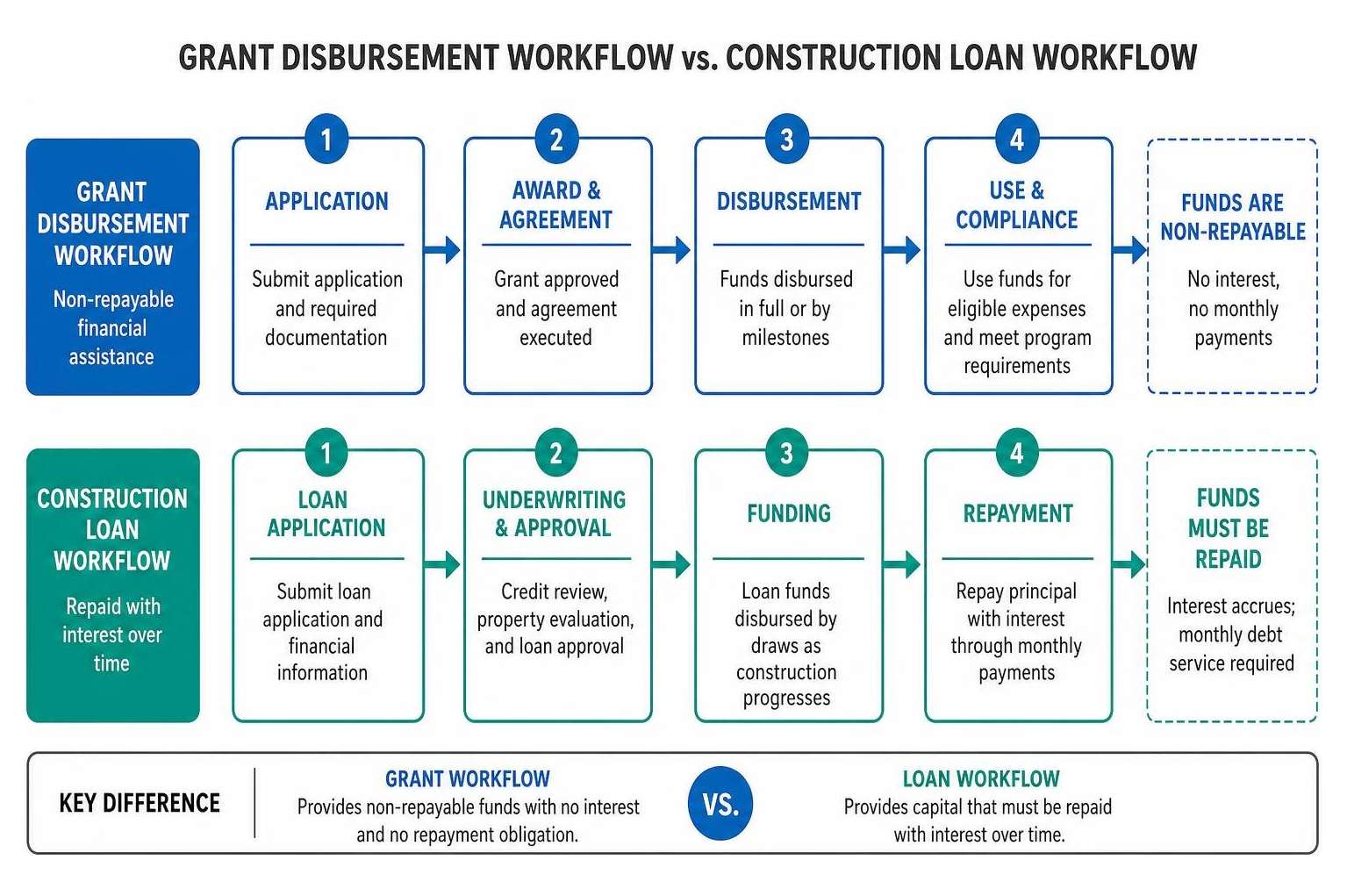
In public housing finance, an ADU grant is defined as non-repayable monetary assistance provided by a public agency, regional housing authority, or non-profit trust to facilitate the design, permitting, or construction of a secondary dwelling. Unlike private construction debt, second mortgages, or home equity lines of credit (HELOCs), true grants do not carry interest rates, require monthly debt servicing, or demand principal repayment—provided the recipient adheres to all recorded regulatory covenants.
Homeowners and industry professionals evaluating public financing options can review available ADU funding grants to understand how local and regional entities structure funding packages to offset early design fees and construction outlays.
Core Funding Structures and Financial Instruments
Public initiatives typically disburse capital through four distinct mechanisms:
- Direct Cash Grants: Lump-sum or milestone-based disbursements specifically allocated to reimburse pre-approved invoices, including boundary surveys, architectural drawings, soil reports, or local plan-check fees.
- Forgivable Loans / Declining Liens: Capital structured as a deferred-payment subordinate mortgage recorded against property title. The principal balance diminishes by a set percentage each year (such as 10% per year across a ten-year compliance term) until it reaches zero, effectively converting into a full grant if the owner adheres to primary residency or affordable tenant occupancy standards.
- Local Fee Waivers: Direct municipal reductions or eliminations of permitting, impact, and plan-check fees, saving property owners thousands of dollars without issuing liquid capital directly to the applicant.
- Subsidized Low-Interest Construction Loans: Publicly backed lending products offering below-market interest rates, deferred initial payments, or extended amortization terms to make secondary unit development accessible.
| Funding Type | Repayment Required? | Title Lien Placed? | Common Eligible Uses | Primary Regulatory Objective |
|---|---|---|---|---|
| Direct Grant | No | Rarely | Architectural plans, permits, pre-development reports | Encourage initial project planning |
| Forgivable Loan | Only if covenants breached | Yes (declining balance) | Complete site prep, utility hookups, framing, finishes | Long-term affordable housing creation |
| Municipal Fee Waiver | No | No | City development impact fees, plan review costs | Reduce municipal barriers to development |
| Conventional Loan | Yes (principal + interest) | Yes (deed of trust) | All project phases, labor, materials, soft costs | Private market capital investment |
State-Level ADU Grant Programs and Regional Funding Models
Statewide and regional approaches to secondary unit financing vary considerably across the country, reflecting distinct legislative priorities and local housing market dynamics.
New York State Plus-One ADU Program
In New York, the state introduced the Plus-One ADU Program, backed by an initial $85 million multi-year allocation. Administered through municipal partnerships and non-profit housing entities, the program provides low- and moderate-income homeowners with up to $125,000 outside New York City and up to $175,000 within New York City. Detailed program guidelines and compliance protocols are outlined in the New York State Plus-One ADU Program Guide. The initiative uses a 10-year declining lien structure to ensure that properties remain dedicated to permanent, long-term residential occupancy.
Colorado Accessory Dwelling Unit Grant Program (ADUG)
In Colorado, the state established the Accessory Dwelling Unit Grant Program through the Division of Local Government. Rather than issuing checks directly to individual homeowners, this program awards competitive grants to local and tribal governments that achieve certification as ADU Supportive Jurisdictions under state housing statutes. Certified municipalities use these funds to develop pre-approved architectural plan libraries, establish localized fee waiver programs, and streamline permitting for affordable housing units. Detailed jurisdiction requirements are available directly from the Colorado Division of Local Government ADUG details.
Massachusetts and Pacific Northwest Regional Initiatives
In Massachusetts, state-level initiatives operate through MassHousing loan products supporting up to $250,000 in financing for detached construction. Locally, the City of Boston combines a $7,500 non-repayable soft-cost grant with a zero-percent deferred loan of up to $50,000. Meanwhile, rumors surrounding a purported $40,000 direct cash grant in Oregon remain unfounded; Oregon jurisdictions such as Portland support development primarily through development impact fee waivers rather than direct financial disbursements.
California Landscape and CalHFA Grant Status
California has led the nation in legislative reforms supporting accessory dwellings, removing zoning barriers, parking mandates, and restrictive setback requirements. Historically, the California Housing Finance Agency (CalHFA) operated a popular $40,000 grant program that reimbursed pre-development and non-recurring closing costs for thousands of homeowners across the state. However, the program fully allocated its available funds on December 28, 2023, and officially closed to new applications.
Property owners must review the official CalHFA ADU portal updates to verify funding availability and guard against predatory third-party services. Because consumer demand remains elevated, fraudulent operators frequently attempt to charge upfront fees claiming they can secure closed CalHFA funds. CalHFA advises consumers to report any unsolicited third-party promises directly to state authorities.
While statewide direct cash grants are inactive, California homeowners can access alternative financial incentives. A comprehensive review of California ADU rebates highlights energy efficiency programs, utility interconnection credits, and localized subsidies offered by community development departments. Furthermore, analyzing regional incentives across California reveals targeted municipal grant rounds, permit fee discounts, and pre-approved architectural plan programs across key jurisdictions including San Jose, Los Angeles, and the San Francisco Peninsula.
Primary Qualifications and Homeowner Requirements
Securing public financing for secondary unit construction requires satisfying strict eligibility criteria established by municipal and regional program administrators. Public funding sources are designed to address housing shortages and support middle-income stability, meaning applicants must undergo rigorous verification before funds are released.
Core Eligibility Criteria for Homeowners
To qualify for public assistance, applicants typically must satisfy four foundational criteria:
- Property Title and Ownership Structure: The applicant must hold clear title to the property, typically under fee simple ownership. Properties held in revocable living trusts or LLCs are generally eligible only if the primary resident is the named grantor or primary beneficiary of the entity. Properties facing active foreclosure, tax liens, or unresolvable encumbrances are excluded from participation.
- Primary Residency Requirements: Most public subsidy programs require the property owner to occupy either the primary residence or the newly constructed secondary unit as their principal domicile for a specified duration (commonly 5 to 10 years). Applicants must verify occupancy using official utility bills, voter registration records, and filed state income tax forms.
- Income Limitations: Public grant and forgivable loan programs usually enforce Area Median Income (AMI) ceilings, restricting assistance to low- and moderate-income households earning at or below 80% to 120% of the county AMI. Evaluating California ADU income thresholds helps property owners determine how local household income caps apply across high-cost metro areas like Santa Clara County, San Mateo County, and Los Angeles County.
- Deed Restrictions and Covenants: Receiving public funds frequently requires recording a restrictive covenant against the property title, binding the owner to maintain the unit as a long-term residential rental and restricting short-term vacation rental use for the entirety of the monitoring term.
Eligible Project Costs and Expense Coverage
Public funding initiatives distinguish between pre-development “soft costs” and physical “hard construction costs.” Knowing which expenses qualify ensures accurate budget planning and avoids unexpected out-of-pocket bills.
- Pre-Development Soft Costs: These include architectural drafting, structural engineering calculations, boundary and topographical surveys, geotechnical soil reports, environmental impact assessments, Title 24 energy calculations, municipal plan-check fees, and permit filing charges.
- Site Preparation and Utility Interconnections: Upgrading main electrical service panels to 200 amps, running dedicated water submeters, extending sewer laterals, trenching for gas or electric heat pumps, and grading residential building pads.
- Hard Construction Costs: Foundation excavation and concrete pours, structural wood framing, roofing, insulation, drywall installation, exterior siding, plumbing rough-ins, electrical wiring, interior doors, and modular unit crane installation.
- Ineligible Expenditures: Luxury interior finishes (such as high-end custom cabinetry, swimming pool integrations, or hot tubs), ongoing landscaping maintenance, loose furniture, electronics, and construction loan financing charges exceeding standard origination caps.
Many state-level assistance initiatives focus exclusively on reimbursing soft costs, enabling homeowners to complete engineering assessments and secure building permits without draining personal savings. Other comprehensive equity programs permit drawdowns for physical construction milestones, including foundation laying, rough framing, utility trenching, and modular craning.
Zoning, Parcel Feasibility, and Utility Infrastructure Standards
Beyond personal financial eligibility, the physical parcel must support secondary dwelling construction under local zoning ordinances, state building codes, and municipal utility regulations:
- Setback and Height Requirements: State statutory guidelines generally mandate rear and side setbacks of no more than 4 feet for detached units up to 16 to 18 feet in height, though historic preservation overlay zones or coastal commission rules may impose supplementary site planning reviews.
- Utility Capacity and Panel Upgrades: Existing residential electrical services (often legacy 100-amp panels) must frequently be upgraded to 200-amp or 400-amp main breaker panels to handle dedicated heat pump HVAC units, induction cooktops, and electric vehicle charging infrastructure.
- Sewer and Water Lateral Extensions: Applicants must verify whether their existing sewer lateral requires trenchless relining or complete replacement before tying in secondary dwelling waste lines.
Navigating the Application Process and Timeline
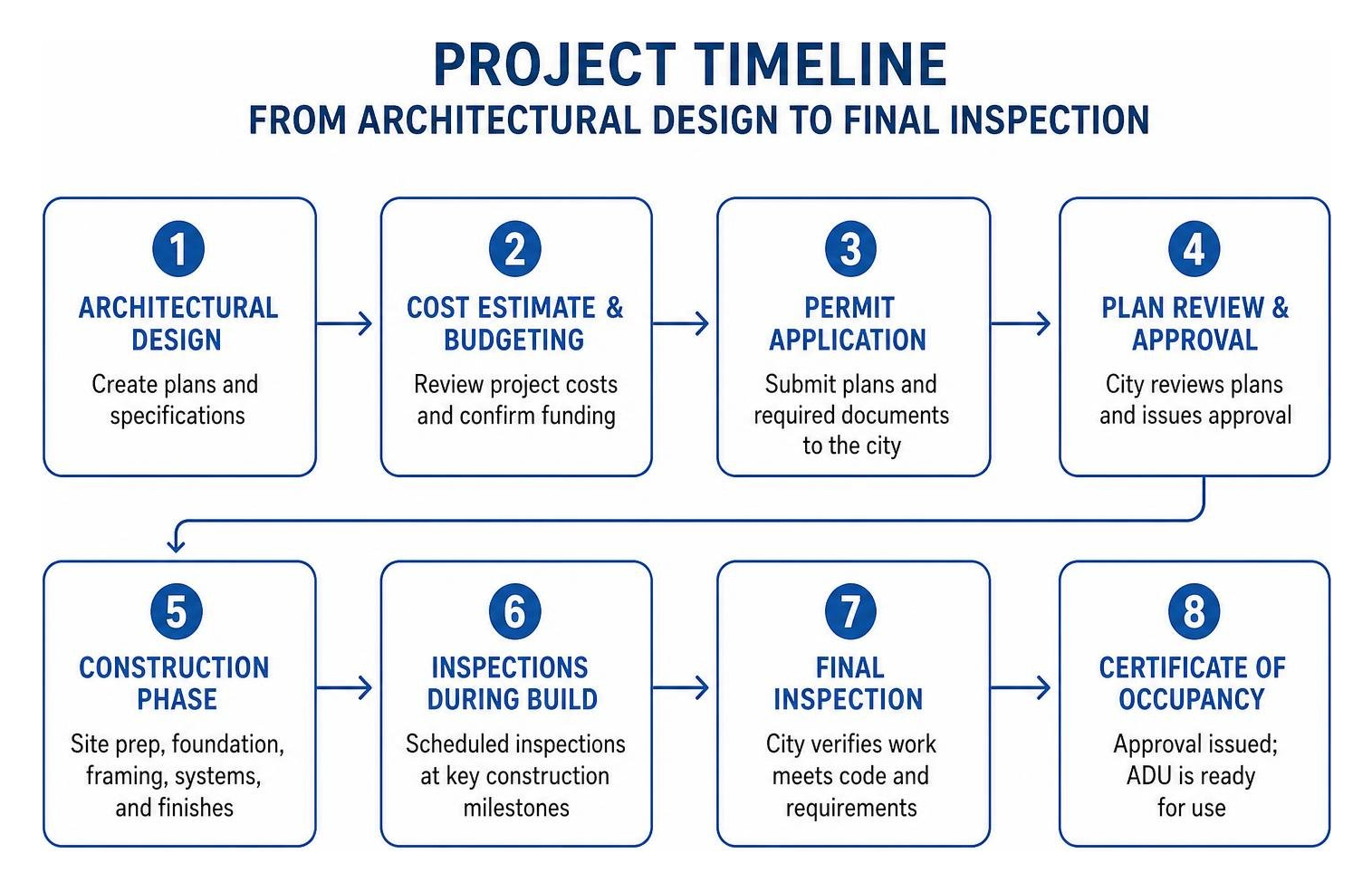
Securing public funding requires careful coordination across multiple project milestones. A clear understanding of the expected project duration for ADU builds helps homeowners align financing schedules with architectural design, permitting reviews, and general contractor availability.
Step-by-Step Application Roadmap
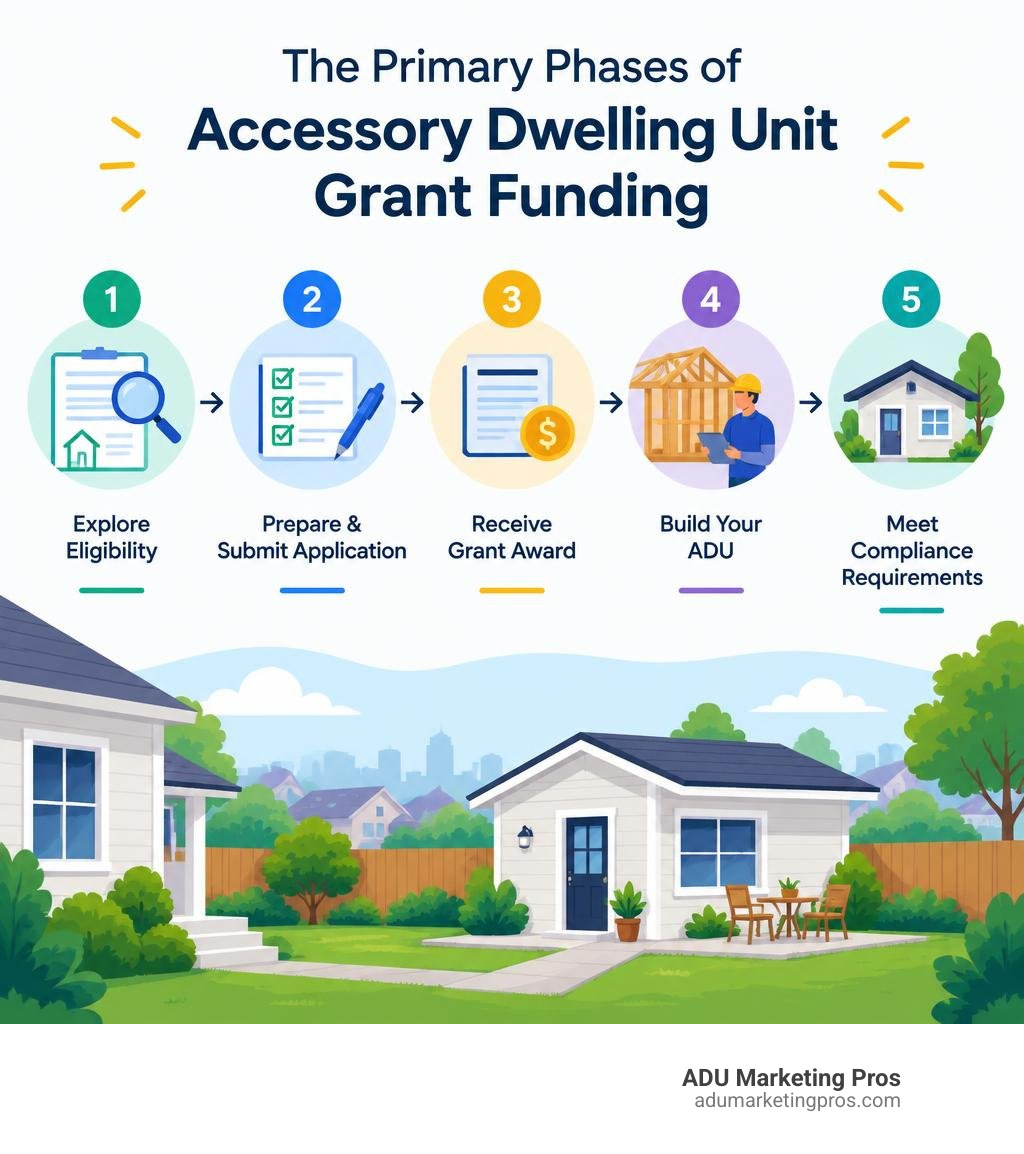
Navigating public funding channels involves seven sequential milestones:
- Step 1: Preliminary Eligibility Verification: Assess household income against published county AMI figures, confirm fee simple ownership on property tax records, verify title history, and check local zoning overlays for building feasibility and utility capacity.
- Step 2: Securing Pre-Development Team: Engage a licensed architect, structural engineer, or design-build firm experienced in local municipal building codes, setback standards, and fire separation guidelines.
- Step 3: Financial Portal Application: Prepare documentation—including federal tax returns, W-2 statements, recent pay stubs, mortgage notes, and property deeds—and submit the initial application package through the administering agency’s portal.
- Step 4: Contractor Procurement and Bidding: Solicit formal, itemized construction proposals from licensed, bonded, and insured general contractors. Many grant programs require at least two or three competitive bids to ensure pricing transparency and fair market labor rates. Homeowners can follow standard procedures for navigating the ADU grant application process to prepare compliant bidding documentation.
- Step 5: Architectural Plan Submittal and Permitting: Submit engineered construction drawings to the local building department for plan-check review, addressing municipal plan-check corrections until final building permit issuance.
- Step 6: Milestone-Based Draw Disbursements: Construction funds are typically held in escrow and released through phased drawdowns upon verified inspection sign-offs (e.g., foundation pour, rough mechanical/electrical/plumbing, framing approval). A standard 10% retention reserve is held until final completion to resolve mechanics liens.
- Step 7: Final Inspection and Certificate of Occupancy: The municipal building inspector conducts the final inspection, signs off on all life-safety and building code standards, and issues the official Certificate of Occupancy.
Managing Escrow Disbursals and Construction Draws
Unlike traditional unsecured personal loans where capital is deposited directly into a borrower’s checking account, grant and forgivable loan programs operate through structured escrow drawdown schedules to protect public funds:
- Initial Soft-Cost Reimbursement: Soft-cost grants reimburse documented out-of-pocket expenses directly to the homeowner or pay licensed design professionals upon receipt of itemized invoices and architectural deliverables.
- Construction Draw Inspections: Construction funds are disbursed in 4 to 6 discrete tranches corresponding to physical milestones verified by third-party construction monitors or municipal building inspectors.
- Mechanic’s Lien Waivers: Before releasing subsequent progress payments, program administrators require unconditional lien releases from subcontractors and material suppliers to safeguard property title.
Long-Term Compliance and Monitoring Standards
Receiving public funding establishes ongoing compliance obligations. Administrators often require annual written certifications confirming that the owner occupies the property and that the secondary unit is either occupied by family members or leased to a qualifying tenant under a long-term rental agreement.
Programs structured as forgivable loans enforce a declining lien balance over a set compliance period (typically 10 years). If the homeowner sells the primary residence, converts the unit into a short-term vacation rental, or breaches affordability covenants before the compliance term ends, the unamortized portion of the funding must be repaid to the granting agency upon title transfer.
Frequently Asked Questions About Accessory Dwelling Unit Funding
Can homeowners use grant funding for short-term rentals or Airbnb?
No. Public grant, rebate, and forgivable loan programs strictly prohibit using subsidized units as short-term vacation rentals on platforms such as Airbnb or Vrbo. The explicit purpose of public housing subsidies is to expand the supply of permanent, long-term residential housing and alleviate local rental inventory shortages. Grant agreements require minimum lease terms of at least 30 consecutive days—and frequently require six-month to one-year residential leases executed with verified occupants. Violating these covenants constitutes a material default of public program terms, triggering immediate revocation of the grant, mandatory lien acceleration, and full repayment of disbursed capital alongside statutory interest and administrative penalties.
Is the California statewide CalHFA $40,000 program still accepting applications in 2026?
No. The statewide CalHFA program exhausted its funding allocation on December 28, 2023, and remains closed to new applicant registrations. Homeowners in California must rely on conventional construction loans, home equity lines of credit (HELOCs), local municipal fee waivers, or city-specific pilot subsidies. For instance, property owners in Southern California can review alternative financing strategies for San Diego properties to discover local municipal fee relief, density bonus incentives, and regional lending solutions.
What happens to a forgivable secondary unit lien if the property is sold early?
If a property carrying a forgivable grant lien is sold or transferred before the required affordability term concludes (typically 10 years), the remaining unamortized balance becomes immediately payable at escrow closing. For example, under a ten-year declining balance model where 10% is forgiven per completed year, selling the home at year four means 40% of the loan is forgiven, while the remaining 60% must be repaid to the granting authority out of property sales proceeds.
Can trust-owned properties or LLCs qualify for municipal ADU subsidies?
Properties held in revocable living trusts qualify under most municipal and state grant initiatives, provided the primary resident is the grantor and named trustee of the trust. Conversely, properties owned by commercial multi-member LLCs, real estate investment funds, or corporate entities are typically excluded from homeowner-focused subsidy programs, as public equity grants are structured to support individual residential owner-occupants.
How do ADU grants impact local property tax assessments?
Constructing an accessory dwelling unit triggers a blended supplemental property tax reassessment under California Proposition 13 and similar assessment rules nationwide. The local county assessor evaluates the incremental construction value of the new secondary structure rather than re-evaluating the underlying primary home or base parcel value. Non-repayable grants do not reduce the taxable assessed market value of the newly constructed physical improvement, but they significantly reduce out-of-pocket development expenditures, thereby maximizing net rental yields and return on investment.
Conclusion
Building a secondary dwelling unit creates long-term property value, provides vital housing for multi-generational family members, and generates dependable residential rental income. While public subsidies, forgivable loans, and localized fee reductions offer valuable financial relief, navigating municipal zoning standards, income ceilings, and multi-year compliance obligations requires strategic planning and careful administrative execution.
For building professionals and design firms, educating property owners about available financing options is essential for turning consumer interest into signed building contracts. At ADU Marketing Pros, headquartered in San Jose, California, we help ADU builders, contractors, and architects scale their operations across competitive markets—including Los Angeles, San Diego, San Francisco, Sunnyvale, Palo Alto, Mountain View, and Menlo Park. We deliver targeted digital marketing, high-intent lead generation, and custom SEO strategies that position your business as a trusted industry authority.
To discover how municipal subsidy programs and zoning incentives can accelerate residential construction pipelines, review our comprehensive resources on the accessory dwelling unit grant program to strengthen your market position and expand your client base today.