
How to Find ADU Financial Aid for University
If you are searching for financial aid at AdventHealth University (ADU), your first step is completing the FAFSA to establish federal, state, and institutional funding eligibility. You should also review the institution’s official financial aid instructions to track specific departmental awards, verification deadlines, and institutional grant forms. Depending on your financial profile, degree program, and enrollment status, academic aid packages generally combine merit-based scholarships, need-based tuition subsidies, and federal direct student loans.
However, in municipal zoning and real estate circles, ADU stands for accessory dwelling unit—commonly known as a secondary suite, granny flat, casita, or backyard cottage. Financial assistance for building an accessory residence differs entirely from collegiate tuition aid: it consists of municipal construction subsidies, soft-second mortgages, local housing authority initiatives, and home equity programs rather than federal student loans. I’m Jock Breitwieser, and this guide provides full clarity between both pathways so you can secure the precise funding your project requires.
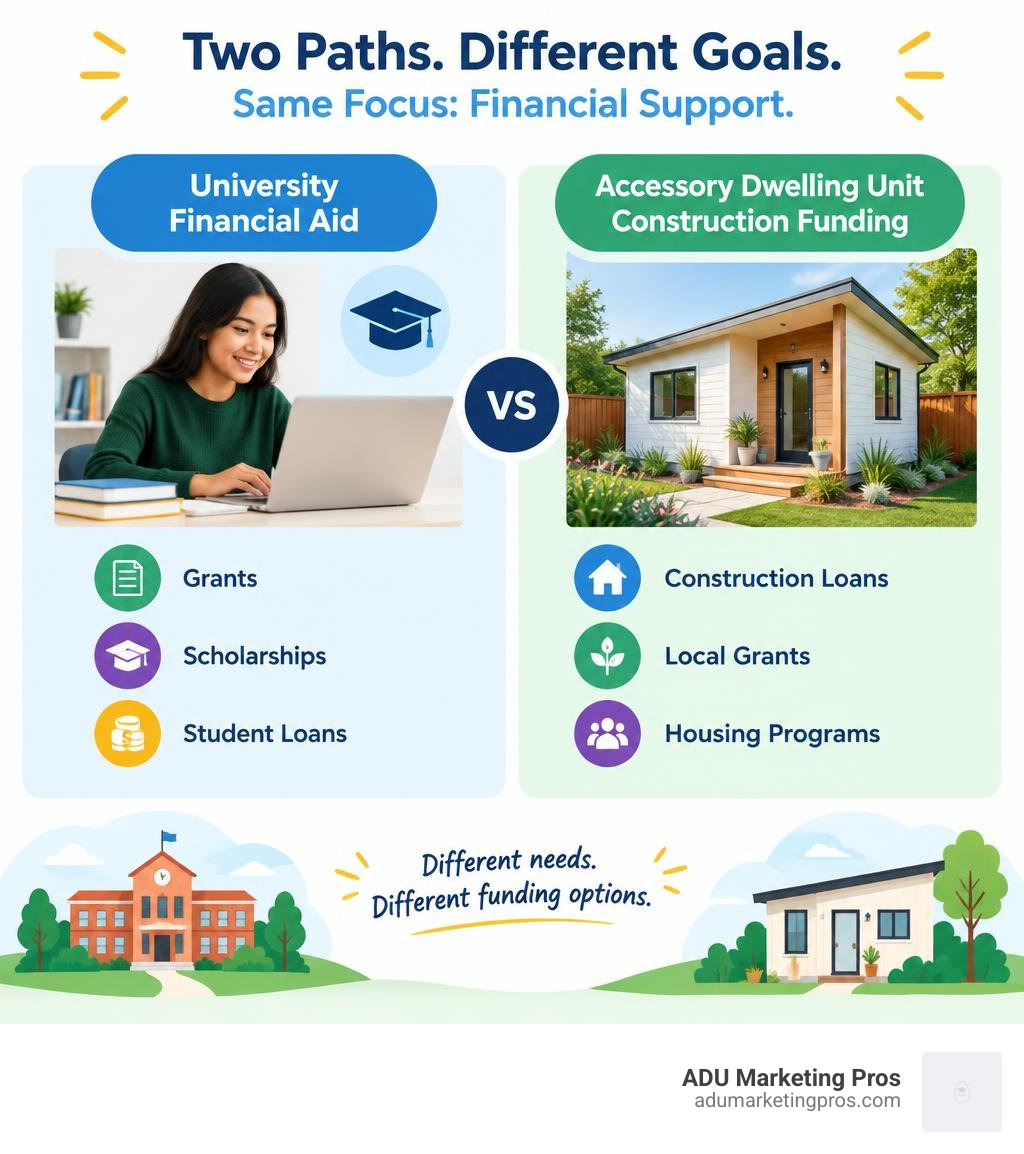
Primary Funding Pathways for Accessory Dwelling Units
Homeowners seeking capital to construct residential secondary units typically focus on three core areas:
- State and Regional Grants: Learning the mechanics of a formal ADU grant application helps homeowners cover architectural, permitting, and pre-development soft costs.
- Income Caps and AMI Benchmarks: Checking regional thresholds for California ADU grants determines whether your household qualifies for forgivable public capital.
- Annual Program Allocations: Preparing your documentation early for the upcoming adu grant california 2025 funding cycle ensures you can submit before public allocations are fully claimed.
Whether your goal is financing higher education or adding an affordable rental unit to your residential parcel, selecting the appropriate financial structure is critical to managing total out-of-pocket costs.
Overview of ADU Financial Aid Programs and Assistance Types
When property owners evaluate residential development options, the acronym “ADU” refers to Accessory Dwelling Units. These self-contained residential units—including detached backyard cottages, garage conversions, attached additions, and basement apartments—offer valuable infill housing options in dense, supply-constrained neighborhoods. Paying for their development requires understanding residential real estate funding channels rather than educational financial assistance.
Securing residential subsidies requires evaluating forgivable public loans, soft-second mortgages, municipal design grants, and technical assistance programs. Across major housing markets, exploring comprehensive ADU financing options enables homeowners to combine local public subsidies with private home equity products to build sustainable construction capital.
Public housing agencies, municipal planning divisions, and non-profit community development organizations structure secondary unit aid across four primary funding mechanisms:
- Forgivable Public Loans: Zero-interest or deeply discounted deferred loans that are forgiven incrementally over a fixed compliance period (typically 5 to 15 years), provided the homeowner leases the completed unit at affordable rental rates to income-certified tenants. These instruments frequently operate as “silent seconds,” requiring zero monthly principal or interest amortizations as long as the affordability covenants remain in good standing.
- Pre-Development Construction Grants and Rebates: Direct public cash transfers or post-completion fee reimbursements designed to absorb costly pre-development expenses. These grants routinely target architectural drafting, environmental site evaluations, civil engineering, permit processing fees, and utility capacity connection charges. Many municipalities also supply targeted rebates for integrating green energy features, including solar arrays, heat pump water heaters, and greywater recycling systems.
- Technical Assistance Pipelines: Publicly funded project management networks that connect qualified homeowners with pre-vetted design professionals, structural engineers, and licensed general contractors. This hands-on guidance prevents costly budgeting miscalculations, accelerates permit approvals through local building departments, and assists owners in managing construction milestones.
- Future-Value Renovation Mortgages: Specialized government-backed loan products (such as FHA 203(k) or conventional renovation mortgages) that allow borrowers to secure financing based on the appraised, post-construction value of the primary residence combined with the planned secondary unit. This structural approach lets homeowners borrow significantly more capital than a standard home equity loan based strictly on current equity.
For low-to-moderate-income families facing strict lending restrictions, reviewing verified low-income ADU loan pathways clarifies which public programs offer direct capital grants versus those offering interest rate discounts or deferred administrative fees. In practice, successful homeowners frequently layer a municipal soft-cost grant with a future-value renovation loan to minimize personal cash outlays.
Eligibility Requirements for Homeowner ADU Financial Aid
Securing public funding or below-market municipal loans for residential construction requires satisfying strict homeowner criteria, income standards, and zoning parameters. Public agencies typically assess financial eligibility against Area Median Income (AMI) thresholds published annually by the Department of Housing and Urban Development (HUD) and state housing authorities. Because AMI fluctuates significantly across different metropolitan statistical areas, an 80% AMI household in a metropolitan coastal county may earn substantially more in gross dollars than an 80% AMI household in a rural market.
Beyond basic income verification, public aid programs enforce several standard requirements:
- Primary Owner-Occupancy: Homeowners are generally required to occupy either the primary home or the secondary living unit as their primary legal residence throughout the construction process and for an established compliance duration post-completion. This restriction prevents speculative investors from utilizing public subsidies.
- Credit and Debt Underwriting Standards: Applicants must maintain a clear property title, have no outstanding municipal tax liens or open building code violations, and meet reasonable debt-to-income (DTI) parameters. Housing authorities also inspect recent credit histories and mortgage payment records.
- Zoning and Parcel Suitability: The building parcel must accommodate the proposed secondary structure under local zoning bylaws, state dwelling mandates, and environmental rules. Factors like setback lines, utility easements, severe slope topography, and high-risk flood zones must all be cleared prior to grant disbursement.
Carefully reviewing local income eligibility standards ensures property owners avoid paying upfront drafting and surveying retainers before confirming their program qualifications.
Affordability Covenants and ADU Bonus Programs
Public financial aid for accessory units is rarely unrestricted. Municipalities allocate public tax dollars with the goal of expanding long-term workforce and affordable housing stock. In exchange for non-repayable grants, zero-interest subordinate loans, or development fee waivers, governing agencies typically record an affordability covenant on the property’s title.
These covenants establish legal parameters that govern the property for 5 to 15 years:
- Rent Ceilings: The monthly rent charged to tenants cannot exceed published fair market rent schedules corresponding to 60%, 80%, or 120% AMI limits. Annual rent adjustments are governed by published housing authority benchmarks rather than prevailing market inflation.
- Tenant Income Verification: Property owners must document and verify prospective tenants’ income levels prior to lease execution and provide annual compliance documentation to the supervising public agency.
- Local Density Bonuses: In specific urban sectors, including designated Transit Priority Areas (TPAs), committing to construct an affordable deed-restricted unit unlocks statutory bonus provisions that allow homeowners to build additional market-rate units on the same lot.
Additionally, many municipal agencies offer streamlined permitting pipelines, parking reduction waivers, and expedited plan checks for deed-restricted accessory units. Property owners should carefully evaluate how long-term rental caps compare against immediate construction subsidies before executing binding deed restrictions.
City, State, and Federal ADU Financing Options
Financing a secondary residential build requires matching your specific parcel with suitable municipal, state, or federal financing vehicles. While federal loan programs provide broad capital liquidity nationwide, municipal and state initiatives deliver targeted capital subsidies that substantially reduce out-of-pocket construction costs. Reviewing statewide California incentives helps homeowners identify regional assistance programs that can be paired with standard construction loans.
Federal renovation mortgages deliver predictable underwriting structures and national availability, though they do not reduce total project costs. Conversely, municipal grants and forgivable loans can eliminate tens of thousands of dollars in pre-development expenses, but they involve restricted application windows and tenant income covenants. A sound strategy involves capturing local municipal subsidies for soft costs, then utilizing federal mortgage products for hard construction framing and finish work.
Municipal Highlights: San Diego and New York City
Several municipal jurisdictions have established progressive financing programs designed to accelerate backyard cottage and basement unit construction:
- San Diego Housing Commission (SDHC) ADU Finance Program: In San Diego, the Housing Commission provides construction financing up to $250,000 for qualifying low-income homeowners earning at or below 80% AMI. This initiative pairs construction funding with dedicated technical assistance to guide owners through architectural drafting, permit acquisition, and general contractor selection. Homeowners can review the municipal program directly through the Accessory Dwelling Units (ADU) portal on the SDHC website, and explore local financing strategies through San Diego grant opportunities.
- New York City Plus One ADU Program: Supported by an $85 million state and municipal partnership collaborating with 14 community organizations to deliver over 550 accessory units statewide, New York City’s Plus One ADU Program provides up to $395,000 in zero- and low-interest construction loans and subsidies per household. Administered alongside non-profit partners like Restored Homes HDFC, the program experienced substantial demand with over 1,300 applicants during its initial rollout. The initiative targets owner-occupants earning up to 165% AMI (prioritizing households at or below 120% AMI) to fund basement conversions, attic buildouts, and detached cottages under the city’s City of Yes for Housing Opportunity regulatory framework.
These municipal programs highlight how combining technical project support with targeted capital accelerates production. San Diego focuses primarily on direct construction loans for low-income homeowners, whereas New York City offers higher subsidy caps to handle complex urban structural conversions such as basement retrofits and foundation underpinning.
Regional and State Grant Frameworks
Outside of specific municipal programs, regional programs across California supply targeted funding designed for varying property types. Homeowners can take advantage of localized Los Angeles financing mechanisms or explore Orange County assistance programs to mitigate site work, grading, utility trenching, and foundation engineering expenses.
At the state level, reviewing state funding grants alongside available state tax credits helps homeowners leverage impact fee exemptions, pre-approved structural plans, and soft-cost relief. Some state initiatives also fund fire-hardening measures, accessibility upgrades for disabled occupants, or sustainable energy retrofits that standard local grants omit.
When conducting digital research into funding resources, always make sure to distinguish residential property subsidies from higher education programs by clarifying university aid distinctions. This separation keeps your financial planning aligned strictly with residential real estate development and mortgage underwriting guidelines.
Qualifying for ADU Loans and Utilizing Rental Income
When municipal grant cycles are exhausted or your household income exceeds program thresholds, secondary units can be funded through private and government-backed construction-to-permanent mortgages. These loans automatically convert into standard long-term primary mortgages once construction is finished, eliminating the expense and hassle of refinancing.
Mortgage Products and Federal Underwriting Guidelines
Federal mortgage organizations have modernized their underwriting standards to support secondary residential construction on single-family properties:
- FHA 203(k) Standard Renovation Mortgage: Enables owner-occupants to refinance their primary mortgage into a single long-term loan that funds both the existing debt balance and the projected ADU construction costs. Underwriting is based on the subject property’s estimated future completed value. The program mandates that a HUD-approved consultant inspect construction stages and manage escrow disbursements.
- Fannie Mae HomeStyle Renovation & Freddie Mac CHOICERenovation: These conventional loan products finance attached, detached, and modular secondary units up to conforming loan ceilings. Both programs allow borrowers to roll design fees, engineering reports, permit charges, and a 10% to 20% contingency reserve directly into the financed loan balance.
- Home Equity Conversion Mortgages (HECM): Senior homeowners aged 62 and older can leverage a federally backed HECM reverse mortgage to access home equity and fund secondary suite construction without taking on mandatory monthly mortgage payments. Borrowers must remain current on property taxes, homeowner insurance, and maintenance, making this an effective option for aging in place or creating dedicated living quarters for on-site caregivers.
Underwriters evaluate loan-to-value (LTV) limits, borrower credit scores, and contractor draw schedules. A comprehensive future-value appraisal is fundamental to this approval process: the appraiser inspects architectural plans and material specifications to project the completed value of the primary residence plus the new suite, establishing the maximum permitted loan amount.
Using Projected ADU Rental Income for Mortgage Approval
One of the most valuable developments in secondary unit finance is the option to count projected ADU rental income toward borrower loan qualification.
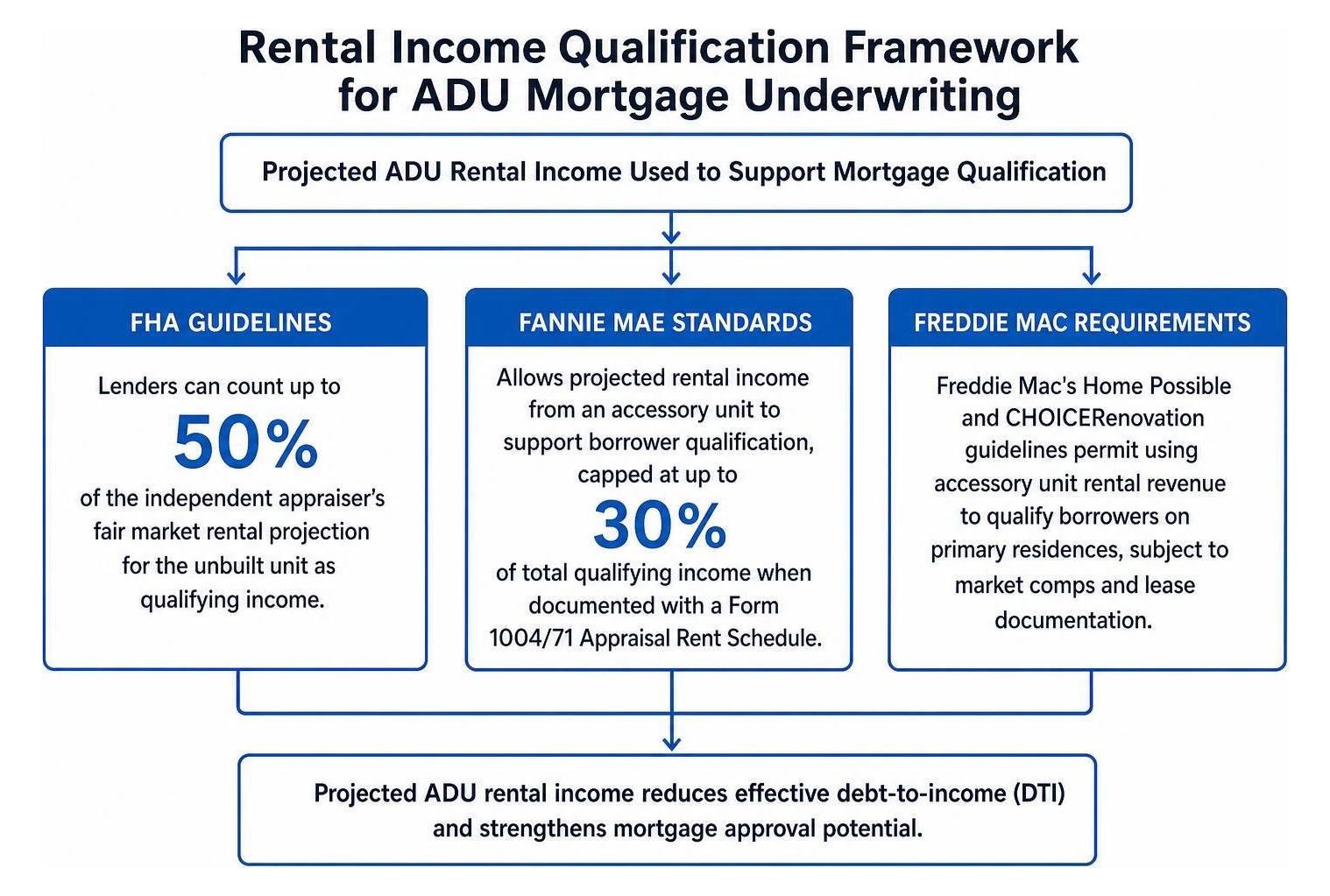
Federal mortgage programs assess future rental revenue using specific guidelines:
- FHA Guidelines: Underwriters can credit up to 50% of the certified appraiser’s projected fair market rental income for the unbuilt unit directly toward borrower qualifying income, lowering the applicant’s debt-to-income (DTI) ratio.
- Fannie Mae Standards: Permits documented accessory unit rental income to support borrower qualification, capped at up to 30% of total qualifying income when supported by a formal Form 1004/71 Appraisal Rent Schedule.
- Freddie Mac Requirements: Freddie Mac’s Home Possible and CHOICERenovation frameworks allow projected secondary unit rental revenue on primary residences, subject to market comps, property suitability, and lease agreements.
In each case, projected rental values must be validated by local rental market comparables. Lenders require a detailed market rent schedule from the appraiser or an executed lease agreement before including future revenue in debt-to-income calculations.
How to Apply: Documentation, Pre-Approved Plans, and Process
Securing public grant subsidies or closing an appraisal-based renovation loan requires thorough project preparation. Municipal housing agencies and residential mortgage lenders adhere to structured due diligence reviews to confirm every permitted unit complies with local building, life-safety, and zoning regulations.
Homeowners can significantly reduce soft costs and pre-development timelines by selecting pre-approved ADU architectural plans. Many municipal building departments maintain catalogs of pre-reviewed, permit-ready plans. Utilizing these standard plan sets can:
- Save between $5,000 and $15,000 in custom structural drafting and architectural design retainers.
- Shorten municipal plan check reviews from several months down to just a few business weeks.
- Ensure structural plans conform to local seismic, wind load, foundation, and utility connection codes.
Pre-approved plans are especially effective when paired with municipal permit fee exemptions and streamlined plan checks. Even when using standard designs, homeowners must secure a parcel-specific site plan, evaluate soil conditions, and verify utility tie-in locations before breaking ground.
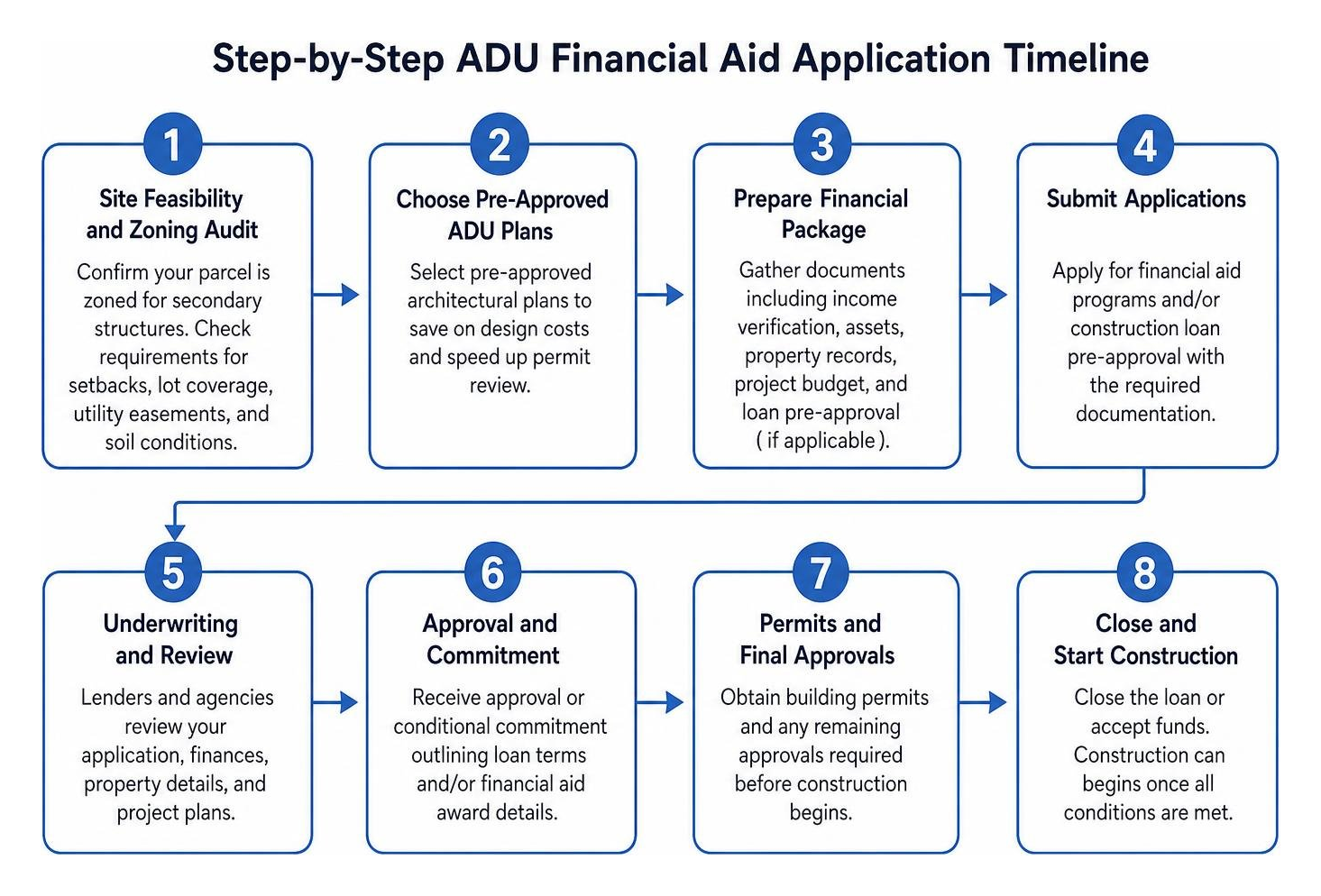
Step-by-Step Process to Apply for ADU Financial Aid
To ensure your application moves efficiently through agency review and loan underwriting, follow this sequential roadmap:
- Site Feasibility and Zoning Audit: Confirm that your parcel is legally eligible for accessory construction under local zoning ordinances. Review rear and side setback rules, maximum lot coverage allowances, utility easements, and parking regulations. A professional title report should be pulled early to verify there are no private deed restrictions or conflicting easements on the property.
- Document Household Financials: Gather your last two years of signed federal tax returns, W-2 forms, recent pay stubs, bank statements, and current primary mortgage notes. Public grant programs may also require proof of active homeowner insurance, verified property tax payment records, and evidence of primary occupancy.
- Select Plans and Obtain Detailed Contractor Bids: Finalize pre-approved plan sets or work with a licensed architect to draft tailored construction drawings. Solicit itemized, fixed-price bids from licensed and insured general contractors. Securing multiple comparable bids ensures your construction budget aligns with current labor and material costs.
- Submit Program Intake and Loan Application: Complete formal intake forms through your local municipal housing authority or designated renovation lending partner. Reviewing structured grant application steps helps ensure all required attachments, site surveys, and disclosures are included on first submission.
- Appraisal, Escrow Closing, and Draw Management: A certified appraiser evaluates the property’s future completed value based on construction plans and contractor bids. Once underwriting is approved, the loan closes, placing construction capital into a supervised escrow account that disburses funds to your builder across verified project milestones.
Applying targeted California grant application strategies keeps your application prepared for immediate intake when funding allocations open. Because most municipal programs operate on first-come, first-served cycles, having your financial portfolio and preliminary site plan prepared in advance prevents costly delays.
Frequently Asked Questions About ADU Financial Assistance
Can I build an ADU with no upfront money using government grants?
Building an accessory unit with zero personal funds is rare but achievable for low-income homeowners who qualify for comprehensive subsidy initiatives, such as New York’s Plus One ADU Program or dedicated non-profit housing programs. For most property owners, public aid acts as gap funding—providing $10,000 to $50,000 to absorb pre-development architectural, permitting, and engineering fees. Homeowners then combine these grants with a home equity line or future-value renovation mortgage to fund hard construction framing and finish labor.
How does an affordability deed restriction affect property resale value?
An affordability covenant caps allowable tenant rent and restricts tenant occupancy to designated income brackets for a specified period (frequently 10 to 15 years). While this limits gross rental revenue during the compliance window, the physical structure still adds livable square footage, utility infrastructure, and long-term appraisal equity to the lot. Once the covenant term expires, the restriction terminates completely, allowing the homeowner to charge market rental rates or utilize the space freely for personal use.
What happens if construction is delayed past the public grant deadline?
Most municipal and state assistance programs enforce structured performance milestones, typically requiring project completion within 12 to 18 months of initial fund commitment. If construction is delayed due to builder default, unapproved design changes, or supply chain bottlenecks, the administering agency may temporarily freeze disbursements or initiate grant clawback terms. To safeguard your funding, partner with licensed, bonded contractors, include milestone penalties in builder agreements, and request formal written timeline extensions immediately if unexpected delays occur.
Conclusion
Constructing an accessory dwelling unit provides an effective path to expanding regional housing supply, generating dependable rental revenue, accommodating multigenerational living arrangements, and creating lasting property value. As municipal and state housing initiatives expand, public grant subsidies, soft-second financing, and flexible mortgage underwriting guidelines make building a secondary unit more achievable than ever.
At ADU Marketing Pros, we support residential builders, design practices, and developers in mastering this rapidly growing sector and connecting with local homeowners. To review active municipal programs, regulatory guides, and local funding pipelines, explore our comprehensive Accessory Dwelling Unit Grant Program resources to advance your next project.